

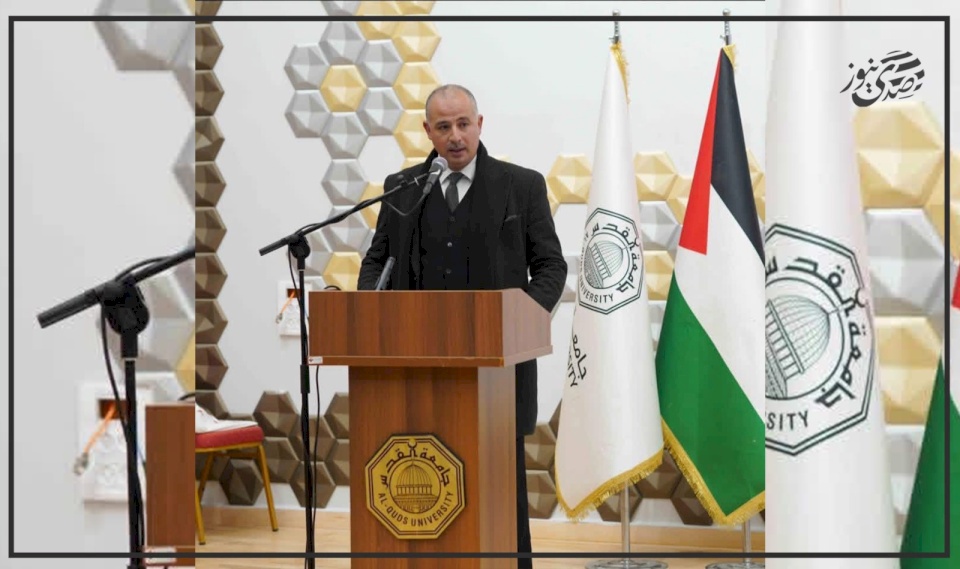
From Employment Economy to Unemployment Economy: Is the Palestinian Labor Market Losing its Balance?
The loss of jobs within the interior was not just a passing shock to the Palestinian labor market; rather, it was—at its core—a sharp turning point that revealed the fragility of an economic model that had relied for years on an external factor beyond its control. Today, the Palestinian economy faces not only rising unemployment but also the danger of gradually transforming into an economy that does not produce job opportunities as much as it redistributes unemployment.
The Palestinian labor market was never a traditional market that was governed solely by the laws of supply and demand; it was shaped within a complex economic and political reality, in which labor within the interior constituted one of the most important safety valves for the Palestinian economy. For years, employment of Palestinians in the interior played a role beyond just providing job opportunities; it was a primary source of income and liquidity, contributing to supporting local demand and alleviating the severity of unemployment. However, this model, despite its importance, was inherently fragile, as it relied on an external factor that is not subject to Palestinian control.
What we are witnessing today is not just a loss of jobs; it is a sudden disruption of an entire economic trajectory that had absorbed a large part of the workforce. Here, we can invoke the concept of "structural transformation" in the economy, where economies typically transition from one sector to another in a gradual and organized manner. However, the Palestinian case represents a reverse model, where transformation occurs forcibly and suddenly, without the existence of alternative sectors capable of absorbing the workforce.
International experiences show that losing traditional sources of employment without alternatives leads to long-term impacts. In some Eastern European economies after the collapse of the Soviet Union, the closure of productive sectors led to chronic unemployment due to what is known as "structural incompatibility in the labor market." Similarly, countries like Spain saw a sharp rise in unemployment after the global financial crisis in 2008, especially among youth, due to the collapse of the construction sector which was a primary source of employment.
However, the fundamental difference in the Palestinian case is that this transformation does not happen as a result of a natural economic cycle, but due to external political constraints that limit the economy's ability to adapt. An economy operating under occupation, with restrictions on movement, trade, and control over resources, does not possess the necessary tools to absorb shocks as natural economies do.
On the other hand, what is happening can also be viewed through the lens of macroeconomics, specifically through the concept of "aggregate demand" as proposed by John Maynard Keynes. The loss of thousands of workers' incomes will inevitably lead to a decline in consumption, which will reflect on the performance of the private sector, leading to a broader economic slowdown and placing the Palestinian economy at risk of entering a vicious cycle of contraction that is difficult to break.
In this context, the danger of expanding the informal economy emerges, which economic development literature indicates is a natural response to the absence of formal opportunities, yet it carries negative effects on productivity and financial stability. Moreover, rising unemployment, especially among youth, is related in many studies to increased social and economic risks in the long term.
Through my academic work in business economics and my research on the impact of entrepreneurship on economic growth, I see that one possible path—despite its limitations—lies in promoting entrepreneurship and small and medium-sized enterprises. These enterprises not only represent an option for employment but also a mechanism to reshape the economy itself. In this context, Joseph Schumpeter refers to the concept of "creative destruction," where growth is not achieved through traditional expansion but through replacing old economic patterns with more efficient and innovative ones. However, this transformation in the Palestinian case cannot happen spontaneously; it requires a supportive economic environment that includes facilitating access to financing, simplifying procedures, and linking education to the labor market.
Additionally, the discourse on startups must be realistic; these companies cannot grow in an unstable environment without a minimum of financial sustainability and institutional support. Therefore, any movement towards this path must be part of a broader economic vision, not a quick substitute for a lost labor market.
In my opinion, the fundamental challenge today lies not only in creating alternative job opportunities but also in preventing the entrenchment of an economic pattern based on unemployment and instability. This requires a shift from reactive policies to proactive policies that focus on building real productive capacities, even within the narrow margin of movement available.
In conclusion, what is happening in the Palestinian labor market cannot be reduced to a temporary unemployment crisis; rather, it is an expression of a deeper transformation in the structure of the economy. We must either address this transformation as an opportunity for redirection or allow it to entrench itself as a permanent reality that reproduces the same fragility. Between these two paths remains the most pressing question: Do we have the capability to navigate within this narrow margin, or will we settle for managing the outcomes of transformation rather than shaping it?
 Follow the latest Sada News via Google News
The Tale of a People Who Refused to Believe the Well

What Does the Supreme National Interest Mean for Palestinians? And How Can It Be Achieved?

The Wronged Ramallah

Between Pragmatism and Survival Management: Where Does Hamas Go After the Election of Khal...

Khalil Al-Hayya as President of Hamas.. Continuation of the Founders' Approach

The Annihilation of Sportsmanship

Until When Will the Palestinian Citizen Pay the Price of an Endless Phase?
