

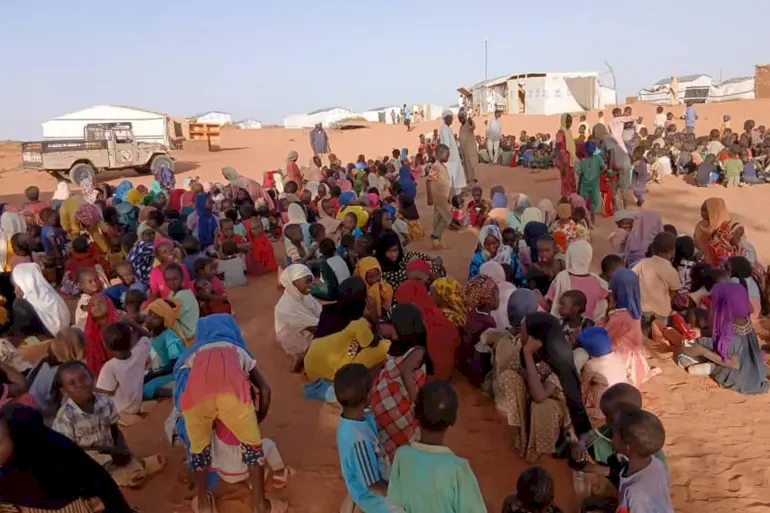
Initiatives Despite Scarcity of Support: Sudanese Women Manage the Refugee Crisis in Chad
SadaNews - One morning, Sudanese journalist Fatima Fadl Jaser was preparing a report on the suffering of displaced persons in Darfur, and by the next evening, she herself became a refugee in a neighboring country. But this sudden turn of events did not break her.
Today, in the "Bamajira" camp for Sudanese displaced people in eastern Chad, Fatima is no longer just a refugee but a voice and a model for creating hope from the womb of suffering.
Fatima turned her tent into a hive of activity, stating, "The wretched conditions of war forced me to abandon my journalistic profession and shift to participating in refugee relief and managing their crisis, from sheltering thousands to distributing water and reuniting families."
She adds, "We established the first organization here under the name 'Jundriyat for Women’s Relief,' and we have been able to implement numerous projects in various fields."
Women’s Organizations
Fatima Jaser's initiatives were not the only ones in the camps of eastern Chad, as many other women have also established organizations to serve refugees.
Samia Adam, founder of a women’s organization in Ardam camp, told Al Jazeera Net, "When I came here two years ago, we thought that aid would save us, but we soon discovered that we were alone without a savior. The men are either dead or missing or incapacitated. We took responsibility because no one else would."
Similar stories abound. In the neighboring "Ardam" camp, Zainab Moussa (35 years old), who was displaced from Karnoy, has become responsible for water distribution.
Zainab told Al Jazeera Net, "In the beginning, there was chaos, and people fought over every gallon. We set up a system; each family receives their share daily, which greatly reduced conflicts."
Community Kitchen
In the "Bamajira" camp itself, Badriya Othman (32 years old), who lost her husband in the bombing, manages a women’s union and a community kitchen that feeds 200 people daily.
She told Al Jazeera Net, "We established a women’s union, and then we started implementing the charity project. We began with a single pot of food, and now we have three pots. We don’t have much, but we believe that sharing is survival."
In the "Bamajira" camp, Huda Abdullah (30 years old) has established a psychological support center inside her tent.
She said to Al Jazeera Net, "Many women here suffer from war trauma. Some have lost their husbands, and others have lost their children. I came here to ease their pain, even if just a little. We hold daily sessions to talk and listen. Just a kind word can restore hope to a weary heart."
She added, "The center also offers recreational activities for children because the little ones here suffer just like the adults. War does not distinguish between young and old."
Shocking Figures
Estimates from the United Nations Population Fund indicate that women and children make up 87% of Sudanese refugees in Chad.
The total number of these refugees is 1.3 million, with more than 900,000 having arrived since the outbreak of war in April 2023. This demographic shift has created a leadership vacuum that women have powerfully filled.
In eastern Chad, mental health services remain primitive, and support teams rarely reach remote camps. In this terrible void, leading female models have emerged, such as Huda, Fatima Jaser, and Badriya, who have turned their tents into actual relief institutions.
Funding Gap
The UN High Commissioner for Refugees and the World Food Programme warn of a funding gap of $428 million that threatens essential aid for more than a million refugees. Currently, the Commission can provide essential aid to only four out of every ten refugees.
Currently, 80,000 families are living without shelter in border camps, and in some areas, refugees receive less than half of the daily minimum water requirement.
Support Session
At 2 PM, Fatima Jaser holds a psychological support session in her tent. She recounts, "A woman came to me crying, saying she has not been able to sleep for months. She saw with her own eyes the murder of her husband and her children. I couldn’t take away the pain of death from her, but I sat with her, listened to her, and promised her that I would stand by her. In the following days, she began to smile a little. That was the effect of a kind word."
She adds, "These sessions aren’t specialized psychological therapy, but they are a first step. Many women here just need someone to listen to them. We are doing what we can, but we need greater support."
A few days ago, an elderly woman arrived at the camp looking for her daughter. Fatima spent a whole night calling her acquaintances in different camps until she found her.
With tears in her eyes, she says, "These stories repeat daily. War leaves no one behind. We cannot bring back the dead, but we can reunite the living."
Major Challenges
Despite these successes, the challenges remain enormous. The United Nations Population Fund has requested $18.7 million to provide reproductive health and protection services for refugees this year. However, as of March 2026, only 2.5% of these services have been funded.
As the rainy season approaches, fears are growing that the camps will turn into breeding grounds for diseases and epidemics.
In the camps of eastern Chad, where the days of refugees pass in tattered tents, Fatima, Zainab, Badriya, Huda, and the Jundriyat women continue to write chapters of successful daily initiative.
Their stories are not just tales of individual survival but represent a broader phenomenon: Sudanese women transforming from victims to initiators, from journalists and teachers and widows to directors of relief operations.
But the question arises: Will this female model succeed in managing the refugee crisis despite the scarcity of resources? Or will the funding gap and the lack of sufficient international support turn these tents into graves for the women’s and broader community efforts born from the womb of war?
Fatima does not wait for an answer. She and her colleagues continue their work, knowing that delays can mean life or death for those around them.
Source: Al Jazeera
 Follow the latest Sada News via Google News
Initiatives Despite Scarcity of Support: Sudanese Women Manage the Refugee Crisis in Chad

Explosions Rock Kyiv as Ukrainian Drone Targets Children's Bus in Belarus

Guterres Warns Against Including Settlers on the UN Blacklist for Violations Against Child...

Yemen Calls on the Security Council to Include Aidros al-Zubaidi on the Sanctions List

The US Administration Approves the Use of "Grok" in Strikes Against Iran

Trump urges Russia to end the war, G7 brandishes the weapon of sanctions

The Arab League condemns the opening of a "Somaliland" embassy in occupied Jerusalem
