

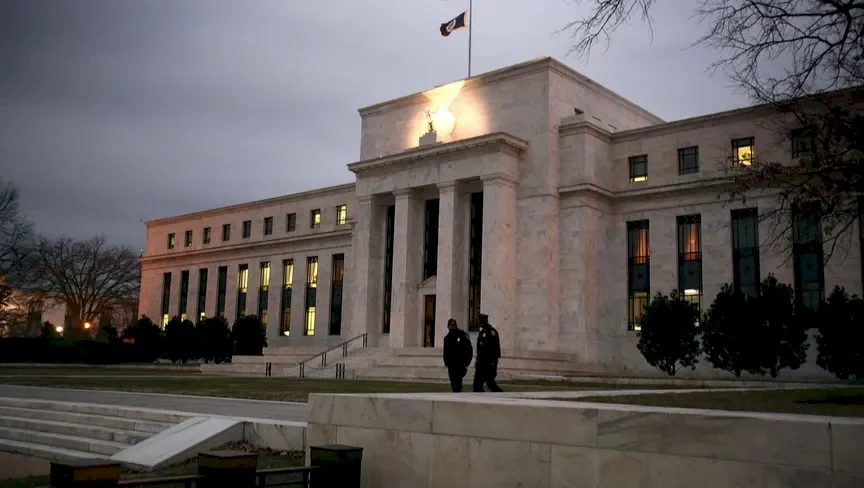
In Line with Expectations.. The "Federal Reserve" Keeps Interest Rates Steady for the Fourth Consecutive Time
SadaNews - The U.S. Federal Reserve has maintained interest rates at the same level, aligning with market expectations, amidst anticipation of the implications of the U.S.-Iran agreement to halt the war on inflation and growth in the United States.
In an early test of his leadership amid inflationary pressures and presidential demands to cut interest rates, Kevin Warsh chaired his first meeting of the Federal Open Market Committee as the new chair of the central bank.
Keeping Interest Rates Steady
The Federal Reserve voted today, Wednesday, to keep the benchmark interest rate unchanged in the range of 3.5% to 3.75%, for the fourth time this year.
Stock prices declined and bond yields rose following the Fed's decision. The S&P 500 index dropped by 0.4%. The yield on two-year U.S. Treasury bonds rose by eight basis points to reach 4.13%. The dollar strengthened.
New forecasts from policymakers indicate that nine officials expect at least one increase of a quarter percentage point this year, while six of them anticipate at least two increases. Nine others predict no change or a cut.
Eyes are on the first press conference that Warsh will hold after taking over as the chair of the Fed, succeeding Jerome Powell, and he is also likely to face questions from reporters about the impact of news regarding the temporary peace agreement between Washington and Tehran on his view of the inflation trajectory and the broader outlook for the U.S. economy.
Investors will be closely monitoring how firmly Warsh adheres to the central bank's commitment to bring inflation back to its 2% target.
Accelerating Consumer Price Index in the United States
The Consumer Price Index in the United States rose by 4.2% in May compared to the previous year, marking the largest pace of acceleration since early 2023, according to data from the Bureau of Labor Statistics. The core Consumer Price Index, which excludes food and energy, increased by 0.2% from April and 2.9% compared to the previous year.
Fed watchers will also try to gauge how Warsh manages his relationship with Donald Trump, who has repeatedly called for interest rate cuts and exerted significant political pressure on the central bank. Warsh's critics argue that he may not be independent enough from the White House, but he has rejected these concerns.
Trump nominated Warsh to chair the Fed after an ongoing public campaign in which he called for the central bank to lower borrowing costs, but later he stated that he wanted Warsh to "make his own decisions."
Trump's Warning Against Raising Interest Rates
Trump recently said that monetary policymakers at the Federal Reserve would make a mistake if they raised interest rates following a very strong jobs report in the United States.
The job growth in May exceeded all expectations in the U.S. employment report released last Friday, leading to a wave of selling in Treasury bonds and causing traders to fully price in the likelihood of a quarter-point hike in the Fed's benchmark rate by the end of the year.
Expectations for raising interest rates strengthened after U.S. labor market data showed that non-farm payrolls increased by 172,000 jobs last month, following upward revisions to the previous two months' data, according to the Bureau of Labor Statistics. The unemployment rate in the United States remained at 4.3%.
The risks of accelerating inflation also intensified due to the global energy supply shock occurring with the practical closure of the Strait of Hormuz, keeping monetary policymakers around the world in a "wait and see" mode, monitoring inflation data in anticipation of keeping interest rates unchanged for a longer period or even raising them if necessary.
Declining Global Oil Prices
Oil prices continued to decline, heading for the longest losing streak in 10 months, amid expectations that a U.S.-Iran agreement to reopen the Strait of Hormuz would lead to a significant increase in supplies. The temporary agreement, set to be signed on Friday, grants Tehran wide financial incentives, including the right to sell its oil immediately.
The drop in crude oil prices contributed to lower product prices, alleviating inflationary pressures and the burden on consumers. In the United States, the average price of gasoline nationwide dropped to about $4 per gallon, after peaking above $4.56 in May.
Despite broad expectations for a supply rebound, crude oil inventories are still being depleted at a rapid pace.
J.P. Morgan stated two days ago that the agreement between Iran and the United States eliminates the need for most major central banks to raise interest rates.
Meanwhile, Morgan Stanley mentioned that the agreement with Iran could lead markets to abandon bets that had favored the Federal Reserve raising interest rates in the near future.
The Fed's move to keep interest rates unchanged came just days after the European Central Bank raised deposit rates for the first time in nearly three years, from 2% to 2.25%, aligning with the expectations of investors and economists who anticipated another quarter-point hike in September.
 Follow the latest Sada News via Google News
In Line with Expectations.. The "Federal Reserve" Keeps Interest Rates Steady for the Four...

10,000 Inactive Wells and High Costs.. Why the Oil Market Won't Return to Pre-Iran War Lev...

Gasoline gallon at 30,000 pounds.. Fuel crisis strangles the Sudanese capital

Qatar Returns Gas Carriers to the Middle East in Preparation for Reopening the Strait of H...
Oil Prices Near Lowest Level in Three Months Amid Expectations of Increased Supply

Gold prices approach $4,324 per ounce

Housing Leads Construction Recovery in Saudi Arabia Despite Cost Pressures
