

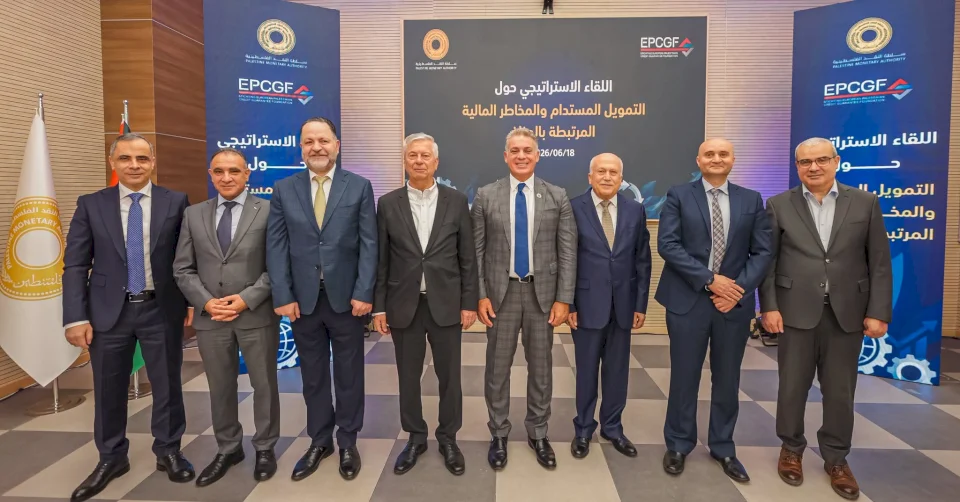
The Monetary Authority Organizes a High-Level Meeting to Launch a Strategic Path to Enhance Sustainable Financing and Manage Climate Risks in the Palestinian Financial Sector
SadaNews - The Palestinian Monetary Authority organized a high-level meeting on "Sustainable Financing and Climate-Related Financial Risks" as part of its efforts to enhance the readiness of the Palestinian financial sector and develop its institutional capabilities in line with relevant international trends and standards.
The meeting was held under the patronage and attendance of the Governor of the Monetary Authority, Yahya Shanar, the Minister of National Economy, M. Muhammad Al-Aamour, the Minister of Industry, Arafat Asfour, the head of the Water Authority, His Excellency Dr. Ziad Al-Mimi, the head of the Energy Authority, Ayman Ismail, the Deputy Governor, Muhammad Mansarah, the Chairman of the Board of Directors of Ooredoo Palestine, Dr. Firas Malhim, and the General Director of the European-Palestinian Credit Guarantee Fund, Hussein Habab (EPCGF), along with representatives from international partner institutions and members of the boards of directors of the Monetary Authority and banks, as well as general and regional directors and representatives of banks and specialized lending institutions.
During the meeting, participants discussed the importance of sustainable financing in supporting financial stability, enhancing governance and risk management, and developing the ability of the Palestinian financial sector to adapt to future challenges.
In his speech at the meeting, the Governor of the Monetary Authority emphasized that sustainable financing has become one of the important components in developing the financial work system, noting that enhancing the management of climate-related financial risks is an important factor in increasing the readiness of the financial sector to deal with future changes, and that the Monetary Authority is working on building a national framework for sustainable financing that aligns with relevant international standards while considering the specifics of the Palestinian reality.
The Governor pointed out that the success of this path depends on effective partnership with financial sector institutions, and the important role of boards of directors and executive management in the banking sector in leading the transformation towards more sustainable financial practices, which enhances governance, supports the development of sustainable financial products and services, and increases the ability of the financial sector to serve the national economy.
For his part, the General Director of the European-Palestinian Credit Guarantee Fund (EPCGF), Hussein Habab, confirmed that enhancing sustainable financing represents a strategic priority to support the development of the Palestinian financial sector, indicating that this initiative reflects the importance of institutional cooperation between the Monetary Authority and partner entities in building a financial system that is more capable of facing challenges and more aligned with global trends in sustainability and climate-related risk management.
Habab explained that the transition to sustainable financing requires a shared vision and long-term commitment from various components of the financial sector, emphasizing that the Fund's role extends to supporting the development of institutional capacities, enhancing financial tools, and enabling financial institutions to adopt sustainable practices that contribute to supporting the Palestinian economy.
The meeting reviewed the key developments in the Palestinian financial sector in the area of sustainable financing, which included the development of relevant regulatory and supervisory frameworks, launching a roadmap for sustainable financing in 2024, and enhancing cooperation with international partners, including the World Bank, in addition to forming specialized working groups at the level of the Monetary Authority and the financial sector, and implementing specialized training programs and workshops in areas of sustainable financing and environmental, social, and governance standards.
The meeting also addressed the results of the first phase of the capacity-building initiative in sustainable financing, which was developed to assess the level of readiness of financial sector institutions, identify gaps and technical and institutional needs, and design specialized training programs that meet the requirements of the next phase.
This meeting represents the opening phase of a broader capacity-building program in sustainable financing, followed by a training program targeting various functions in banks and specialized lending institutions, focusing on the practical aspects of sustainable financing, environmental and social risk management, environmental and social management systems (ESMS), developing sustainable financial products, and data management and disclosure.
 Follow the latest Sada News via Google News
The Monetary Authority Organizes a High-Level Meeting to Launch a Strategic Path to Enhanc...

"The Environmental Quality Authority" and "Palestine Bank" Hold a Training Workshop to Est...

National Beverage Company Sponsors the Palestinian U-18 Basketball Team in the 2026 Asian...

Housing Bank in partnership with the European Bank for Reconstruction and Development hold...

The Arab Islamic Bank and SOS Children's Villages Organization Sign Memorandum of Understa...

Palestine Investment Bank Signs Framework Agreement to Provide Financing for Projects and...

The Jerusalem District Water Authority Calls on Subscribers to Settle Their Debts and Bene...
