

How Does Israel Strangle the Economy of the West Bank?
Sada News - On June 15, 2026, a report titled "The Choking Grip: Confronting Israel's Stranglehold on the Economy of the West Bank" was released by the International Crisis Group. The report examines the transformations the Palestinian economy has undergone since the outbreak of the Gaza War in October 2023 and provides a comprehensive picture of how financial, banking, commercial, and administrative tools have turned into means of pressure exerting a profound influence on the lives of Palestinians in the West Bank.
The report does not view the economic crisis merely as a side effect of the political or military conflict but asserts that the economy itself has become a separate battleground. Just as there are military operations and security confrontations, there are also financial, banking, and commercial policies that the report believes serve the same function of pressure and subjugation, albeit through different means.
The report starts from a fundamental fact that the Palestinian economy has never been independent of the Israeli economy since the occupation of the West Bank in 1967. However, what has occurred after the Gaza War represents, in the opinion of its authors, a transition from a state of economic dependency to a state of direct economic strangulation.
Roots of Economic Dependency
The report traces the roots of the crisis to the nature of the economic relationship that has developed between Israel and the occupied Palestinian territories since 1967. Israel has maintained control over borders, crossings, foreign trade, and essential resources, which has rendered the Palestinian economy operational within a framework that lacks control over its most crucial aspects.
When the Paris Economic Protocol was signed in 1994 as part of the Oslo Accords, it was supposed to represent a transitional step towards building a Palestinian economy capable of managing its affairs independently. However, practical implementation retained most of the tools of Israeli control, whether in customs, foreign trade, the movement of goods, or the monetary system.
Over time, the Palestinian Authority has come to rely on the clearance revenues collected by Israel on its behalf, while the Israeli shekel has become the main currency circulating in the Palestinian market, and Palestinian banks have been linked to Israeli banks as the primary channel to access the global financial system.
The report argues that this relationship has created a condition of asymmetrical mutual dependency, as the Palestinian economy remains far more reliant on Israel than Israel relies on it.
The Gaza War and the Turning Point
The report considers October 7, 2023, to be a major turning point in Israel's management of the economic relationship with Palestinians.
After the outbreak of the war, Israeli measures were not limited to military actions but included a wide array of economic and financial decisions. With the rise of Israeli Finance Minister Bezalel Smotrich, who openly supports the annexation of the West Bank and opposes the idea of a Palestinian state, these policies acquired a more explicit political dimension.
The report presents a number of statements made by Smotrich linking economic pressure on the Palestinian Authority directly to the goal of preventing the establishment of a Palestinian state in the future. From the report's perspective, these statements help clarify the political framework within which economic restrictions have intensified over the past two years.
The Weapon of Banks and Banking Relations
The report dedicates considerable space to the banking relations between the two sides, considering them to represent one of the most critical weaknesses in the Palestinian economy.
Palestinian banks depend on Israeli correspondent banks to conduct a large part of their financial transactions. Through this relationship, money is transferred, payments are settled, and access to the global financial system is provided.
The report notes that the repeated threat to stop the legal guarantees granted to Israeli banks dealing with Palestinian banks has created a permanent state of uncertainty. Even when this threat is not actually executed, its mere suggestion has a negative impact on investment, lending, and economic planning decisions.
The report asserts that the modern economy relies not just on the availability of funds but also on trust, stability, and future expectations. When the banking system itself becomes prone to instability, this reflects on the entire economic activity.
The Clearance Revenues: The Financial Lifeline
One of the issues the report focuses on is the clearance revenues. According to the existing economic arrangements, Israel collects customs duties and taxes on Palestinian imports and then transfers them to the Palestinian Authority. This money represents the primary source of the Authority's revenues.
However, the report indicates that recent years have witnessed an expansion in deductions and restrictions imposed on these funds, including halting their transfers for specific periods. As a result, the Palestinian Authority has faced a worsening financial crisis that has affected its ability to pay salaries, provide services, and meet its financial obligations.
This crisis does not only impact the Authority's institutions but extends to the entire economy. An employee who does not receive his full salary reduces his spending, a merchant whose sales decline reduces his purchases, and a contractor who does not receive his dues postpones his projects. Thus, the crisis is transmitted from one sector to another.
The Shekel Crisis and Accumulated Currency
Among the lesser-covered topics in media outlets, yet receiving significant attention in the report, is the issue of massive accumulation of shekels within the Palestinian territories.
Palestinian banks face restrictions on returning cash to the Israeli banking system, leading to the accumulation of billions of shekels within the West Bank.
This situation increases costs related to storage, insurance, and transportation and drives some economic activities to resort to informal financial channels. The report views this issue as a clear example of how what could be a technical and banking matter transforms into a factor impacting daily economic activity.
Barriers and Fragmented Economy
The report does not stop at financial issues alone but also addresses the issue of movement and mobility as an essential element of economic activity.
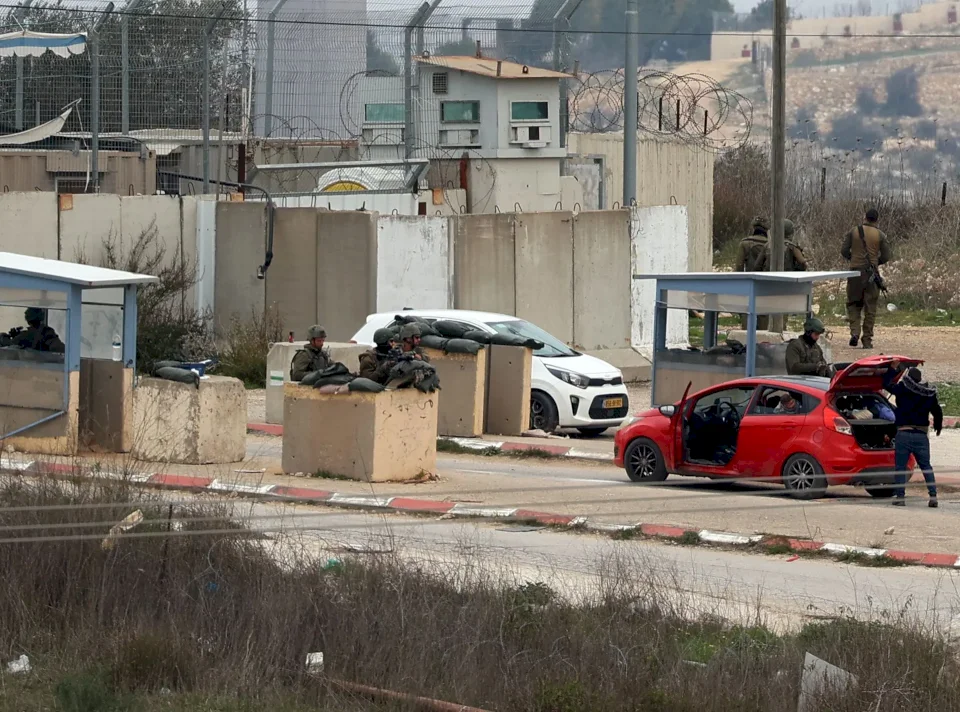
The increase in the number of checkpoints, closures, and military gates after the Gaza War has not only impacted the movement of individuals but also the movement of goods, workers, and internal trade.
The report describes the West Bank as having become closer to a collection of separate economic islands. Movement between cities and towns has become more difficult and costly, while transportation, distribution, and marketing costs have risen.
It stresses that the economy cannot operate efficiently when short trips turn into long and uncertain journeys and when access to markets is tied to constantly changing security conditions.
Palestinian Workers and Double Losses
Tens of thousands of Palestinians were working inside Israel before the war, and their income constituted an important source of liquidity within the Palestinian economy.
However, the restrictions imposed after October 2023 deprived a large number of them of returning to their jobs.
The report sees this step as a severe blow to Palestinian families that lost their primary source of income, but it also inflicted damage on certain Israeli economic sectors that depended on Palestinian labor, particularly in construction and agriculture.
Hence, the issue is not only about labor relations but also one of the most crucial pathways that transferred income from the Israeli economy to the Palestinian economy.
Israeli forces closed the entrances to the Old City of Hebron and restricted Palestinian movement during a raid in the area on June 13, 2026 (Anadolu Agency)
Area "C" and Deferred Development
The report highlights that Area "C" constitutes more than half of the West Bank's territory and includes a large portion of agricultural land, natural resources, and developable space.
Nevertheless, the restrictions on construction, investment, and access to land render economic benefits from this area very limited.
From the report's viewpoint, any serious discussion about long-term Palestinian development cannot be separated from the issue of access to resources and land in this area.
Ultimately, the report paints a picture of an economy suffering from severe contraction, declining income levels, rising unemployment, and expanding poverty.
It does not present these indicators as mere abstract numbers but rather as reflections of deeper transformations affecting the structure of the Palestinian economy and its sustainability.
Families are facing increasing pressures, businesses operate in a high-risk environment, municipalities struggle to maintain their services, and the Palestinian Authority confronts a continuous financial crisis.
What Does the Report Propose?
The report believes that addressing the crisis begins with removing the most impactful restrictions, foremost among them resuming the transfer of clearance revenues, providing stability to banking relations, easing movement restrictions, and enabling Palestinian workers to return to their jobs.
However, the report simultaneously emphasizes that these measures, no matter how significant, will not address the fundamental problem of the structural dependency of the Palestinian economy.
Thus, it calls for exploring mechanisms to reduce Palestinian dependence on Israel in areas of trade, the financial sector, currency, and revenue collection, alongside internal reforms that enhance transparency and the efficiency of public administration.
The report concludes that the continuation of the current trend does not merely indicate economic slowdown but warns of further deterioration and instability. The more fragile the Palestinian economy becomes and the weaker its institutions, the higher the likelihood of social and political explosion. Hence, the importance of the report lies in its attempt to read the Palestinian economy not merely as a financial dossier but as one of the key elements for understanding the future of the West Bank and the entire Israeli-Palestinian conflict.
 Follow the latest Sada News via Google News
Soaring Oil Prices Burn the Pockets of the Palestinian Citizen "The Poor"

Millions of Dollars in Losses.. "SadaNews" Reveals Shocking Figures for Traders from Pales...

The Problem of Shekel Overcrowding Worsens.. Fuel Station Owners Threatened with Closure o...

The Palestinian Economy at a Crossroads: 4 Files Awaiting Resolution

Watermelon Season in Danger: Virus Affects About 20% of Agricultural Areas in Israel

How Does Israel Strangle the Economy of the West Bank?

Palestinian Deposit Insurance Corporation Board Holds Its Third Meeting, Confirms Strength...
