

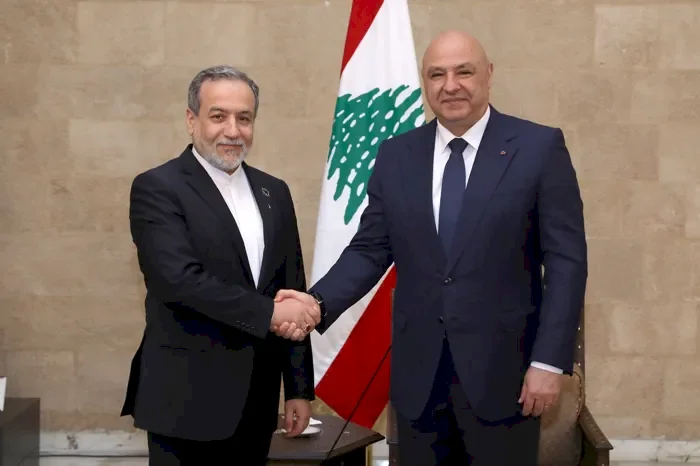
Iraqi to Aoun: If Lebanon Were a Bargaining Chip, We Would Have Reached an Agreement with America Long Ago
SadaNews - Iranian Foreign Minister Abbas Araghchi responded to the statements of Lebanese President Joseph Aoun, who considered that Iran uses Lebanon as a bargaining chip on the negotiation table, calling on it to stop interfering in the affairs of his country.
Araghchi said in a post on his X account today, Saturday: "If Lebanon were a bargaining chip, we would have reached an agreement with Washington a long time ago.
He also added that "one might think based on Aoun's statements that Iran occupies one-fifth of Lebanon, has displaced a quarter of the Lebanese, and is bombarding the country daily," in reference to Israel.
He concluded by saying: "Save Lebanon from its true enemy, Mr. President."
Araghchi's stance came as tensions between his country and America escalated, following exchanges of strikes between the two sides in recent hours.
This came after Aoun stated in a television interview with CNN yesterday, Friday, that Tehran exploits Lebanon as a negotiating card. The Lebanese president demanded Iran stop interfering in his country's affairs, saying: "This is not your country; it is our country, and your job is not to interfere in our country," adding, "Our people are the ones who are being killed, and our homes are the ones being destroyed."
He also affirmed that Hezbollah does not represent the Lebanese people but that the state holds sovereign decisions, adding that the party must be convinced that there is no solution other than through negotiations.
For his part, Lebanese Prime Minister Nawaf Salam addressed Iranian leaders during a press conference yesterday, saying, "If I were to address Iran, it would be to spare our South and stop treating it and its people as just a card to improve its negotiation terms." He added that Lebanon "refuses to be turned into a mailbox for others' messages, or an open field for their wars... it is not a card on anyone's table, and the South is not a reserve front for anyone."
These Lebanese stances coincided with the Secretary-General of Hezbollah criticizing the proposed ceasefire agreement mediated by the United States after four rounds of direct Lebanese-Israeli talks in Washington, deeming it an insult to the country. He rejected the withdrawal of Hezbollah elements from southern Lebanon, calling for a ceasefire across Lebanon, not just in the southern suburbs of Beirut or in "specific" areas in the South, and for the withdrawal of Israeli forces from all Lebanese territories.
Meanwhile, Ismail Qaani, commander of the Quds Force of the Revolutionary Guard, which founded Hezbollah in 1982, preemptively responded to the party itself, stating earlier last Thursday that the "minimum demands of the resistance" in Lebanon are the withdrawal of Israel to the positions it occupied before the outbreak of war on March 2nd.
It is noteworthy that Iran has insisted during its negotiations with the United States on halting the war on all fronts, including Lebanon, and renewed this demand after Israel hinted days ago at the possibility of launching raids on the southern suburbs of Beirut, before the United States announced last Wednesday that the Lebanese and Israeli delegations agreed on a "conditional" proposal for a ceasefire.
 Follow the latest Sada News via Google News
Jordanian Army Intercepts 4 Iranian Missiles and 4 Drones

Death of a Moroccan Man During His Arrest in Italy Sparks Calls for Investigation

Due to Trump's Sanctions.. Canada Cancels Joint Ceremony with the US for Bridge Opening

Trump: We will make great progress with Beirut.. Aoun: It is time for Lebanon to be stable

The Lebanese Army Deploys in the South and Comes Under Gunfire; Israel Clarifies

Bezhkian: Directives from the Leader to End the State of No War, No Peace

Meeting Between Aoun and Trump Expected Alongside 'Experimental Areas'
