

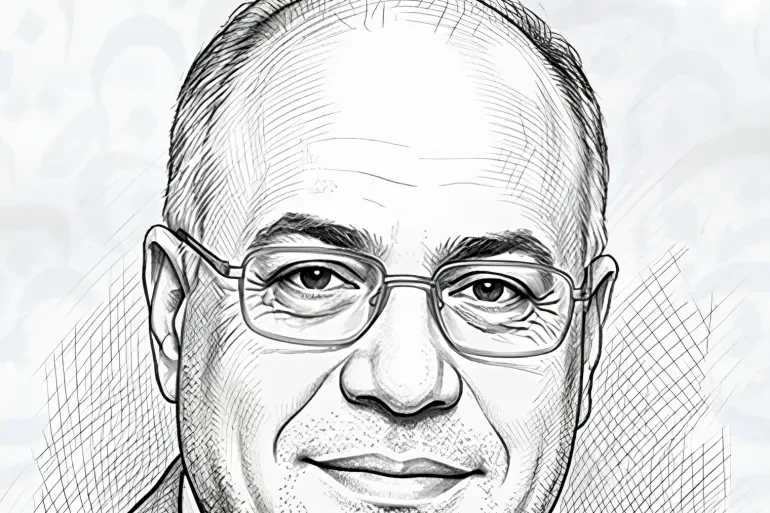
The Departure of the Guardian of the Arabic Language: Academics and Intellectuals Bid Farewell to Dr. Khaled Fahmy
SadaNews - The academic and cultural circles in Egypt and the Arab world have lost a distinguished scholarly and linguistic figure with the passing of Professor Dr. Khaled Fahmy, a professor at the Faculty of Arts, Menoufia University, and an expert at the Arabic Language Academy in Cairo, who passed away this evening at the age of 55, leaving behind a vast intellectual and cultural legacy, and an indelible mark in the records of contemporary linguistic and lexicographical studies.
A profound sense of sadness enveloped his students, admirers, and colleagues upon the announcement of his death, with condolences pouring in that recalled the virtues of the deceased, not only as an exceptional linguist but as a humble person and a thinker concerned with the issues of his country and nation.
The Academy of the Immortals Mourns Its Expert
The Arabic Language Academy in Cairo swiftly issued an official statement mourning its late expert, praising his long journey of contribution that "yielded more than sixty published books in the fields of language and Arab studies." The academy extended its heartfelt condolences to the deceased's family, admirers, and students, indicating that his significant contributions to the service of the Arabic language and scientific research will remain eternal.
A Distinguished Academic Career
Dr. Khaled Fahmy Ibrahim was born in Qalyubia Governorate in 1970 and grew up in an environment saturated with love for the Arabic language. He graduated from the Faculty of Arts at Ain Shams University in 1991 with a very good honors degree, then continued to excel, obtaining his master's degree in 1995 for his study on "The Linguistic Efforts of Al-Thaalibi," before culminating his journey with a Ph.D. from Menoufia University in 1999 with first-class honors for his pioneering thesis "The Heritage of Lexicons in Arabic."
The late scholar progressed through academic positions from an assistant lecturer at Helwan University to attaining the rank of professor at Menoufia University in 2011. His contributions extended beyond university lecture halls to major institutions; he served as the chairman of the Egyptian National Library and Archives, a member of the Supreme Council of Pre-University Education, the Supreme Council for Islamic Affairs, and the Egyptian Writers Union, in addition to his role as an expert at the Arabic Language Academy.
A Civilizational Project Beyond the Lexicon
Dr. Khaled Fahmy was not just a traditional researcher; he was the owner of a "civilizational project" that viewed language as a living entity where knowledge intersects with identity. He enriched the Arabic library with over 60 works that varied between methodologically rigorous texts, authorship in linguistics, lexicography, linguistics related to issues of disability, development, and rhetorical analysis of the prophetic tradition. Among his notable works: "Culture of Neglect," "The Time of the Lexicon," "The Authority of Linguistics," and "The Anthem of Text and Margin."
In a previous article on Khaled Fahmy's academic journey titled "Khaled Fahmy: From the Lexicon and Language to Establishing Consciousness and Shaping Identity,"
Professor Dr. Wasfi Ashour Abu Zaid confirmed that Dr. Fahmy was "a rare example of a scholar whose linguistic awareness was formed at a delicate intersection between heritage and linguistics, and between text criticism and thought." He added that the late scholar recognized early on that linguistics was a gateway to understanding culture and the structure of thought, writing critically about the criticism of texts as much as he completed, redefining the "critic" to become a responsible intellectual for integrating the heritage text into the contemporary life cycle.
The Ascetic Scholar and the Listening Intellectual
On a personal level, the late scholar left a kind impression on everyone who knew him. In an emotional testimony through "Facebook," writer and thinker Dr. Ammar Ali Hassan revealed hidden aspects of the deceased’s personality, describing him as a "beautiful-natured person" and a man "concerned about everything that propels our country forward."
Hassan noted that his relationship with the late scholar was marked by lengthy and profound discussions through "audio talks" that encompassed literature, history, politics, and religion. He described his meetings with the deceased as "overflowing with knowledge," confirming that Dr. Fahmy possessed an extraordinary and impressive ability to listen with great humility, and when he spoke, "he overflowed with so much knowledge that it was astonishing," pointing to his precision in critique and follow-up away from flattery.
Dr. Khaled Fahmy has departed in body, but he left behind generations of researchers who learned from him and a library rich with works that will remain a beacon guiding lovers of the Arabic language and defenders of its identity and civilization.
Source: Al Jazeera
 Follow the latest Sada News via Google News
The Egyptian Federation Files Official Complaint Against Referee Letexier

Do You Know How to Comfort Someone Who is Crying? Here's What to Say and Do in Tough Momen...

"Backrooms": From Digital Legend to Cinematic Phenomenon

Prediabetes.. The Silent Bomb Carried by Millions Without Their Knowledge

From Sweden 1958 to the Epic of Egypt 2026.. Argentina's History with World Cup Comebacks

After the South Africa Precedent.. Nigeria Investigates the Encroachment of Technology Com...

Argentine Admission and Global Consensus on the Referee's Injustice to Egypt's National Te...
