

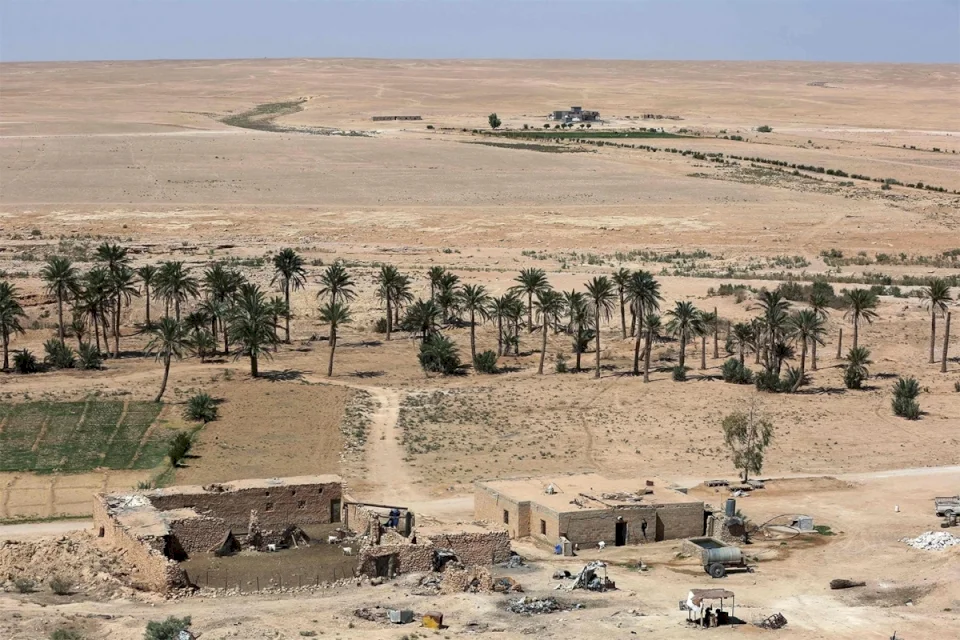
Discovery of a Second Israeli Base in the Western Desert of Iraq
SadaNews - Iraqi officials revealed the existence of a second secret Israeli base in the desert of Iraq that was used for operations against Iran, according to a report by the New York Times.
The report cited regional officials stating that Israel spent over a year preparing a secret site within Iraq for its operations against Iran, while Iraqi officials later confirmed the existence of a second base.
Discovery by a Shepherd
The first base was discovered near the town of "Al-Nukhayb" after a local shepherd driving a pickup truck was reportedly chased by a helicopter that fired upon him repeatedly until the truck suddenly stopped in the sand.
The shepherd, who was identified as Awad Al-Shammari, was on a trip to buy supplies, according to his cousin, Amir Al-Shammari, speaking to the New York Times. However, instead of returning home, the shepherd stumbled upon a highly sensitive Israeli military secret hidden in the Iraqi desert. His family believes this discovery cost him his life.
Al-Shammari ultimately revealed how Iraq hosted two secret bases operated by Israel, the hostile state, intermittently for over a year.
Al-Shammari communicated with the regional military leadership in Iraq to report what he had seen: "soldiers, helicopters, and tents gathered around a landing strip."
According to senior Iraqi and regional officials, Israel was operating a base there to support its military operations against Iran.
Second Base
The Wall Street Journal had previously reported on the existence of an Israeli site within Iraq, but Iraqi officials informed the New York Times of the existence of a second, also undisclosed, base in the western desert of Iraq.
Regional security officials stated that the base discovered by Al-Shammari dates back to before the current war between the U.S., Israel, and Iran, and was used during the 12-day war against Tehran in June 2025.
One regional official added that Israeli forces began preparations to construct the temporary base as early as late 2024, by identifying remote locations that could be used in future conflicts.
According to Iraqi officials, Washington was aware of at least one of the bases, the one found by Al-Shammari, which had been established since June 2025 or possibly earlier, implying that Iraq's main ally, the United States, concealed the presence of hostile forces on its territory.
Wael Al-Kadhu, an Iraqi MP who attended a secret parliamentary briefing regarding the base, stated: "This shows a blatant disregard for Iraqi sovereignty, its government, and its forces, as well as for the dignity of the Iraqi people."
The American Role
Regional officials added that the U.S. role in Iraqi security was part of Israel's calculations that led it to believe it could operate secretly within Iraq safely.
Two Iraqi security officials stated that during last year's brief war and the current conflict, Washington compelled Iraq to shut down its radars to protect American aircraft, making Baghdad increasingly reliant on U.S. forces to detect hostile activities.
According to the newspaper, the existence of the bases raises questions about whether the Iraqi government was aware of them and also about Iraq's inability to exert full control over its territory.
Meanwhile, Major General Ali Al-Hamdani, commander of the Western Euphrates Forces in the Iraqi army, stated that the army had suspected an Israeli presence in the desert for over a month before the shepherd discovered the location.
He added: "So far, the government has remained silent about it."
Lieutenant General Saad Ma'an, spokesperson for the Iraqi security forces, told the New York Times that Iraq "has no information regarding the locations of any Israeli military bases."
Two regional security officials stated that the base revealed by Al-Shammari had been used by Israel for air support, refueling, and medical treatment.
The site was established to reduce the distances needed for Israeli aircraft to reach Iran.
It was meant to be only a temporary presence to assist in military operations, such as those that took place during the June 2025 war, which the officials said proved to be highly beneficial.
Former American military leaders, Pentagon officials, and American diplomats who served in the region stated that it is unreasonable, given the close relations between the U.S. and Israeli armies, that Central Command was unaware of the Israeli presence in western Iraq.
For weeks, Bedouin gatherings in the western Iraqi desert had been informing the regional command about unusual military activity, according to General Al-Hamdani.
He said the army decided not to approach, opting for "remote reconnaissance" of what the commanders believed to be Israeli forces. They requested information from their American counterparts but received no response.
Death of Al-Shammari
On the day Al-Shammari found the foreign forces, he also contacted local authorities, according to his cousin and Major General Faheem Al-Kariti, spokesperson for the Karbala Operations Command.
Shortly thereafter, Al-Kariti and Al-Shammari's family reported that the army and his relatives had lost contact with him.
His cousin Amir stated: "We were told that a burned truck similar to Awad's truck was there, but no one dared to go. When we arrived, we found the car and the body burnt."
The family shared photos of his blood-stained corpse, with his head and fingers burned, along with images of his burned truck. They buried his body next to the vehicle under a simple gray tombstone.
On the day following the shepherd's report, the Iraqi regional command sent a reconnaissance mission, according to Al-Kariti and Al-Hamdani.
As the units approached the area, they came under gunfire, according to a statement issued by the Iraqi Joint Operations Command the next day. One soldier was killed, and two others were injured, while two vehicles were hit before the units decided to withdraw.
Senior Iraqi security officials in Baghdad were trying to understand what had happened, and two senior officials stated that their efforts were repeatedly hampered by high-ranking military leaders who downplayed the incident.
Publicly, the Iraqi Joint Operations Command announced that "foreign" forces attacked its soldiers, stating that it had raised complaints to the United Nations Security Council.
In private, however, Iraqi Armed Forces Chief of Staff Lieutenant General Abdurrahman Yaarallah contacted his American counterparts, according to Al-Hamdani and the two senior Iraqi officials.
Al-Hamdani stated: "They confirmed that the force was not American. Therefore, we understood it was Israeli."
Four days after the attack on the Iraqi soldiers, on March 8, the Iraqi parliament forced military leaders to provide a secret briefing. MPs who attended the session stated they could not disclose the details. However, one of them, Hassan Fadham, told the New York Times that Israel had established at least one other site within Iraq.
He said: "The site in Al-Nukhayb is just the site that was discovered."
Another Iraqi official confirmed the existence of a second base, without specifying its location, only stating that it is also in a western desert area.
According to a current and a former Iraqi official, official protocol requires Washington to inform Baghdad of any activities on Iraqi soil.
This means, according to the officials, that Washington either concealed Israeli activity or informed the senior Iraqi leadership of the operations and kept them secret. However, they deemed it highly unlikely that the Iraqi leaders had known that the presence was Israeli before the shepherd's revelation, and they likely assumed the sites were American.
The shepherd's family claims that his murder has been overlooked.
His cousin Amir stated: "They are demanding that the government investigate this incident and find out why it happened. They want respect for his rights."
 Follow the latest Sada News via Google News
Axios: Proposal for a 10-day Ceasefire Between Washington and Tehran and Two Options for M...

In a Rapid Pace.. The Occupation Builds a Huge Earth Barrier Inside Gaza

Meeting Between Aoun and Trump Expected Alongside 'Experimental Areas'

Gaza Health Warns of Collapse of Oncology Services Due to Depletion of Treatments and Susp...

The Occupation Demolishes a House in the Town of Sa'ir near Hebron

Israel Reveals Details of Secret Iranian Nuclear Facility in Mount Fas

A Mother, Her Child, and Her Three Daughters Martyred in Israeli Shelling on Gaza City
