

Gazans in Occupied West Bank Stranded Since Outbreak of War
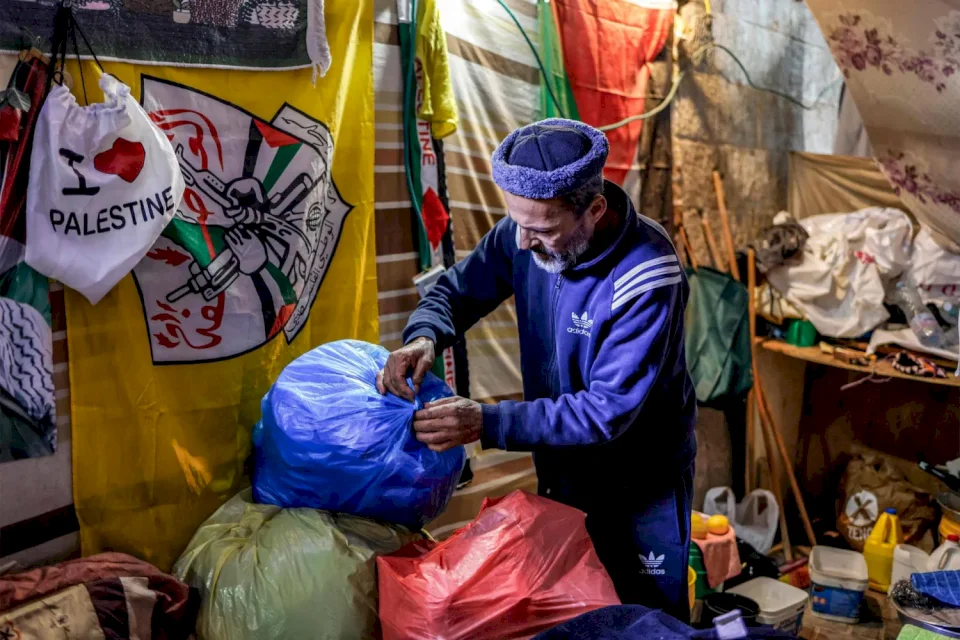
SadaNews - Under the stands of a stadium in the occupied West Bank, around ten Palestinians live in changing rooms, stranded since the outbreak of the recent war with Israel, with no prospect of returning to their homes in Gaza.
Before settling in Nablus, in northern West Bank, 54-year-old Samir Abu Salah worked in several small jobs in Tel Aviv, where wages are much higher than in Khan Younis, his hometown in the Palestinian territory.
He tells the "Agence France-Presse" from the small space he prepared for himself under the stands: "Israel invaded just four days before the war. I was honored and dignified. Then the war began" on October 7, 2023.
He adds: "Look at me now, I live in a tent. We were honored and dignified in our homes, in our country."
Today, Abu Salah earns a living by collecting and selling recyclable waste, sending a little money to his family. Two of his sons were killed in Israeli strikes.
Amid poverty, he tries to make do with what he has: he made a small closet from cardboard boxes, decorated the walls with Palestinian flags, and hung a picture of the late Palestinian president Yasser Arafat.
It is nearly impossible to count the number of Gazans living like him in difficult conditions, but the Palestinian Ministry of Labor reported in March 2026 that it provided cash assistance to 4,605 people stranded in the occupied West Bank since Israel took control in 1967.
Abu Salah and his suffering companions fear leaving the city, as some of their friends have been stopped at Israeli military checkpoints and sent back to the Gaza Strip, which is under an Israeli blockade and has been devastated by a war lasting two years.
"Nothing Remains"
Samah, a family man who preferred not to reveal his name, arrived ten days before the war erupted as a result of an attack by Hamas on southern Israel, seeking medical treatment not available in Gaza: "This place is boring, but what can we do? We are in prison."
His son returned to Gaza, but he preferred to stay in the West Bank searching for a way to support his family financially. In the changing room, he hung a sheet on a rope to maintain some privacy.
Like the other men residing there, Samah lost his home, which was targeted in Israeli strikes, and he displays a picture of its rubble.
Nahid Halou (43) settled in Ramallah in the center of the West Bank.
Halou had left the Gaza Strip on the eve of October 7 for Tel Aviv, using a work permit to bring goods back to the Strip, where he owned a restaurant in the Al-Rimal neighborhood of Gaza City.
In Ramallah, he opened a restaurant so he could send money to his family who remained in Gaza. He says: "I returned to what I know; my job and my profession and what I love."
He currently employs nine people from Gaza and serves highly spiced food in the Gaza style.
However, he is worried about his family. He says: "We haven't heard anything from them for twenty days."
Yet, he rules out returning to his homeland. He says: "Sure, Gaza is more valuable than here, but there is no house left, nothing remains."
Unemployment
According to the "United Nations", 81% of Gaza's infrastructure was destroyed during the war, and economic activity has ceased. The unemployment rate stands at 80%, while prices of goods have risen significantly, especially due to Israeli restrictions on truck access to the Strip.
Israel still controls about half of the Gaza Strip. Since the ceasefire went into effect on October 10, 2025, the Israeli army has killed 846 people.
Shihada Za'rob, 45, is somewhat luckier than others, as he has a residence permit in the West Bank, where he has worked for twenty years.
Za'rob hails from Beit Lahiya, a city in northern Gaza that was known for its strawberry fields before the war.
In the West Bank, he opened a farm in Qalqilya, but despite his relative freedom, he has not seen his relatives since 2021.
He laments: "My children are in one place, and I am in another, and I cannot bring them because of the crossings; they prevent my wife from leaving Gaza because her identity is registered as being from Gaza."
 Follow the latest Sada News via Google News
Report: Washington feared Israel's assassination of Qalibaf and Araqchi during negotiation...

4 Martyrs in the Gaza Strip

Hebrew Channel: Egypt Offered Hamas to Hand Over Its Weapons to Cairo as a Custody

Katz: We Rose After 1000 Days of War and Became a Major Power

Journalist Union: We Reject Doubts About the Status of Martyr Journalists and Warn Against...

Jordanian King Issues Order to Transfer Kingdom's Ambassador to Israel to Amman

Zamir: The War We Are Fighting is the Longest in Israel's History
