

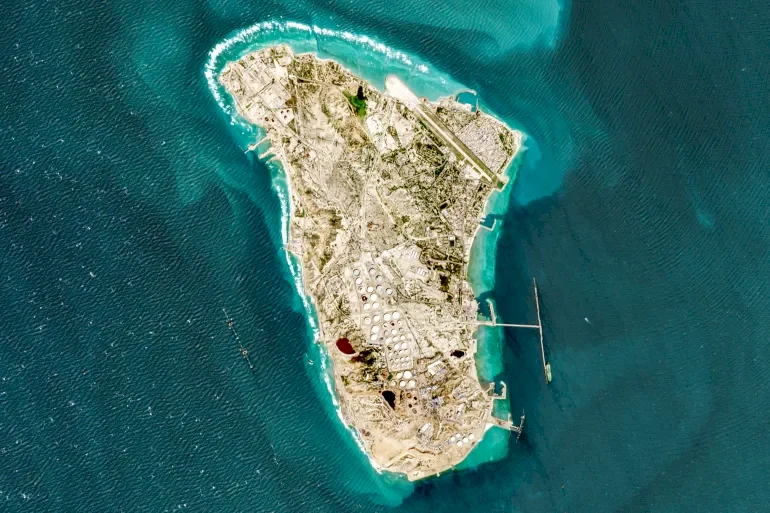
Report: This is why Trump rejected controlling Khark Island
SadaNews: The American Wall Street Journal reported, citing sources and officials in the U.S. administration, that President Donald Trump resisted the idea of sending troops to take control of the Iranian Khark Island out of fear of casualties, and intentionally used language that seemed "demeaning and unstable" to push Tehran to the negotiating table.
The paper quoted informed sources as saying that Trump personally grapples with the fear of issuing orders to send troops to positions where soldiers could be injured, possibly leaving some of them not returning to the United States, similar to other American presidents who engaged in wars.
The newspaper clarified that "the failure of foreign policy during former President Jimmy Carter's term regarding the Iran hostage crisis in 1979 strongly occupies Trump's mind", recalling him saying last March, "If you look at what happened with Jimmy Carter... with the helicopters and the hostages, it cost them the election... what a mess".
Sources revealed that Trump resisted the idea of sending American soldiers to control Khark Island, despite being informed that the mission would succeed and that seizing the island would give the U.S. access to the strait.
It was indicated that Trump feared that American casualties would be "unacceptably high", stating that American soldiers would be "easy targets".
Along with his hesitation about the deployment, the newspaper reported that the closure of the Strait of Hormuz was a major source of frustration for Trump, who was shocked - he and some of his advisors - by the speed at which the tanker traffic stopped after the bombing began, expressing late annoyance that this vital waterway was so fragile that "someone with a drone could close it".
Trump also expressed repeated anger at the refusal of European countries and NATO to join his military campaign and help reopen the strait, mocking French President Emmanuel Macron in White House meetings and criticizing British Prime Minister Keir Starmer for his slow response to allow the use of British bases.
Regarding statements, the Wall Street Journal quoted senior officials in the U.S. administration that Trump's pronouncement warning of "ending Iranian civilization" was improvised, and not part of a national security plan, adding that what Trump really wanted was to intimidate the Iranians and end the conflict.
The officials also mentioned that Trump told one of his advisors that he used a vulgar term and the phrase "thank God" in one of his posts because he wanted to appear "as unstable and demeaning as possible," believing that it might push the Iranians to the negotiating table, considering this "a language the Iranians understand".
The newspaper reported from high-level officials that Trump believed that defeating Iran would give him a chance to reshape the global order in a way he could not achieve during his first term, leading him to think at the start of the military operation that he was "saving the world".
However, close sources revealed that he was hesitant between discussing economic concerns in calls with advisors when energy sector leaders were worried about the impact of closure on the strait that carries 20% of global oil supplies resulting in price increases beyond White House estimates, and insisting on continuing the war.
In late March, Trump ordered his negotiating team to find a way to start talks, according to an informed source.
On April 8, a two-week ceasefire began between Israel and the United States and Iran.
This came after a round of negotiations between Washington and Tehran hosted in Islamabad, Pakistan, last Sunday, without reaching an agreement to end the war.
After that, Iran tightened transit restrictions in the Strait of Hormuz, and the United States began imposing a blockade on Iranian ports and vessels transiting the strait.
 Follow the latest Sada News via Google News
Axios: Proposal for a 10-day Ceasefire Between Washington and Tehran and Two Options for M...

In a Rapid Pace.. The Occupation Builds a Huge Earth Barrier Inside Gaza

Meeting Between Aoun and Trump Expected Alongside 'Experimental Areas'

Gaza Health Warns of Collapse of Oncology Services Due to Depletion of Treatments and Susp...

The Occupation Demolishes a House in the Town of Sa'ir near Hebron

Israel Reveals Details of Secret Iranian Nuclear Facility in Mount Fas

A Mother, Her Child, and Her Three Daughters Martyred in Israeli Shelling on Gaza City
