

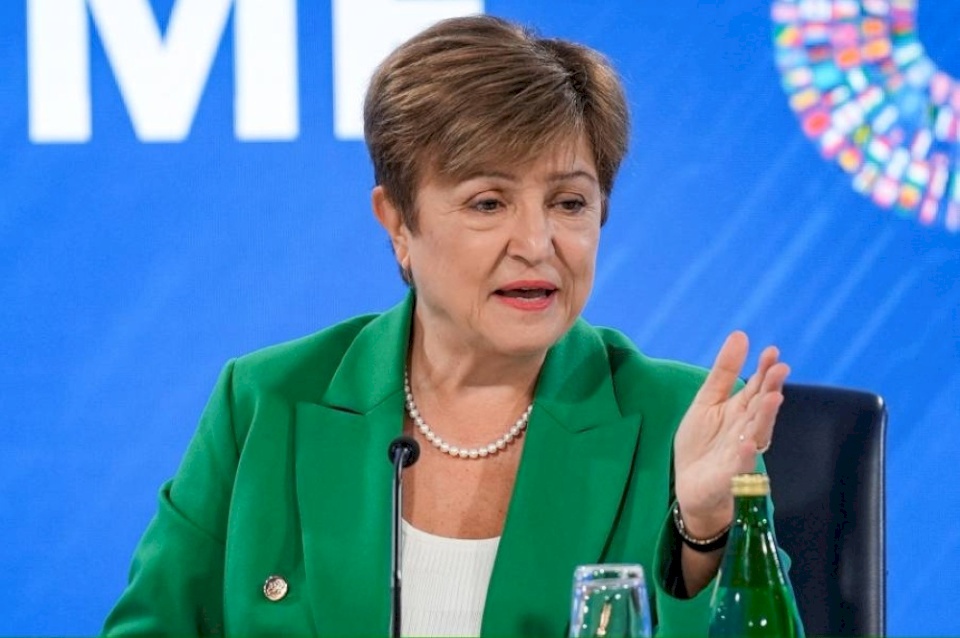
Georgieva: The Strength of Gulf Economies Supported Regional Stability During the War
SadaNews - Kristalina Georgieva, the Managing Director of the "International Monetary Fund", confirmed that the strength of the economic fundamentals in the Gulf countries contributed to supporting the stability of the region's economies during the war between the United States and Iran.
Georgieva stated during a joint press conference with the Executive Director of the "International Energy Agency" Fatih Birol, in response to questions from "Asharq" that the Gulf countries have worked over the past decade to "build strong fundamentals, establish sound policies, and create precautionary margins". She noted that this has "benefited the region as a whole because its strength has transferred to others".
She added that the assessment of the impact of the crisis varies between countries based on whether a country is a net energy exporter or importer, as well as the strength of policies and economic fundamentals, considering that countries with strong institutions are better able to withstand crises, even under restrictions imposed on markets.
This is not the first time during the war that Georgieva praises the Gulf economies and their diversification efforts. She affirmed on April 6 that their economies are capable of absorbing the shocks of the war despite being affected by it, thanks to their "efforts in building diverse economies with strong institutions".
Support for Affected Countries
The war in Iran, which broke out at the end of February, led to a near closure of the vital Strait of Hormuz, choking off crude oil and gas supplies from the region to global markets, and prompting some producers to halt production as inventories filled up.
This war also resulted in a massive surge in oil prices, which remain more than 40% higher than pre-war levels. The energy shock raised fears of rising global inflation and cast shadows of doubt on global growth forecasts at a time when economic crises began to unfold in many countries.
In recent times, the "IMF" and the "World Bank" have begun preparing for the potential requests from affected countries for emergency financing.
Ajay Banga, the President of the "World Bank", noted last week that the institution might be able to mobilize between $20 billion to $25 billion in rapid financing for countries facing the repercussions, and is seeking to determine if it can provide additional capabilities ranging from $50 billion to $60 billion for assistance.
In her response to a question from "Asharq", Georgieva indicated that the institution does not expect a significant increase in demand for "IMF" resources, as "emerging economies alone have built strong institutions, independent central banks, financial councils, and strong reserves over the past decade to mitigate their impact and that of the world".
The War's Impact Varies from Country to Country
For his part, Fatih Birol, Director of the "International Energy Agency", confirmed in his response that Middle Eastern countries fall into two main groups: oil-exporting and non-oil-exporting, noting that there is a significant disparity even within oil-exporting countries in terms of their ability to cope with shocks.
He pointed out that Lebanon is facing a very difficult situation among non-oil-exporting countries, while some oil-exporting countries suffer from economic fragility, citing Iraq, which relies on oil for about 90% of its government revenues, making it more susceptible to shocks, especially with its oil revenues decreasing by nearly two-thirds due to the war.
On the other hand, Birol noted that Saudi Arabia enjoys a stronger financial position, praising its efforts regarding the "East-West" pipeline, as well as its ability to store oil, giving it greater flexibility compared to other countries lacking these capabilities.
Since the beginning of the war, Saudi Arabia has quickly shifted supplies to the "East-West" pipeline for export from the Red Sea, especially after raising its export capacity from this line to about 7 million barrels per day, up from about 800,000 barrels before the war.
These steps have helped alleviate supply concerns in the market, effectively curbing the rise of oil prices to record levels.
However, on April 9, markets held their breath after Saudi Arabia announced that an Iranian attack on the "Manifa" facility led to a production drop of about 300,000 barrels, while the "Khrais" facility previously suffered a similar attack that reduced its output by the same amount, resulting in a drop in the kingdom's production capacity by about 600,000 barrels per day.
A pumping station on the "East-West" pipeline was also attacked, resulting in a loss of about 700,000 barrels per day in pumping quantities. However, the kingdom was able to restore operational capacity within days, easing market pressures.
 Follow the latest Sada News via Google News
London Stock Exchange Enters the Era of 24/7 Trading

Shamaran Petroleum: Suspension of Oil Production in Duhok Fields in the Kurdistan Region o...

Dollar Steadies Near One-Week High Amid War Developments

Trump Imposes Tariffs on Canadian Imports... Ottawa Vows to Respond

Oil Prices Drop After Reports of Mediation Efforts Between the U.S. and Iran

Gold Price Rises Supported by Increased Buying Amid Lower Prices

Due to "Hazardous and Counterfeit Products".. Europe Fines "AliExpress" $627 Million
