

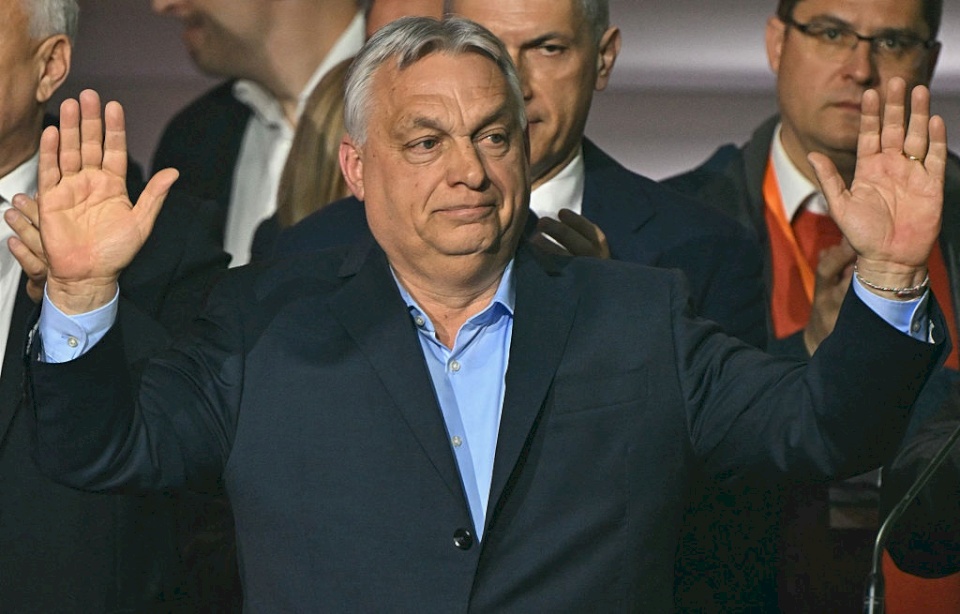
The Fall of Orban May Lead to Resolution of Stalled Issues Between Hungary and the European Union
SadaNews - The defeat of Viktor Orban in the Hungarian elections has brought great relief in Brussels, as the European Union has had to deal for years with a Hungarian Prime Minister closely associated with Russian President Vladimir Putin and American President Donald Trump, who has obstructed several issues, including the one related to Ukraine.
Here is an overview of the issues that may progress with the election winner, Peter Magyari, taking over from Orban, as the leader of the "TISA" party has promised to "work for a free and European Hungary":
90 Billion Euros for Kyiv?
The European Union is likely to prioritize the 90 billion euro loan file for Ukraine, amid questions about whether Kyiv will finally be able to receive it, and when that might happen.
European leaders approved this package during a summit last December, but Orban, who was then in the peak of his election campaign, has spent months obstructing Kyiv's access to the loan.
Berlin called on Monday for the rapid release of this European aid "as quickly as possible".
An EU official said, "I feel that (Orban) will not want to make a major move during the transitional period," concluding that his successor Peter Magyari will be "under immense pressure to release the loan".
Sanctions
The situation regarding the European loan is similar to the approval of new economic sanctions against Moscow, as Orban, the European leader closest to the Kremlin, has for weeks obstructed the adoption of these measures, conditioning the resumption of Russian oil shipments to Hungary via a pipeline crossing Ukraine.
Several European officials expect this issue to be resolved once Magyari assumes his position.
However, a diplomat warned against overestimating the enthusiasm of the next Hungarian Prime Minister for Ukraine.
He believed that "Magyari will seek, as he did during his campaign, to prevent the impression that he is a tool in the hands of Brussels".
The diplomat called for "not to expect (Magyari) to agree with everything happening" in Brussels.
Ukraine's EU Membership
This trend may be reflected in the contentious issue of Ukraine's accession to the European Union, as Orban's rigidity has led to the freezing of this file without a clear path to resolving it.
The long and complex path of this accession requires the consensus of all 27 member states at each new stage, but the diplomat also noted that "we should not believe that Hungary will suddenly become very enthusiastic about Ukraine's accession".
Magyari ruled out, on Monday, Ukraine's accession to the bloc as long as the war continues.
He added, "This is a country at war, and it is absolutely unlikely that the EU will accept a country that is at war".
Also contributing to putting more obstacles to accession are other countries that also, if somewhat secretly, express some reservations about Ukraine joining the EU.
Sebastian Maier, a special adviser at the Jacques Delors Institute, believes that "the removal of the Hungarian obstruction to Ukraine's accession does not mean its acceleration".
Better Atmosphere Among Leaders?
European leaders hope that discussions among them from now on will occur in a better, quieter atmosphere.
Some have recently expressed dissatisfaction with phone calls between Budapest and Moscow, the contents of which were leaked by the media, in which Hungary relayed to Russia what was discussed in Union meetings.
After German Chancellor Friedrich Merz denounced Orban's "disloyalty" during a summit in mid-March, he expressed pleasure on Monday at the possibility of "reaching joint decisions within the European Council more easily" following the defeat of the Hungarian Prime Minister in the election battle.
Frozen Funds
Brussels may push for the rapid release of funds allocated to Budapest, as a gesture of goodwill towards the next Hungarian Prime Minister.
The EU is currently freezing 18 billion euros allocated due to concerns related to the rights of asylum seekers, as well as conditions related to public procurement contracts and conflicts of interest.
European Commission President Ursula von der Leyen promised to "work tirelessly" on this file, praising Magyari's commitment to implementing reforms, reaffirming that "Hungarians deserve" this money.
In a similar scenario, the EU, which froze billions of euros allocated to Poland, acted very quickly following the first guarantees provided by the government of pro-European Prime Minister Donald Tusk.
An EU diplomat stated: "This is exactly the model that (Magyari) should follow; if he tells (his citizens) look, I returned from Brussels with money, it will give him a huge boost".
 Follow the latest Sada News via Google News
Macron: France Requested EU Assistance to Deal with Fires

Ukrainian Drones Target St. Petersburg Area in Russia

Man Stabs Two People in New York While Shouting 'Allahu Akbar'

Tehran Responds: Trump Threatens to Use Iranian Funds to Compensate Damaged Ships

American Escalation Using B-1 Bomber Against Targets of the Iranian Revolutionary Guard

Iranian Revolutionary Guard Targets Al-Adairi Camp and Ali Al-Salem Air Base in Kuwait

Massive Fire in Spain Forces Residents of 34 Villages to Evacuate
