

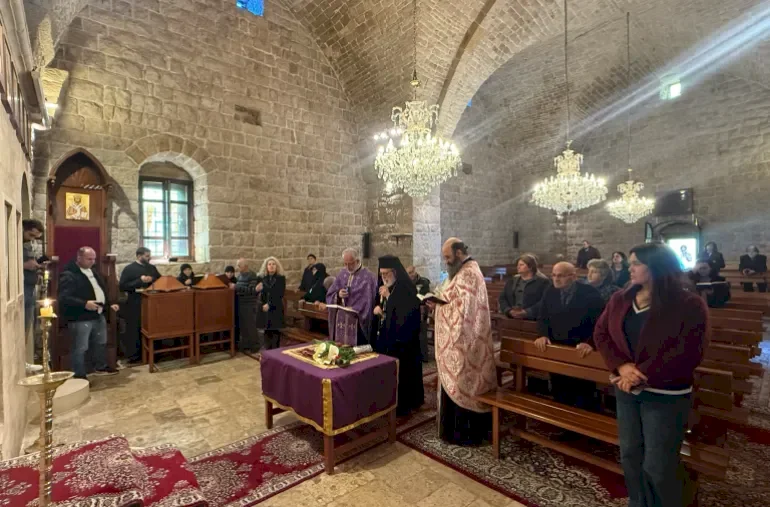
Rituals Amidst Bombardment and Fear... This is How Southern Lebanon Celebrated Easter
SadaNews - This year, Easter is unlike any other in the past. Between the south, Beirut, the Bekaa Valley, and the mountain, the Lebanese are spread across a geography burdened by bombardment and fear, where the rituals of the holiday blend with the sounds of planes and explosions, reflecting an exceptional reality that the country is enduring under one of its harshest phases.
In the southern Christian villages, where some families have chosen to stay despite the dangers, the paradox is clear: churches are opening their doors for prayer, and homes are still preparing Easter cakes, but with heavy hearts and watchful eyes. Here, the holiday is not entirely absent, but it arrives surrounded by anxiety and caution.
Sanaa Isber, from the town of Rashaya al-FKHR, says that this year's holiday is "sad in every sense of the word," pointing out that many were unable to reach their villages due to blocked roads or security threats, leading to the absence of familiar faces that usually fill the squares and homes on such days.
Isber adds, "We had hoped that the holiday would be an occasion for people to gather safely, but reality imposed something different."
Isber believes that what the Lebanese are experiencing today intersects with the symbolism of the occasion, saying, "This is the day of the Lord Jesus' passion, and the whole world is in pain, but we in Lebanon suffer more due to the wars imposed on us, yet we remain children of hope and peace."
Continuous Israeli Aggressions
In Rashaya al-FKHR, where the church of St. George stands witness to past wars, the scene today is different amid the ongoing Israeli aggressions and the prevailing anxiety in the region.
Nevertheless, prayer does not fade, as Bishop Elias Kfoury confirms to Al Jazeera Net that the holiday comes with "great sadness," but it also carries within it a commitment to hope.
He says, "We depend on God, and we pray for peace, and for the war to stop," noting that some residents are still holding on to staying in their town despite the harsh conditions. For them, the church represents not just a place of worship but a refuge they seek, as in previous chapters of the region's history.
The bishop expresses his hope for an immediate ceasefire, lamenting, "Why is Lebanon being destroyed under the pretext of having armed individuals? Not everyone in the nation is armed." He adds, "We will not surrender; we are the owners of this land, and we have the right to live in it with dignity," confirming the residents' attachment to their land despite all challenges.
At the town level, the transformation is evident between last year's and this year's holidays. The mayor of Rashaya al-FKHR, Pierre Atallah, summarizes the scene by saying, "How did you return, O holiday?" In previous years, the town was bustling with its children coming from various areas, along with visitors and friends, but today the attendance is limited, and the atmosphere is unusually calm.
Atallah says, "The wishes are simple; we hope that the conditions improve, peace prevails, and we can celebrate as Lebanese during our holidays." He emphasizes that the true meaning of the holiday can only be completed with the return of stability and for people to live peacefully in a region worn out by crises.
Despite all that, some details of the holiday do not fade; in the homes, traditional sweets are still being prepared, and people exchange greetings, but "with a lingering bitterness" accompanying these moments.
Different Atmosphere
For his part, young Kleem Jibran, who came from Beirut to spend the holiday in his town, clearly notices the difference, saying that "last year's holiday was much better," recalling the memories of holidays that once revived the village's life. Today, however, the atmosphere is different, characterized by a cautious calm that does not reflect the usual festive spirit.
Nonetheless, Jibran believes that these circumstances have revealed another aspect of relationships among people, saying, "People have come closer to each other... perhaps because fear has brought us together." He adds that this year's Easter carries a doubled meaning, as it signifies "a holiday of forgiveness and peace," which the Lebanese need now more than ever.
As for Eli, one of the townspeople, he recalls the scenes of previous holidays that were overcrowded with expatriates coming from Beirut and outside Lebanon, noting that many could not attend this year, while others hesitated due to security situations. He says, "The holiday is much quieter than usual," but he simultaneously affirms that those who remained are trying to preserve whatever can be preserved: "It’s not like before, but there is an attempt to continue."
Between sadness and determination, this year’s Easter passes in southern Lebanon. The celebrations do not fill the streets as before, and there is no crowding in the squares, but there is something deeper, which is a desire to remain and a commitment to life, even at its minimal level.
Source: Al Jazeera
 Follow the latest Sada News via Google News
Death of a Moroccan Man During His Arrest in Italy Sparks Calls for Investigation

Due to Trump's Sanctions.. Canada Cancels Joint Ceremony with the US for Bridge Opening

Trump: We will make great progress with Beirut.. Aoun: It is time for Lebanon to be stable

The Lebanese Army Deploys in the South and Comes Under Gunfire; Israel Clarifies

Bezhkian: Directives from the Leader to End the State of No War, No Peace

Meeting Between Aoun and Trump Expected Alongside 'Experimental Areas'

Saudi Arabia condemns the Houthi threats to navigation and pledges to protect its ships
