

Orban Loses Elections in Hungary After 16 Years in Power
SadaNews - Preliminary results from the elections in Hungary show the opposition "Tissa" party, led by Peter Magyar, winning a two-thirds majority in parliament, indicating a significant political shift in the country, which garnered intense attention from Tel Aviv and Washington. The Prime Minister of Hungary, Viktor Orban, acknowledged his defeat, stating: "I congratulated the winning party in the elections; the result is painful for us."
The Hungarian opposition leader stated, "Prime Minister Orban congratulated me on winning the parliamentary elections."
The National Election Office in Hungary reported preliminary indicators of the Tissa party winning a two-thirds majority in parliament.
Israeli Concerns
Concerns have arisen in Israel over the election results in Hungary, amid estimates that the loss of Prime Minister Viktor Orban could lead to a shift in the European stance towards Tel Aviv, particularly regarding Budapest's use of the veto within the European Union.
The elections were held under clear political tension, with direct Israeli and American support for Orban. U.S. President Donald Trump pledged to leverage the "full economic power" to support him, while European officials noted that the election results might determine the future of Hungary's relationship with the EU, especially after years of disputes over the rule of law and Budapest's obstruction of collective European decisions.
According to the Israeli newspaper "Yedioth Ahronoth," Israeli estimates suggest that Magyar's victory as a center-right candidate will not transform Hungary into an anti-Israel state, but it may push it to "align with Brussels," meaning an end to its role in blocking European decisions against Israel, especially those related to imposing sanctions on settlers.
The newspaper quoted an informed source on Sunday, stating that "a mere shift in Hungary to a Germany-like model, which supports Israel but does not use the veto, will be enough to bring about a significant change," pointing out that there are files "blocked solely by Hungary," giving it special weight in the European equation.
In this context, estimates indicated that Orban's loss would be a personal and political blow to Prime Minister Benjamin Netanyahu, who considers Orban "one of his closest allies among world leaders, aside from Trump" and sought during the election campaign to support him, including sending his son Yair to deliver a supportive speech on his behalf.
In this context, the Israeli ambassador to Singapore, Eli Verd Hazen, posted on the "X" platform a photo of himself with Orban, accompanying it with a statement that "whoever stands with Israel wins," indicating a clear support for him during the election campaign, in a step considered a breach of diplomatic norms that impose neutrality in the internal elections of states. However, the Israeli ambassador later deleted the tweet.
In the follow-up to the election's implications, the "Idea Institute," linked to the "New Israel Fund," an American non-profit supporting the Israeli opposition, sent a delegation consisting of two members of the Knesset from the opposition, Orit Farkash from Gadi Eizenkot's party, and Eitan Ginsburg from "Kahlon Lavan," along with constitutional law academics and activists opposing Netanyahu's government.
The delegation's visit, according to Israeli Channel 12, aimed to study the possibility of a similar "political shift" in Israel. The institute stated that the goal is to monitor elections addressing issues related to the "future of liberal democracy," indicating an attempt to benefit from the Hungarian opposition's experience if it succeeds, in the context of efforts to remove Netanyahu from power in the upcoming elections.
Record Turnout
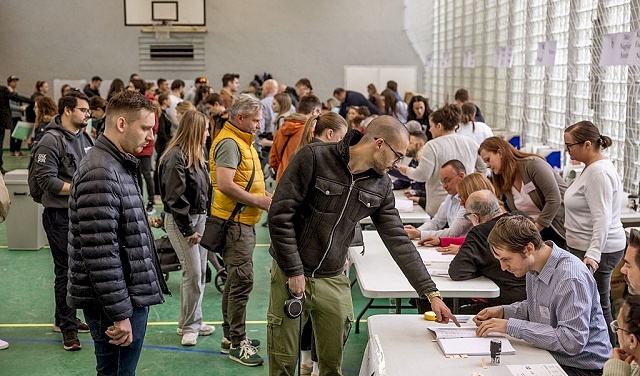
Hungarian voters participated in record numbers on Sunday in the legislative elections that seemingly brought an end to Orban's rule, which has lasted for 16 years, in an event that captures the interest of many countries, particularly the United States and European nations.
7.5 million voters inside Hungary, in addition to more than 500,000 registered abroad, chose among five parties, according to a mixed plurality electoral system that largely benefits the ruling "Fidesz" party.
Polling stations closed at 7 PM Greenwich Mean Time, with the turnout rate reaching 77.8% by 6:30 PM, exceeding the previous record of 70.5% in the 2002 elections.
Even before the preliminary indicators, analysts pointed out that the high voter turnout could benefit opposition leader Peter Magyar, who expressed "cautious optimism" about his party's chances of winning.
A voter opinion poll conducted by the 21 Research Center based in Budapest this week, published after polling stations closed, showed that the pro-European Tissa party led by Magyar would receive 55%, outpacing the ruling coalition led by Orban, which is expected to garner 38%.
Magyar: "We are Choosing Between East and West"
Magyar stated after casting his vote in Budapest: "We are choosing between the East and the West, between propaganda and honest public debate, between corruption and an honest public life, between continued deterioration and complete collapse of public services or the return of European funds and the revitalization of Hungary's economy."
Orban reiterated his warning of a "major crisis" awaiting Europe after casting his vote, stating: "Fortunately, we have many friends in the world, from America to China, passing through Russia and the Turkish world," adding that he will not allow the European Union to "deprive" Hungary of its "future and sovereignty."
Orban received strong support from U.S. President Donald Trump before the elections.
This support was manifested by a visit from his deputy, JD Vance, to Budapest this week, where he praised Viktor Orban's merits and criticized the "Brussels bureaucrats" intervening in EU affairs.
Trump himself adopted multiple supportive positions for Orban on Friday, pledging to harness "the full economic power" of the U.S. to help Hungary if voters support his ally, whom he sees as embodying the battle against immigration and defending the "Western civilization."
"Negative Campaign"... Orban Exemplifies Extreme Right Movements
The Hungarian Prime Minister, who has made his country of 9.5 million inhabitants a model of "illiberal democracy," has become an example for various extreme right movements worldwide.
Orban is also close to Russian President Vladimir Putin and has consistently criticized the sanctions the European Union imposed on Russia since its invasion of Ukraine in 2022.
While Brussels has avoided publicly expressing its position on the Hungarian elections, a European diplomat confirmed that "most EU member states would be pleased to be rid of Orban," noting that "patience has reached its maximum."
Orban (62) has repeatedly taken stances contrary to those of the other 26 member states while Brussels has frozen billions of euros earmarked for financing Hungary, accusing him of undermining the rule of law.
During his campaign, Orban affirmed his intention to continue targeting what he described as "fake civil society organizations, paid journalists, judges, and politicians."
Andrea Shabo from the Center for Social Sciences at Eötvös Loránd University opined that Orban's victory "would clearly mean... a slide towards an authoritarian system."
Orban also tried to give the impression that he is a bulwark against Ukraine, accusing it of attempting to drag Hungarians into war. However, analysts viewed that this argument failed to convince his citizens amid the economic recession in Hungary and rampant corruption.
During an election rally on Thursday, Magyar, who was previously affiliated with "Fidesz," called for giving "a chance for change," launching a series of promises, the most prominent of which include combating corruption, reviving democratic institutions, and making Hungary a responsible member of the European Union, which it has belonged to since 2004.
 Follow the latest Sada News via Google News
Axios: Proposal for a 10-day Ceasefire Between Washington and Tehran and Two Options for M...

In a Rapid Pace.. The Occupation Builds a Huge Earth Barrier Inside Gaza

Meeting Between Aoun and Trump Expected Alongside 'Experimental Areas'

Gaza Health Warns of Collapse of Oncology Services Due to Depletion of Treatments and Susp...

The Occupation Demolishes a House in the Town of Sa'ir near Hebron

Israel Reveals Details of Secret Iranian Nuclear Facility in Mount Fas

A Mother, Her Child, and Her Three Daughters Martyred in Israeli Shelling on Gaza City
