

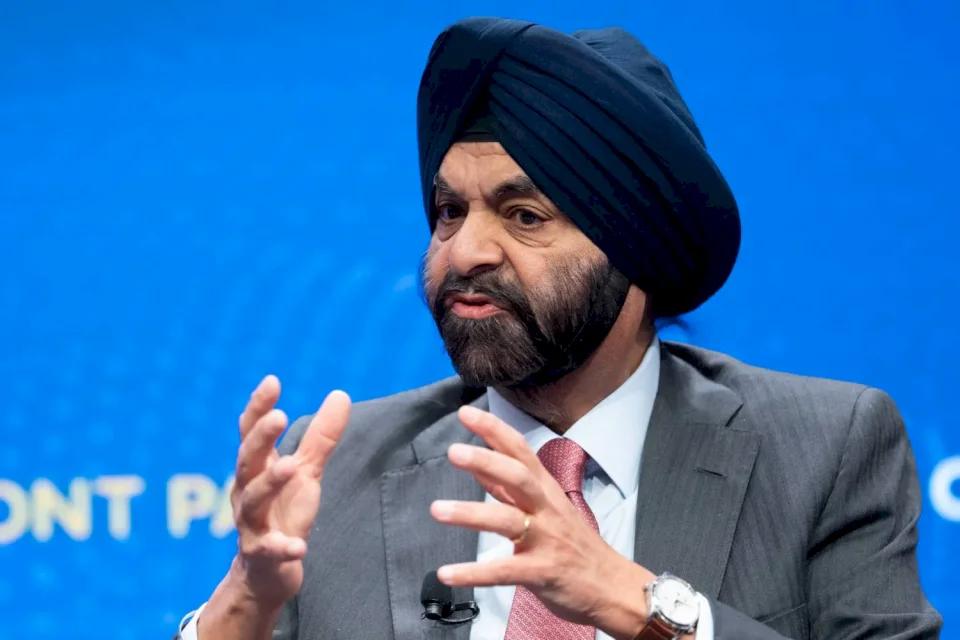
World Bank President: The war's repercussions are "cascading" even if the ceasefire holds
SadaNews Economy - World Bank President Ajay Banga warned that the war in the Middle East will have a cascading impact on the global economy, even if the fragile ceasefire declared by U.S. President Donald Trump is upheld.
Banga's remarks come ahead of the annual meetings, and in an interview with Reuters, he added that the damage would be much deeper if the ceasefire fails and the conflict escalates.
Banga mentioned on Tuesday that global growth could decrease by between 0.3 and 0.4 percentage points in the baseline scenario, if the war ends early, and by up to one percentage point if the war continues. He said inflation could rise by 200 to 300 basis points, with a much greater impact of up to 0.9 percentage points if the war persists.
The war, which has killed thousands across the Middle East, has resulted in oil prices rising by 50%, disrupting supplies of oil, gas, fertilizers, helium, and other goods, as well as impacting tourism and air travel. The two-week ceasefire announced by Trump appears fragile, with Israel and Iran continuing to carry out strikes.
Iran stated on Friday that Iranian assets should be released and that the ceasefire in Lebanon should take effect before U.S.-Iranian talks, scheduled for Saturday in Pakistan, can proceed. Trump mentioned that U.S. warships are being resupplied with ammunition in anticipation of a failure in the talks.
Banga questioned, "The real question is: Will this current peace and the negotiations taking place this weekend lead to a lasting peace, and thus the reopening of the Strait of Hormuz? If that does not happen, and if conflict erupts again, will that have a larger or more long-term impact on energy infrastructure?".
Support for Developing Countries and Crisis Management
Banga stated that the world's largest development bank is already in discussions with some developing countries, including small island nations lacking natural energy resources, on how to utilize funds available from existing programs under the "Crisis Response Windows".
The World Bank's crisis management tools allow countries to access previously approved funds that have not yet been disbursed, without needing additional approvals from the board, thereby increasing their flexibility.
Energy Support
However, Banga warned countries against creating energy support systems they cannot afford, which would lead to major problems in the future.
He added, "I am concerned about ensuring their ability to get through this crisis by determining what they need, without doing anything that exacerbates their financial situation."
Many developing countries are suffering from high levels of debt, and interest rates remain high, limiting their ability to borrow to finance the necessary measures to address the sharp rise in energy and other commodity costs caused by the war.
Banga explained that the crisis has again highlighted the need for countries to diversify their energy sources and strengthen their self-sufficiency. The World Bank lifted a long-standing ban on financing nuclear energy projects last June, as part of its efforts to meet the increasing electricity demands.
Nigeria, which has faced long-term problems, would benefit from a $20 billion investment from the Dangote Group in oil refineries, which have already increased their output during the war and are now supplying neighboring countries with jet fuel.
He said, "Nigeria should breathe a sigh of relief; it has enhanced its ability to achieve energy security through this massive investment. It is indeed a good example of getting self-sufficiency in energy; not just for itself, but for its neighbors as well."
The World Bank is also working closely with Mozambique, another African country, to expand its energy production capabilities, both from natural gas and hydropower.
Banga stated that the World Bank has many energy projects in development, noting that discussions are ongoing with some countries seeking to extend the lifespan of their nuclear reactor fleets, and other countries eager to transition to nuclear energy.
He added, "If nuclear, hydropower, and geothermal energy are not developed widely alongside wind and solar energy, they will end up relying more on traditional fuels, which is something nobody wants."
 Follow the latest Sada News via Google News
Shamaran Petroleum: Suspension of Oil Production in Duhok Fields in the Kurdistan Region o...

Dollar Steadies Near One-Week High Amid War Developments

Trump Imposes Tariffs on Canadian Imports... Ottawa Vows to Respond

Oil Prices Drop After Reports of Mediation Efforts Between the U.S. and Iran

Gold Price Rises Supported by Increased Buying Amid Lower Prices

Due to "Hazardous and Counterfeit Products".. Europe Fines "AliExpress" $627 Million

Gasoline Prices Exceed $4 Again in America Amid Resumed War
