

Scientists Discover Evidence of Complete Annihilation of Massive Stars in the Universe
SadaNews - When a massive star explodes at the end of its life, known as a supernova, it ejects material into space and usually leaves behind incredibly dense remnants, such as a black hole or a neutron star.
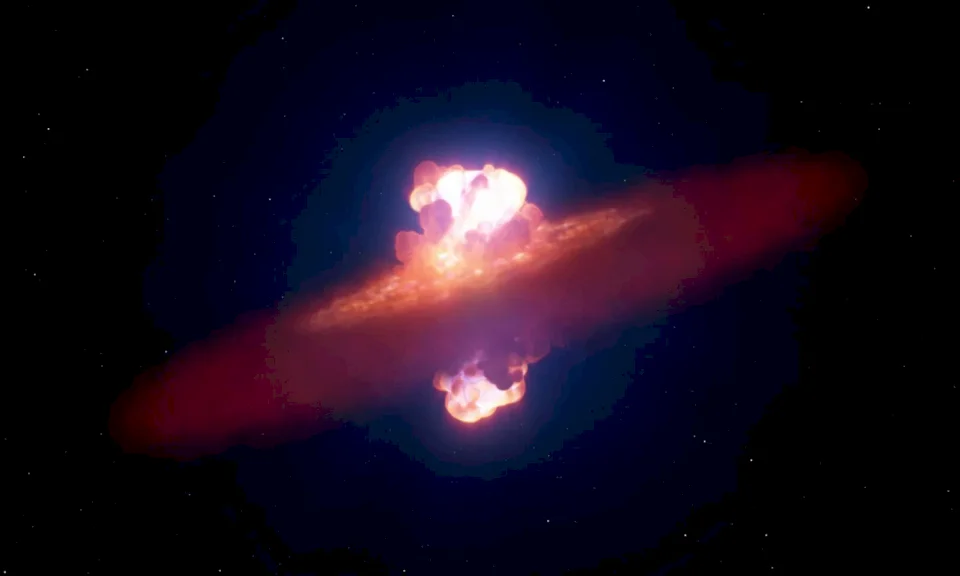
However, some of these explosions, when they occur in the largest stars in the universe, may be so powerful that they leave absolutely nothing behind, according to the news agency "Reuters".
Since the 1960s, scientists have proposed a theory regarding these extremely powerful stellar explosions, and they have now found evidence of their existence, albeit indirect.
This evidence has emerged from research related to black holes and gravitational waves in the fabric of the universe, which are known as spacetime ripples.
Hui Tong, a PhD student in astrophysics at Monash University in Australia and the lead author of the study published on Wednesday in the journal "Nature", stated that predictions indicate such super luminous stellar explosions occur in the most massive stars; specifically, those whose mass exceeds 140 to 260 times that of the Sun.
Tong added: "Despite their immense mass, their lifespan is relatively short, around a few million years. In comparison, the Sun will live for about 10 billion years, so these stars burn approximately a thousand times faster, like large fireworks that ignite intensely and for a short period before they explode."
"The Forbidden Range"
The explosion of a large star of a certain mass leaves behind a neutron star, which is the collapsed and compressed core of the star. When some stars larger than that explode, they leave behind a black hole, which is an extremely dense object with a gravitational pull so strong that light itself cannot escape it. The black hole retains part of the original star's mass, while the rest is ejected into space.
In this study, the researchers meticulously examined aggregated data on 153 pairs of black holes, calculating their mass based on the gravitational waves they emitted, then isolating the black holes that formed through previous mergers between two smaller black holes.
The researchers then discovered the absence of black holes with masses 44 to 116 times that of the Sun, which they termed the "Forbidden Range".
They suggested that this absence can be best explained by the extinction of larger stars, but instead of leaving behind black holes within this mass range as expected, they explode without leaving any trace in a rare type of explosion known as "Pair-Instability Supernova".
Best Indicator So Far
Co-author of the study, astrophysicist Maya Fishbach from the Canadian Institute for Theoretical Astrophysics at the University of Toronto, described this phenomenon as "one of the most violent types of stellar death explosions".
She added: "Typically, massive stars form black holes. The heavier the star, the more massive the black hole," until the stars reach a certain mass threshold, beyond which the physical laws governing their explosion prevent them from leaving any stellar remnants.
Tong stated: "The core becomes unstable, leading to a runaway collapse and then a violent nuclear thermal explosion that obliterates the star."
Currently, the evidence presented in this study may be the best indication yet of the occurrence of pair instability explosions.
Tong said: "We are essentially using something invisible, black holes, as a record of some of the brightest explosions in the universe."
 Follow the latest Sada News via Google News
After Deschamps' Departure... Zinedine Zidane Tops the Candidates to Lead France

Mbappe Surpasses Messi and Becomes the All-Time Top Scorer in the World Cup

England Defeats France and Achieves Largest World Cup Achievement Since 1966

Messi Refused to Play for Spain and Missed 3 World Cups

Publishers Sue Google for Allegedly Using Books to Train Artificial Intelligence

Google Expands Capabilities of Google Search Console to Support Social Media Accounts

The Mediterranean Table... An Ancient Diet Revealing Its New Secrets for Health and Longev...
