

Report: Trump May Order Attack on Iran Next Sunday
SadaNews - A website "Drop Site" quoted sources that American military officials informed an allied command in the Middle East that Trump may order the start of an attack on Iran next Sunday morning.
What are the American military options in facing Iran?
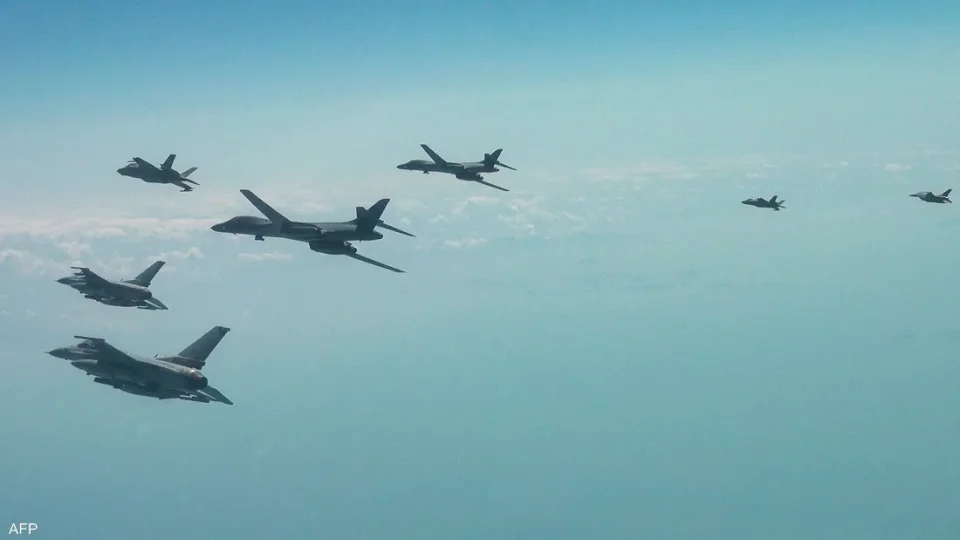
The United States has reinforced its military presence in the Middle East in recent weeks, reflecting escalating tensions with Iran, particularly after President Donald Trump's threats to deliver a military strike against Tehran.
This came with the deployment of a naval strike group led by the aircraft carrier "USS Abraham Lincoln", in a clear deterrent message amid fears of slipping into open confrontation.
If Washington decides to transform its threats into direct military action, multiple scenarios are available, ranging from limited and precise strikes to a wide-ranging military campaign that could target the pillars of the Iranian regime.
American military capabilities in the region
President Trump has hinted at the possibility of military intervention in support of the anti-government protests in Iran that erupted in late December, in the face of what he described as "violent repression" that resulted in thousands of casualties.
The American fleet in the region includes the aircraft carrier "Abraham Lincoln", which carries over 80 fighter jets, along with a strike group comprising three destroyers equipped with Tomahawk missiles and advanced missile defense capabilities. This group is often accompanied by an attack submarine capable of launching missiles designed to strike ground targets.
This force is added to an existing American deployment that includes four minesweeping ships, in anticipation of any Iranian attempt to disrupt navigation in the Strait of Hormuz, along with dozens of American aircraft. Military transport planes bearing air defense batteries and squadrons of F-15 fighters have also been spotted arriving.
Despite his preference for diplomatic solutions, Trump warned that time is running out for Iran to reach an agreement regarding its nuclear program. Analysts believe that American strikes targeting Iranian nuclear facilities in June 2025, during the Israeli war on Iran, have altered Tehran's calculations and raised the bar of its demands.
Farzan Thabet, a researcher at the Graduate Institute in Geneva, states that the U.S. seeks a complete halt to uranium enrichment in Iran, restricts its ballistic missile program, and imposes strict limitations on its regional allies, such as Hezbollah in Lebanon and the Houthis in Yemen.
For his part, French researcher David Khalfa believes that accepting these conditions represents "an unacceptable surrender" for Tehran, speculating that Trump may resort to military options to demonstrate his ability to enforce his red lines.
The limited strikes scenario
One proposed option involves conducting limited strikes with narrow targets, allowing Washington to send a firm message without engaging in full-scale war. These operations may include targeting ships that export Iranian oil, similar to what the U.S. previously did with Venezuela, aiming to choke the Iranian economy and push it to make concessions.
Strikes could also target air defense systems, missile launch platforms, and drone sites, in addition to sites associated with the Revolutionary Guard and "Basij" forces. Middle East affairs analyst Eva Kolorioti confirms that U.S. intelligence, aided by Israeli Mossad, possesses accurate information about these sites.
The broad strikes option
The most escalatory scenario involves executing comprehensive strikes targeting the pillars of the Iranian regime, starting from the highest leadership, led by Supreme Leader Ali Khamenei, down to the Revolutionary Guard leadership and senior political and military officials.
According to Kolorioti, such a campaign might entail neutralizing major military bases, missile programs, and what remains of the nuclear program. David Khalfa points out that the American goal in this case would be to "destabilize the regime and paralyze its command and control capabilities" by targeting its leaders and masterminds.
However, analysts emphasize that the Iranian regime remains cohesive, and the Revolutionary Guard has been preparing for such a scenario for years, making regime change a complex task.
Potential Iranian response
Despite the losses Iran incurred during the June 2025 war, its response capabilities remain intact. Experts estimate that Tehran possesses between 1,500 and 2,000 medium-range ballistic missiles capable of striking Israel, in addition to a larger number of high-precision short-range missiles, cruise missiles, and anti-ship missiles, along with a fleet of fast boats and sophisticated drones.
Kolorioti believes that Iran's decision to respond will largely depend on the nature and scale of the American strike, and whether it is limited or targets the regime's very existence.
In light of these developments, all options remain on the table, while the world waits to see if Washington will settle for military and political pressure or will indeed enter into direct confrontation with Iran, with far-reaching regional and international repercussions.
 Follow the latest Sada News via Google News
Axios: Proposal for a 10-day Ceasefire Between Washington and Tehran and Two Options for M...

In a Rapid Pace.. The Occupation Builds a Huge Earth Barrier Inside Gaza

Meeting Between Aoun and Trump Expected Alongside 'Experimental Areas'

Gaza Health Warns of Collapse of Oncology Services Due to Depletion of Treatments and Susp...

The Occupation Demolishes a House in the Town of Sa'ir near Hebron

Israel Reveals Details of Secret Iranian Nuclear Facility in Mount Fas

A Mother, Her Child, and Her Three Daughters Martyred in Israeli Shelling on Gaza City
