

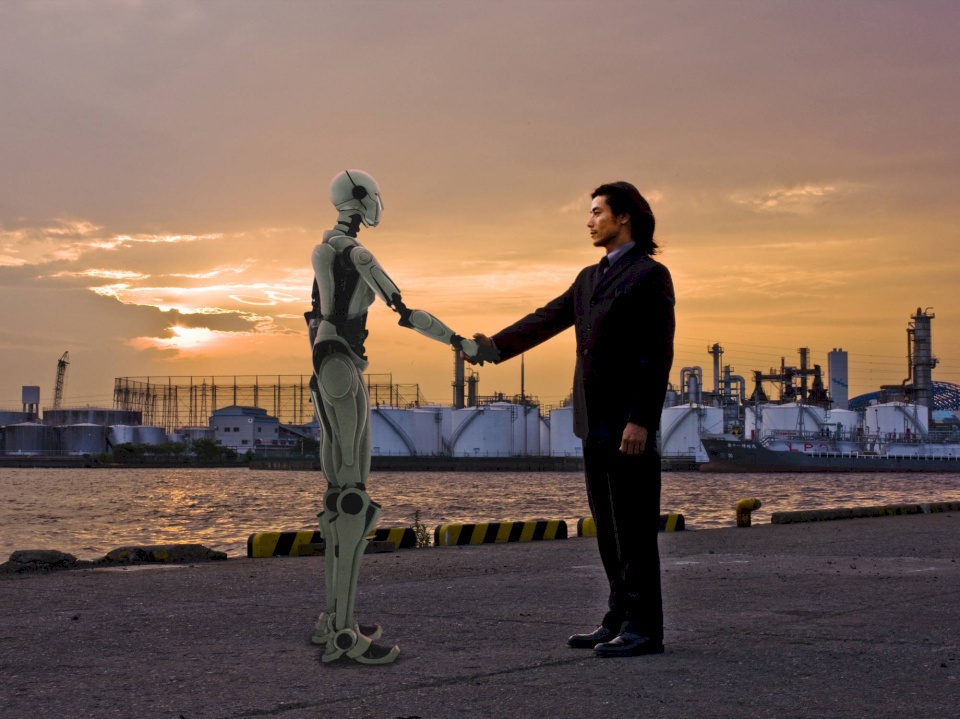
Robot Research... "Has Lost Its Way"
SadaNews - Rodney Brooks says: "I like to look at what everyone else is doing, and I try to find a common denominator that they all implicitly assume... but I deny its existence."
Pioneer in Robotics
Brooks, a pioneer in the field of robotics, was speaking directly to the camera in Errol Morris's film "Fast, Cheap, and Out of Control" from 1997, which combines interviews with Brooks, a black panther trainer, a gardener specializing in tree pruning, and a researcher studying naked mole rats. Recently, Brooks reflected on the film: "Four men, each trying to control nature in their own way, and we were all failing."
In the film, Brooks described an early achievement. In the 1980s, technical computing constraints limited the development of robotics. But while observing insects, he realized they had limited mental capabilities but were much more efficient than his robots, and that simulating animal biology was smarter than trying to control every aspect of robot behavior through programming. His successes led him to predict the proliferation of robots "everywhere around us."
Former director of the Massachusetts Institute of Technology's lab, who devoted his career to making intelligent machines a part of our daily lives and co-inventor of the famous "Roomba" robotic vacuum, at the age of seventy, he now finds himself skeptical.
Skepticism about Robots' Capabilities... and Wasted Money
Today, entrepreneurs are promising robots that not only look human-like but are also capable of doing everything a human can do.
Technology investors are pouring billions of dollars into this endeavor, but Brooks sees that humanoid multifunctional robots will not be returning to our homes anytime soon and that they are not safe enough to be around humans. Last September, he published a scathing critical article concluding that over the next fifteen years, "huge sums of money will be wasted trying to extract any possible improvements from current humanoid robots. But these robots will have long been forgotten."
His blog post caused a significant stir in the small robotics world. This person is a legend in the field, and his insights contributed to the rise of the humanoid robot trend.
Chris Paxton, an artificial intelligence and robotics researcher, commented: "At least twelve people have asked me whether I agree with what he said shortly after he published it (and I do not agree) with what he said."
Historical Examples
Brooks remembers Ernest Dickmanns' self-driving car, which began its journeys across Europe in 1987. He was present when IBM's giant computer "Deep Blue" defeated world chess champion Garry Kasparov in 1997, and when AI researcher Geoffrey Hinton predicted in 2016 that radiology would be a thing of the past in five years because machine learning programs would do its work better.
All of these were important developments, but drivers and chess players and radiologists are still among us.
Brooks insists he is being realistic: "We will go through a period of extreme excitement, then comes a period of disappointment."
Arms Race Towards Humanoid Robots
Brooks, who now works at the "Robost" Foundation, says the robot's appearance suggests its capabilities. The widely used robots today are designed for specific tasks under certain conditions, and they look the part - like a robotic arm performing the same repetitive movement on a production line, or automated pallet jacks in Amazon warehouses. They are not impressive. He adds: "People see the human-like shape and think it can do everything a human can do."
In other words, humanoid robots are an ideal idea for Silicon Valley, where potential growth means everything for venture capital-backed companies.
Aspirations or Delusions?
That is why it appears that Tesla, owned by Elon Musk, is betting everything on its robot "Optimus." Last October, Musk stated that building such robots at scale represents "an infinite financial dilemma," and predicted that his company's robot "could achieve five times the productivity of a human annually due to its ability to work around the clock." Among other things, he believes Optimus will be a skilled surgeon, a bold claim, as human dexterity is one of the toughest challenges in robotics.
Musk is not the only one aiming for lofty goals. Among other companies, the startup Figure AI has raised nearly $2 billion since 2022 to develop its line of C-3PO-like robots, which are used in various fields from manufacturing to elder care. You can also spend $20,000 to acquire a robot from 1X Technologies in Palo Alto and place it in your home next year, but its limited independence will be supported by company employees who will remotely control it as part of a plan to teach it new tasks.
The Difficulty of Simulating Humans
This is just the latest attempt to achieve what Brooks and his colleagues once described in a research paper published in 1999 as developing the "Holy Grail." Previous attempts to build multipurpose humanoid robots stumbled due to difficulties in walking on two legs and other challenges related to simulating the human form using electronics.
Then, there is the vast number of situations an individual may find themselves in. How can one write a program that helps a robot, to solve one of the routine tasks that could be outsourced to execute, navigate every home, gather laundry, and sort it?
Generative AI
Generative AI offers a new answer: teaching the robot to do this in the same way we teach computers to recognize people, copy audio recordings, or respond to requests like "write a 90s rap song."
Training neural networks using vast amounts of data is a proven technique, and there is a massive amount of data showing humans moving in their environments - decades of video footage of people doing various tasks fuel data centers.
Results may seem impressive, at least in the videos, where humanoid robots from Figure and other companies can be seen folding clothes, or sorting toys, or categorizing spare parts in a BMW factory in South Carolina.
Humans and the Dangers of Robots
But what is often not seen in most of the videos is the presence of people nearby the robots. Brooks states he would not come within a meter of any humanoid robot. He adds that if - and when - these robots lose their balance, the powerful mechanisms that make them useful turn them into dangerous tools.
Safety regulations generally require individuals to stay away from robots in industrial environments. Aaron Brother, director of robotics and autonomous systems at ASTM International, a standards organization, says humanoid robots are not inherently unsafe but require clear guidelines, especially when they leave environments where humans have been trained to work alongside them.
Brother adds: "For robots entering homes, especially remotely controlled humanoid robots, we are in a new territory."
Last November, the former chief of product safety at Figure filed a lawsuit against the company for wrongful termination, claiming he was fired after attempting to enforce strict safety guidelines. The company refused to comment on its technology, but a representative denied the claims in the lawsuit, saying the employee was fired due to poor performance. A representative from 1X stated that their home robot relies on new mechanisms "that make it safe and uniquely compatible with humans."
Stunning Sensory Finger Capabilities... Hard to Translate to Machines
Brooks is highly skeptical about the ability of neural networks to solve the dexterity problem. Humans do not have a language for gathering, storing, and transferring tactile data as we do for language and images. The amazing capacity of our sensory fingers collects various types of information that are difficult to translate to machines. Brooks believes that the visual data preferred by the new generation of robotics startups will simply not be able to simulate what we can do with our fingers.
He says: "My students have made many hands and arms and have shipped tens of thousands of robotic arms. I am fully convinced that humanoid robots will not reach the level of human manipulatory (dexterous) capabilities."
Researchers argue that if visual data alone is not sufficient, they can add tactile sensors to their robots, or use the internal data collected by the robot when operated remotely by a human user. It remains unclear whether these technologies will be cheap enough to make these companies sustainable.
But there are also numerous possibilities between human dexterity and robot failure. Brass Vilagabody, CTO of Agility Robotics, states: "Brooks raises many important points, but I differ with him on one point, which is that we need to reach the level of human dexterity to benefit from the multipurpose robots."
Realist... Not Pessimist
Brooks describes himself as a realist, not a pessimist. His main concern is that excessive focus on the latest training methods will lead to neglecting other promising ideas. He predicts that one day robots will work alongside humans, and that we may call them "humanoid robots," but they will, as he says, be equipped with wheels and multiple arms, and perhaps not be multifunctional.
He is currently working over a prototype warehouse in San Carlos, California, where Robost's robots learn their tasks, but he expects to step away from working at companies in the next few years. Not for retirement, but to write a book about the nature of intelligence and why humans will not be able to create it artificially for another 300 years.
About his growing dream of AI, he says: "This has been my dream my whole life." He adds: "What I dislike now is general artificial intelligence. We have always aimed for general artificial intelligence! Soon they will call it super AI."
"I do not know what will come next, but it will be super AI."
 Follow the latest Sada News via Google News
After Deschamps' Departure... Zinedine Zidane Tops the Candidates to Lead France

Mbappe Surpasses Messi and Becomes the All-Time Top Scorer in the World Cup

England Defeats France and Achieves Largest World Cup Achievement Since 1966

Messi Refused to Play for Spain and Missed 3 World Cups

Publishers Sue Google for Allegedly Using Books to Train Artificial Intelligence

Google Expands Capabilities of Google Search Console to Support Social Media Accounts

The Mediterranean Table... An Ancient Diet Revealing Its New Secrets for Health and Longev...
