

Arab Ministers of Economy and Trade Adopt Decisions and Recommendations in Support of Palestine
SadaNews Economy - Arab Ministers of Economy and Trade called on Arab countries to continue their efforts to stop the Israeli aggression on the Gaza Strip, and to confront the settlers' assaults against our people, including the demolition, burning, and destruction of citizens' homes, farms, properties, and economic establishments.
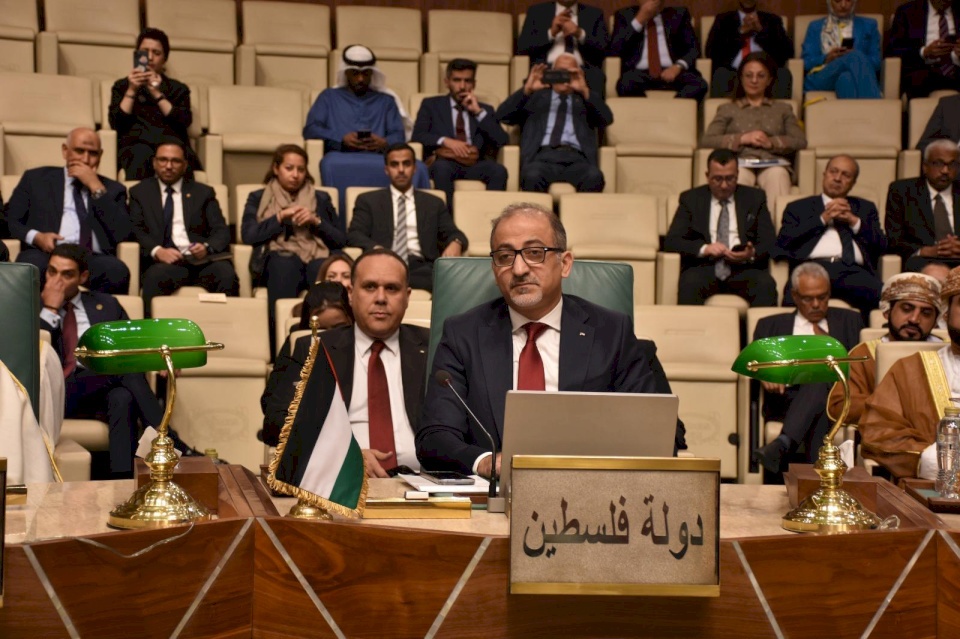
This came in their decisions issued by the Economic and Social Council during its 117th ordinary session, which commenced today, Thursday, at the Arab League in Cairo, chaired by Algeria, with the attendance of the Secretary-General of the Arab League, Ahmed Aboul Gheit.
The delegation from the State of Palestine at the meeting was chaired by the Permanent Representative of Palestine to the Arab League, Ambassador Muhannad Al-Aklouk, along with Senior Advisor Tamer Al-Tayeb, Senior Advisor Jumana Al-Ghoul, First Secretary Riham Al-Barghouthi, and Third Secretary Ola Amer, all from the Palestinian delegation to the Arab League.
The Council urged Arab countries, specialized Arab organizations, and institutions of joint Arab action to support the Palestinian Airlines financially for the costs related to the maintenance of its only aircraft, in order to maintain the operational license of Palestinian Airlines and its ongoing work and international status as the official carrier and flag bearer of the Palestinian flag.
It called for support for Palestinian steps towards implementing the Electronic Commerce Law, aimed at providing support and assisting the State of Palestine in the framework of the historic and national role of the Arab League in this context, particularly in the developmental sectors that have a direct impact on the lives of Palestinian citizens, and in accordance with the Palestinian needs outlined in the attached document.
The Council urged Arab countries wishing to fully or partially implement the proposed project to communicate with the Palestinian Ministry of National Economy through the General Secretariat of the Arab League and the Permanent Delegation of the State of Palestine to the League, to reach an agreement on the overall framework of the project proposal and the financing thereof.
The Ministers of Economy urged Arab countries, the General Secretariat, and partner Arab and international organizations to set up a mechanism for implementing this decision, and to design Arab and international programs that contribute to enhancing the capacities of Palestinian institutions in organizing electronic commerce, in order to expand access to external markets, support small and medium-sized enterprises, and entrepreneurial projects in the digital economy, and provide job opportunities for youth and graduates in light of the high unemployment rates, which constitute one of the main challenges in the State of Palestine, in addition to protecting the Palestinian consumer, enhancing trust in digital transactions, as well as protecting the rights of traditional trade and the rights of the state.
They emphasized the importance of providing the necessary Arab social support to the State of Palestine by meeting the institutional and social needs of the Palestinian people, and referred Palestine’s proposal regarding the support and rehabilitation of centers affiliated with the Ministry of Social Development in the West Bank to the Council of Arab Ministers of Social Affairs for discussion and appropriate decision-making regarding it.
In his speech, Aboul Gheit stated that the humanitarian situation remains deteriorating, with more than 2 million people in the Gaza Strip living in tents that do not withstand the cold or rain, and without the minimum level of health and living services.
He added that the occupation insists on destroying the structure of Palestinian society through the blockade and targeting its people with killings despite the ceasefire, indicating that since October 1, last month, approximately 500 Palestinians have been martyred, mostly civilians, women, and children, affirming that addressing these humanitarian situations is a main priority for social and developmental work at this time.
For his part, Ambassador Al-Aklouk confirmed that any serious course towards peace or development will remain deficient unless it is accompanied by ensuring Palestinian trade freedom, regularization of Palestinian financial resources, respecting signed agreements, and putting an end to the use of the economy as a tool of occupation.
He called on Arabs to move from political solidarity to practical economic partnerships that place the Palestinian individual at the center of the development process, contributing to building a national economy capable of resilience and growth, based on the unity of land and economy between the Gaza Strip and the West Bank, including Jerusalem as the capital.
Ambassador Al-Aklouk also called on the Council to activate the Arab financial safety net to meet the urgent needs of the Palestinian government, amid the continued piracy of the occupation on clearance funds, using them as a political blackmail tool, despite constituting about 65% of public revenues, and to support holding an international reconstruction conference in the Arab Republic of Egypt, actively participating in it, and providing the necessary financial commitments to implement the Arab reconstruction plan.
He called for opening Arab markets wider to Palestinian products, and implementing the decisions of the Economic and Social Council calling for support to the Palestinian economy, including exemption from customs duties, facilitating intra-trade procedures, including digital trade, and enhancing Arab-Palestinian economic partnerships and support for employment programs and small and medium-sized enterprises, considering them the backbone of the resilience economy.
Ambassador Al-Aklouk emphasized the necessity of supporting the resilience of the city of Jerusalem through financing economic and developmental projects that enhance the presence of its people in the face of judaization policies, believing that the Palestinian economy is capable of recovery and growth whenever real Arab support and effective partnerships are available.
He pointed out that the occupation imposes systematic restrictions on Palestinian trade through full control over crossings and borders, establishing 1,200 military checkpoints in the West Bank, depriving Palestinian traders of direct import and export, and obstructing the entry of dual-use goods, as well as the forced separation policy between the West Bank and Gaza Strip, in addition to sudden and unannounced closures, undermining the competitiveness of the Palestinian economy, causing heavy losses for traders.
 Follow the latest Sada News via Google News
Soaring Oil Prices Burn the Pockets of the Palestinian Citizen "The Poor"

Millions of Dollars in Losses.. "SadaNews" Reveals Shocking Figures for Traders from Pales...

The Problem of Shekel Overcrowding Worsens.. Fuel Station Owners Threatened with Closure o...

The Palestinian Economy at a Crossroads: 4 Files Awaiting Resolution

بنك إسرائيل يخفض توقعات النمو ويحذر من ارتفاع العجز

Exchange Rates of Currencies Against the Shekel on Tuesday (July 21)

Inflation Expectations in Israel Stabilize at 1.5%
