

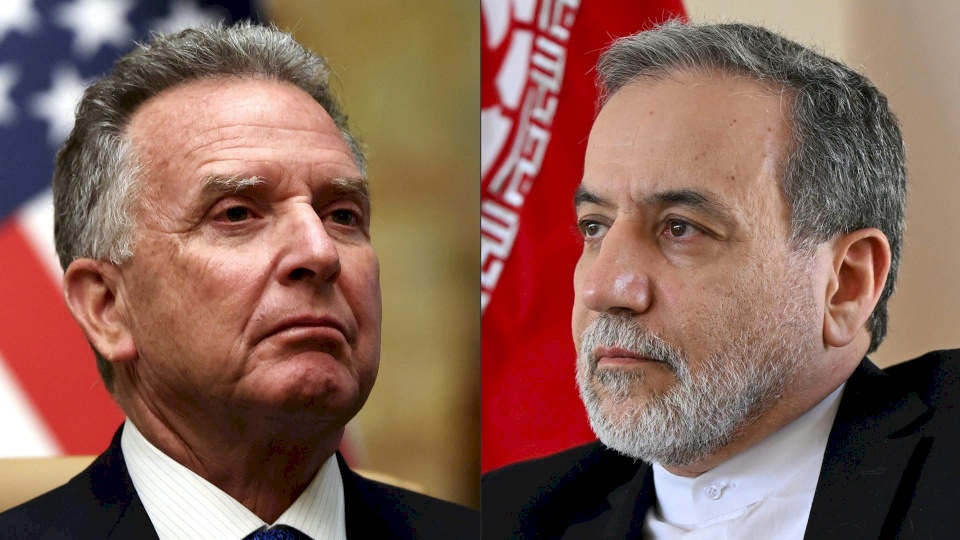
Washington and Tehran at the Muscat Table Amid "Red Lines"
SadaNews - On the eve of sensitive talks in Muscat, Iran has set a clear ceiling for any potential dialogue with the United States, considering its uranium enrichment programs and missile capabilities as "red lines" that are not on the negotiating table.
Negotiations between the two sides will commence on Friday in the Omani capital.
Iran's Foreign Minister Abbas Araghchi stated: "Iran enters the negotiations with eyes wide open and a vivid memory of last year's events, engaging in good faith and firmly asserting its rights."
The United States and Iran agreed to hold talks in Oman on Friday, amid an ongoing dispute over Washington's insistence on including Tehran's missile arsenal in the agenda, in contrast to Iran's insistence on limiting discussions to the nuclear issue only, a disagreement accompanied by mutual threats of airstrikes.
The two adversaries held several rounds of nuclear negotiations mediated by Oman last year, but the diplomatic path was interrupted when Israel launched a 12-day war on Iran in June, including U.S. airstrikes on Iranian nuclear sites.
U.S. envoy Steve Wittekov, accompanied by Jared Kushner, President Trump's son-in-law, arrived in Muscat from Abu Dhabi on Thursday evening.
White House spokeswoman Caroline Levitt said President Donald Trump is looking forward to the Friday talks to see if an agreement with Tehran can be reached.
Levitt added to reporters that "the president, during these negotiations, reminds the Iranian regime that it has multiple options besides diplomacy," emphasizing that "as the commander in chief of the most powerful army in the history of the world, all options remain on the table."
For his part, Iranian Foreign Ministry spokesman Ismail Baqaei announced that the Iranian delegation, headed by Foreign Minister Abbas Araghchi, headed to the Omani capital.
Baqaei stated that "this diplomatic track is being conducted competently and aims at reaching a fair, acceptable, and honorable understanding for both parties regarding the nuclear issue," adding that "the bitter past experiences, including violations of commitments and military aggression in June, and foreign interventions last January, are vivid in our minds."
He noted that Tehran "considers itself obligated to demand the rights of the Iranian people," while also "bearing the responsibility of not missing any opportunity to utilize diplomacy in the service of the Iranian people's interests and to maintain peace and stability in the region." He expressed hope that "the American side will engage seriously, realistically, and responsibly."
Disputes over the location of the discussions and the topics to be addressed have cast doubts on the feasibility of holding the meeting, leaving the door open for the possibility of Trump implementing his threats to strike Iran.
No indications have emerged regarding the possibility of reaching a common ground on the agenda. The region remains in a heated state, with the United States bolstering its forces, while regional parties seek to avoid a military confrontation that many fear could escalate into a larger war.
Iran insists that the talks should be confined to the ongoing nuclear dispute with Western powers, rejecting America's demand to include missiles, warning that broadening the discussion beyond the nuclear program could jeopardize the negotiations.
These diplomatic efforts come in the wake of American threats of military action against Iran during its crackdown on protests last month, which resulted in casualties, as well as the deployment of more U.S. naval forces in the Gulf.
In this context, Iranian National Security and Foreign Policy Committee spokesman Ibrahim Rezaei stated that raising demands such as "zero enrichment" will lead to the failure of negotiations from the outset.
Rezaei noted that Tehran's red lines have not changed, indicating that entering negotiations under previous American conditions, or expanding the agenda to include non-nuclear files, practically means aborting the negotiations before they even begin.
He clarified that any upcoming talks will be strictly limited to the nuclear file, completely excluding discussions on missile or regional issues, noting that Tehran has informed mediators and concerned parties that it is not prepared to retreat from rights it describes as indisputable and will not exceed the framework it has previously established for the negotiations.
Rezaei placed the lifting of sanctions at the core of any negotiating process, considering that the goal of the talks is to enable Iran to resume trade and financial transactions, boost exports, which would directly impact the living and economic conditions of the citizens, adding that any agreement that does not yield tangible economic gains loses its validity.
He emphasized that the retention of enriched materials and the continuation of enrichment within Iranian territory are non-negotiable issues, urging Washington to deal with this reality with a more realistic political approach.
He also expressed rejection of European countries' participation in any negotiations, deeming there is no justification for this role in light of what he described as prior European bias following the activation of the "snap back" mechanism.
American Positions
In response to a question about whether Iranian Supreme Leader Ali Khamenei should feel worried, Donald Trump told NBC News on Wednesday: "I say he should be very worried. Yes, he should feel that way," adding, "They are negotiating with us," without providing further details.
Later, U.S. Treasury Secretary Scott Piesen said on Thursday that the actions of the Iranian leadership represent a "good sign" that an end may be near. He pointed out that leaders in Iran are rushing to move money out of the country, adding that "the rats are beginning to leave the ship," as he put it.
Conversely, U.S. Secretary of State Marco Rubio stated that negotiations should also address Iran's ballistic missile system, its support for armed groups acting as proxies in the Middle East, and how Iran deals with its people, in addition to nuclear issues. Iranian sources say the United States is demanding Tehran to limit the range of its missiles to 500 kilometers.
Iran's regional influence has waned in recent months due to Israeli attacks on groups allied with or supported by it, including Hamas in Gaza, Hezbollah in Lebanon, the Houthis in Yemen, and factions in Iraq, in addition to the ousting of its key ally, former Syrian president Bashar al-Assad.
The talks were originally scheduled to take place in Turkey, but a regional official said Iran preferred to hold the meeting in Oman as an extension of previous talks that took place in the sultanate, focusing exclusively on the nuclear program.
The New York Times reported that Iranian officials and a regional official stated that the two sides made mutual concessions, with the United States agreeing to hold the talks in Oman and exclude regional parties, while Iran agreed to meet the U.S. delegation, with an agreement to focus on the nuclear program and discuss the missile and armed groups files aimed at reaching a framework for a potential agreement.
Iranian officials revealed that Tehran requested on Tuesday to change the meeting's location and format at the last minute, limiting attendance to only Iranian and American representatives, fearing that a broader meeting would appear as a political "show," making Iran seem besieged by negotiations with the entire region rather than just with Washington.
They added that the talks nearly collapsed on Wednesday morning when Abbas Araghchi informed his regional counterparts that the U.S. insistence on expanding the agenda would lead to canceling the meeting. As this position circulated, the value of the Iranian rial sharply declined against the dollar.
Tehran repeats that its nuclear activities are for peaceful purposes, while the United States and Israel accuse it of previous attempts to manufacture nuclear weapons.
Unprecedented Alert
Alongside the diplomatic track, the United States has sent thousands of soldiers to the Middle East, in addition to an aircraft carrier, other warships, fighter jets, reconnaissance planes, and air refueling capabilities. Trump warned that "bad things" could happen if an agreement cannot be reached, increasing pressure on the Islamic Republic.
Iranian army spokesman General Mohammad Akraminia stated that the armed forces are in "full readiness" to defend the country, noting that access to U.S. bases is "easy," which increases their "vulnerability to attack."
He added that the inclusion of a thousand strategic drones into the combat formation of the four branches of the military reflects preparedness to face "any option and any scenario," pointing out that other defensive systems are being updated and equipped, emphasizing that "the American president is the one who chooses between settlement or war," and that the armed forces are "prepared for both options."
He warned that any potential war would "encompass the entire geography of the region, and all U.S. bases," from occupied territories to the Gulf and the Sea of Oman. In Israel, the Jerusalem Post quoted Chief of Staff Eyal Zamir as saying that Israel is ready to deliver "surprise strikes" on targets in Iran if Tehran chooses war, adding that the U.S. retreat from its position on Iranian ballistic missiles constitutes a "red line" for Israel.
Iran has stated that it has strengthened its missile stockpile following last year's war with Israel, warning of using its missiles if its security is threatened.
Fars News Agency, linked to the Revolutionary Guard, reported on Thursday the first deployment of the ballistic missile "Khoramshahr 4" in one of the "missile cities" within Iran. The agency claimed that the deployment of the "Khoramshahr 4" missile in the missile cities has elevated the capabilities of the Iranian armed forces to an "unprecedented" level. It operates on liquid fuel and has a range of two thousand kilometers. It carries a warhead weighing 1500 kilograms.
In the context of military readiness, the Noor News Agency, affiliated with the National Security Council, reported that President Masoud Bezhakian issued a decision to appoint Ali Shamkhani as head of the Defense Committee, which has been reinstated under the umbrella of the Supreme National Security Council.
The committee, which was dissolved after the end of the 1980s war with Iraq, oversees military decisions in times of war, overall defensive readiness, and mechanisms to confront emerging threats.
The tension escalated following the U.S. military's downing of an Iranian drone that approached the aircraft carrier "Abraham Lincoln" in the Arabian Sea, in addition to another incident in the Strait of Hormuz described by U.S. Central Command as Iranian forces approaching an American-flagged oil tanker and threatening to seize it.
Calls for De-escalation
Amid this escalation, several parties welcomed the resumption of negotiations. Iranian Foreign Minister Abbas Araghchi stated that he has been in contact with his counterparts in Oman, Qatar, and Egypt to discuss regional and international developments.
Russian Foreign Minister Sergey Lavrov stated that his country is willing to contribute to resolving the issue of enriched uranium stocks in Iran if Washington and Tehran reach an agreement.
In Ankara, Turkish President Recep Tayyip Erdogan stated that his country is working to prevent the Middle East from drifting into a new conflict due to tensions between Washington and Tehran, considering that leadership-level talks would be beneficial after lower-level negotiations scheduled in Oman.
In Cairo, Egyptian Foreign Minister Badr Abdel Atti stressed the utmost importance of reaching a peaceful and consensual settlement based on mutual respect and common benefit, which would spare the region the risks of war, pointing to contacts with Qatar, Oman, Iran, and the U.S. envoy.
In Baghdad, Iraqi Foreign Minister Fuad Hussein stated that his country supports negotiations and calls for resolving issues through dialogue to spare the region the fires of war, warning that his French counterpart, Jean-Noel Barot, expressed that the danger of military escalation is "already present."
In Doha, German Chancellor Friedrich Merz stated that concerns about escalating tensions overshadowed his discussions in the Gulf, calling on Iran to engage in talks and confirming that Germany will work to calm the situation.
Conversely, China stated that it supports Iran's legitimate right to the peaceful use of nuclear energy, opposes threats of using force and sanctions pressure, noting that it will continue to push for an appropriate resolution to the Iranian nuclear file.
 Follow the latest Sada News via Google News
Smotrich: Israel Has No Interest in Joining the War Against Iran

Occupation Issues Military Order to Seize 5 Dunams of Land in Jaba'

Axios: Proposal for a 10-day Ceasefire Between Washington and Tehran and Two Options for M...

In a Rapid Pace.. The Occupation Builds a Huge Earth Barrier Inside Gaza

Meeting Between Aoun and Trump Expected Alongside 'Experimental Areas'

Gaza Health Warns of Collapse of Oncology Services Due to Depletion of Treatments and Susp...

The Occupation Demolishes a House in the Town of Sa'ir near Hebron
