

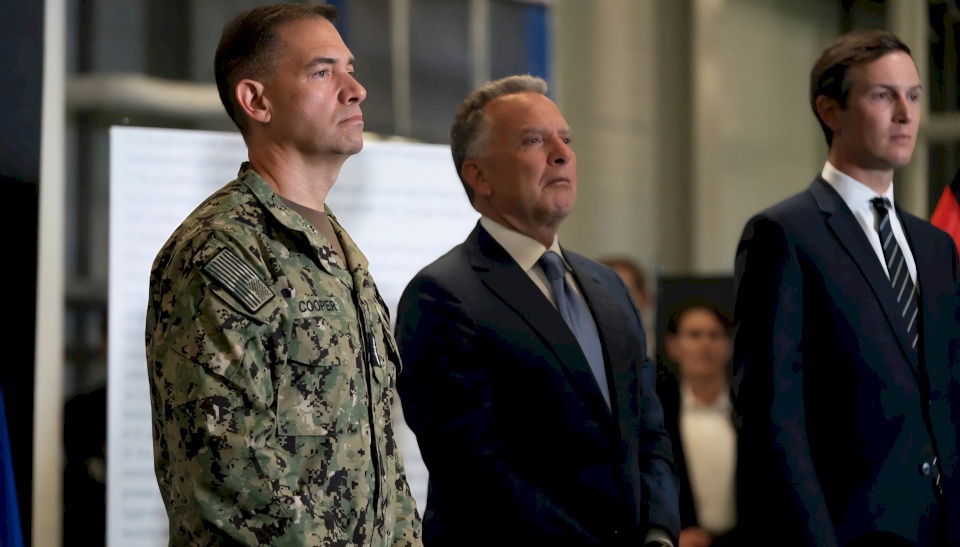
What Does the Participation of a U.S. Military Leader in Iran Negotiations Mean?
SadaNews - Under the watchful eyes of the region and the world, negotiations between Washington and Tehran have commenced in the Omani capital, Muscat, amidst heightened anticipation due to increasing military mobilization in the area, regional pressures to prevent war, and mutual official statements. In this context, this round of talks appears to be more sensitive than ever, as the region watches whether diplomacy will succeed in containing escalation or whether non-negotiable red lines will lead to a potential confrontation. The participation of U.S. Central Command leader General Brad Cooper in the talks reflects a clear indication of managing the direct military threat and ensuring that political tensions do not turn into actual confrontations between U.S. and Iranian forces, according to political columnist Peter Rouf of Newsweek. According to Rouf's remarks to Al Jazeera, the aim of this participation is to prevent war and monitor Iran's commitments regarding regional security and ballistic capabilities, while emphasizing that the U.S. wants to remain the dominant power in defining its strategic priorities in the region. It also indicates that any security or military action must be conducted according to "precise calculations that prevent slipping into a full-blown conflict, while keeping the U.S. leadership's view of the regional scene clear and controlling." This morning, indirect negotiations between Iran and the United States kicked off in Muscat, with Tehran reaffirming its adherence to its rights in the face of escalating American threats, and with the White House closely watching the outcomes of the talks. Iran's delegation is led by Foreign Minister Abbas Araghchi, while the U.S. delegation is headed by President Donald Trump's envoy to the Middle East, Steve Wittekoff. The Wall Street Journal reported, citing a U.S. official, that the Central Command leader will join the discussions. Three key factors characterize this round, according to Middle East policies expert Mahjoub Al-Zuwairi: 1. The ever-present yet absent Israeli role that incites escalation. 2. The use of military option by the U.S. as a pressure tactic rather than a final decision. 3. The regional pressures to prevent war, posing a challenge to the traditional narrative of Israel. The topics under discussion include "zero nuclear enrichment," the disposal of enriched uranium, ballistic missiles, and Iran's regional role, as Al-Zuwairi points out. Al-Zuwairi noted that Iran had previously agreed to reduce uranium in the 2010 and 2015 agreements, but considers maintaining its regional influence a red line that cannot be crossed, emphasizing that the missile program is Israel's number one concern in this round of negotiations. Iranian Red Lines In turn, Hassan Ahmadian, a professor of Middle Eastern Studies at the University of Tehran, confirmed that these defensive capabilities, along with the Iranian funds held abroad, represent Iran's red lines to ensure its security and defend its interests, and it will not concede these in any negotiations. Iran enters the negotiations aiming to reduce escalation and lift sanctions, but according to Ahmadian, it is prepared for military confrontation if demands exceed the nuclear file. According to the Iranian academic, withdrawal is "possible" if pressured on issues beyond Iran's defensive capabilities, as these capabilities, along with the nuclear and missile programs and regional role, represent red lines that cannot be crossed. From the U.S. side, Peter Rouf clarified that Americans are focused on reducing Iranian military movement in the region, limiting its ballistic capabilities, and partially lifting sanctions in exchange for Iran's commitment to good behavior. Rouf also confirmed that Russia is excluded from any role in uranium transfer, as the United States does not wish to increase Moscow's influence in the Middle East. Before the talks commenced, Araghchi stated that Tehran would negotiate in good faith and uphold its rights during the Muscat talks, while the White House confirmed that Trump is awaiting the results of the negotiations amidst U.S. military reinforcements in the Middle East.
 Follow the latest Sada News via Google News
Axios: Proposal for a 10-day Ceasefire Between Washington and Tehran and Two Options for M...

In a Rapid Pace.. The Occupation Builds a Huge Earth Barrier Inside Gaza

Meeting Between Aoun and Trump Expected Alongside 'Experimental Areas'

Gaza Health Warns of Collapse of Oncology Services Due to Depletion of Treatments and Susp...

The Occupation Demolishes a House in the Town of Sa'ir near Hebron

Israel Reveals Details of Secret Iranian Nuclear Facility in Mount Fas

A Mother, Her Child, and Her Three Daughters Martyred in Israeli Shelling on Gaza City
