

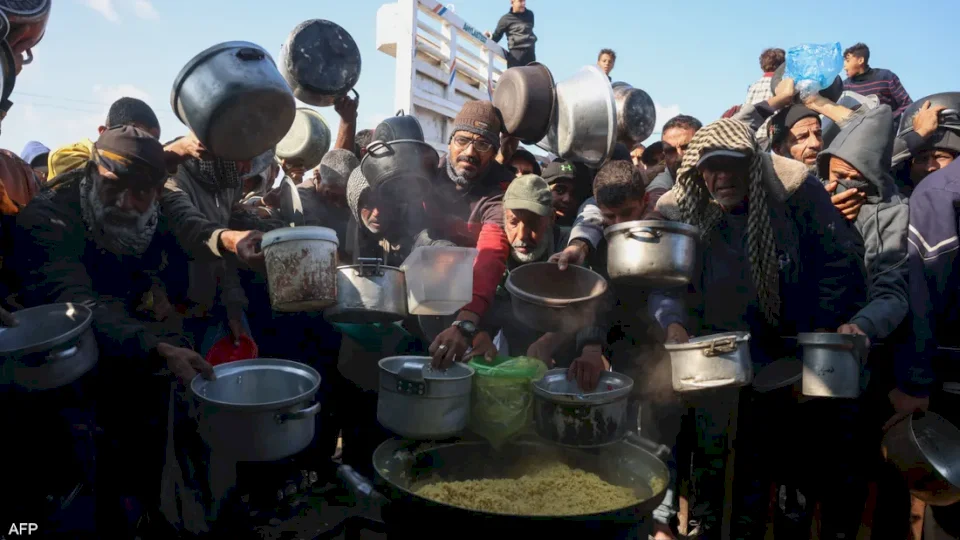
Global Hunger Observatory: There Is No Longer Famine in Gaza.. But the Situation Is Critical
SadaNews - The Integrated Food Security Phase Classification initiative reported on Friday that there is no longer famine in the Gaza Strip following improvements in the access to humanitarian and commercial food supplies after the fragile ceasefire was implemented on October 10 in the war between Israel and Hamas.
The latest assessment from the classification, which is a global observatory for monitoring hunger, comes four months after it announced that 514,000 people, nearly a quarter of the population in Gaza, were suffering from famine. It warned on Friday that the situation in the sector remains critical.
The Integrated Food Security Phase Classification stated in the report: "In the worst-case scenarios, which include a resurgence of hostilities and a halt of humanitarian and commercial flows, the entire Gaza Strip is at risk of famine until mid-April 2026. This confirms the acute and ongoing humanitarian crisis."
Israel controls all access points to Gaza. In August, the Coordinator of Government Activities in the Territories, an Israeli military agency responsible for coordinating aid, denied the existence of famine in Gaza. The agency claims that between 600 and 800 trucks enter Gaza daily since the ceasefire began in October, with 70 percent of these supplies being food. Hamas disputes these figures, stating that the number of trucks arriving in Gaza daily is much lower than 600.
Relief organizations have repeatedly emphasized the urgent need for significantly increased access to aid in Gaza, accusing Israel of preventing the entry of desperately needed supplies, which Israel denies.
No Famine, But Conditions Remain Catastrophic
The Integrated Food Security Phase Classification confirmed the occurrence of five famines in the past 15 years, one in Somalia in 2011, two in South Sudan in 2017 and 2020, another in Sudan in 2024, and a famine in Gaza in August.
A region is not classified as experiencing famine unless at least 20 percent of the population suffers from severe food insecurity, one in every three children suffers from acute malnutrition, and two out of every 10,000 people die daily due to hunger, malnutrition, or disease.
The Integrated Food Security Phase Classification noted that "there are no areas classified as under famine." It added, "The situation remains extremely fragile and relies on the regular continuation and expansion of humanitarian and commercial access."
Even if a region is not classified as experiencing famine due to the failure to meet these conditions, the Integrated Food Security Phase Classification can identify that families are experiencing catastrophic conditions, which it describes as acute food shortage, hunger, and a significant increase in the risk of acute malnutrition and death.
On Friday, the Integrated Food Security Phase Classification stated that more than 100,000 people in Gaza are experiencing catastrophic conditions but expected this number to decrease to about 1,900 by April 2026.
It added that the entire Gaza Strip is classified at an emergency stage, which is the one directly preceding the level of catastrophic conditions. The Integrated Food Security Phase Classification stated: "Over the next 12 months, approximately 101,000 children aged between six months and 59 months in the Gaza Strip are expected to suffer from acute malnutrition and need treatment, with over 31,000 cases being severe."
The report also noted: "During the same period, 37,000 pregnant and breastfeeding women will face acute malnutrition and will need treatment."
Signs of Improvement in Hunger Conditions
Antoine Renard, the World Food Programme's senior official in Gaza and the West Bank, stated that there are signs of improvement in the dire hunger situation in Gaza. He told reporters on Thursday that "most of the population eating two meals a day actually represents a clear sign that we are indeed witnessing some improvement."
However, he mentioned that there is a "persistent struggle" to gain broad and swift access to Gaza, noting that humanitarian and commercial trucks are facing congestion at border crossings.
The UN and relief organizations also warned on Wednesday that humanitarian operations in Gaza are at risk of collapse if Israel does not remove obstacles, including a "vague, arbitrary, and highly politicized" registration process.
 Follow the latest Sada News via Google News
Smotrich: Israel Has No Interest in Joining the War Against Iran

Occupation Issues Military Order to Seize 5 Dunams of Land in Jaba'

Axios: Proposal for a 10-day Ceasefire Between Washington and Tehran and Two Options for M...

In a Rapid Pace.. The Occupation Builds a Huge Earth Barrier Inside Gaza

Meeting Between Aoun and Trump Expected Alongside 'Experimental Areas'

Gaza Health Warns of Collapse of Oncology Services Due to Depletion of Treatments and Susp...

The Occupation Demolishes a House in the Town of Sa'ir near Hebron
