
Syria is Free from 'Caesar'
SadaNews - US President Donald Trump signed the National Defense Authorization Act for Fiscal Year 2026 (NDAA) on Thursday, worth approximately $900 billion, which includes an addendum to repeal the "Caesar sanctions" that have been imposed on Syria since 2019.
The US Congress, in both the House of Representatives and the Senate, approved the National Defense Authorization Act for Fiscal Year 2026, with the Senate backing the bill on Wednesday by a majority of 77 votes to 20, with strong support from both Republican and Democratic parties.
The law includes the termination of the broad sanctions imposed on Syria, in a step that lawmakers say aims to support the economic recovery of Damascus after more than a decade of war.
Repeal of Caesar sanctions on Syria
The law requires the President of the United States or his representative to submit a report to Congress every six months over the next four years to assess the performance of the Syrian government and its "tangible actions" concerning several issues, including the elimination of the threat posed by "terrorist groups".
The US Senate confirmed, on Wednesday, the annual defense policy bill which included an addendum stating the repeal of the "Caesar sanctions" imposed on Syria.
Trump and al-Shara meeting
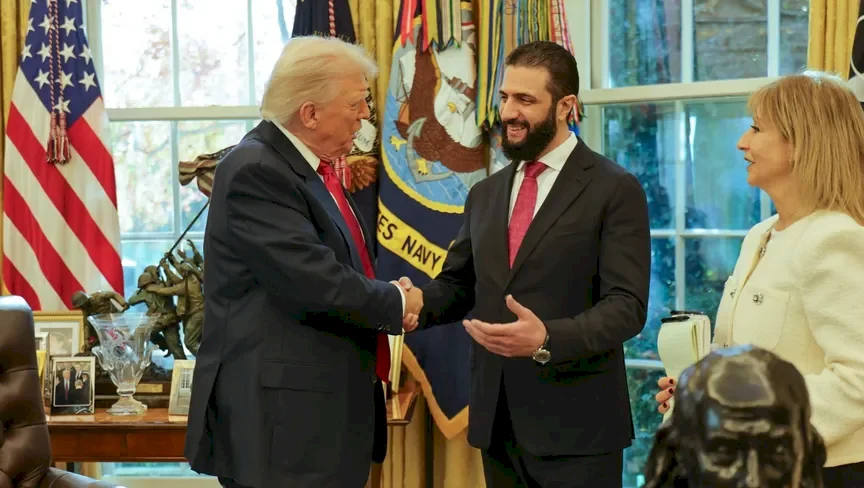
Full removal of US sanctions was among the primary objectives of Syrian President Ahmad al-Shara's visit to Washington last month when he met with Trump at the White House.
After holding a closed meeting with Trump, the US Treasury Department announced in November the extension of a suspension on sanctions under the "Caesar Act" for 180 days, but a complete lifting of these sanctions was contingent on Congressional approval.
Why were Caesar sanctions imposed?
In 2019, broad sanctions were imposed on Syria under the "Caesar Act" targeting individuals, companies, and institutions linked to former Syrian President Bashar al-Assad.
The "Caesar Act" is considered one of the strictest laws imposed on Damascus, prohibiting any state or entity from dealing with the Syrian government or financially or economically supporting it.
Syrian welcome for US decision
For his part, Syrian Foreign Minister Asaad al-Shibani expressed his country's appreciation and gratitude to the US Senate for its vote in favor of repealing the "Caesar Act" sanctions on Syria.
Al-Shibani added, via the "X" platform: "We consider this step a positive development that opens new horizons for cooperation and partnership between our country and the world."
Repeal of authorizations to use force against Iraq
The approval of the bill and its entry into force also means the repeal of the authorizations to use military force against Iraq for the years 1991 and 2002.
The Iraqi Foreign Ministry welcomed, on Wednesday, what it described as the "historic vote" by the US Congress, in both the House of Representatives and the Senate, in favor of repealing the authorizations to use military force against Iraq for the years 1991 and 2002.
The ministry stated in a statement: "This repeal is a crucial turning point in changing the legal nature of the relationship between the two countries, establishing a new form of relations based on respecting Iraq's sovereignty and ending the legacy of war, as well as enhancing the framework of strategic partnership, sending a message to the international community that Iraq has become a safe and attractive environment for investment."
The ministry confirmed that the repeal of the military force authorizations "does not undermine efforts to combat terrorism, as the military force authorization for 2001, related to combating terrorism issued after the events of September 11, to address the threats of al-Qaeda and other terrorist organizations linked to it, remains in force."
The ministry stated that the Government of Iraq is committed to enhancing bilateral relations to establish a long-term partnership that serves the interests of both countries and supports stability in the Middle East region.
The 2001 authorization related to the global war on terrorism will remain in effect under the new bill.
While the authorizations of 1991 and 2002 were rarely used and focused specifically on Iraq, the 2001 authorization granted President George W. Bush broad authority to launch the invasion of Afghanistan, permitting the use of force against "countries, organizations, or individuals" that planned or supported the September 11, 2001 attacks on the United States.
Since its adoption in September 2001, this authorization has been used in recent years to justify US military operations against groups such as al-Qaeda and its branches, including ISIS and al-Shabab.
Saudi support for lifting sanctions
The Saudi Foreign Ministry stated that it appreciates the steps taken by the Syrian government to restore stability to all areas of the country and to create the necessary conditions for rebuilding the state and its economy.
The Saudi Foreign Ministry added that the US decision to lift the sanctions imposed on Syria under the "Caesar Act" is a step that would support stability and development in the country.
The Saudi Foreign Ministry also praised the positive role played by Trump in lifting the sanctions imposed on Syria.
What does the repeal of Caesar sanctions mean for Syria's classification?
For his part, the Governor of the Central Bank of Syria, Abdul Qadir al-Hosry, indicated in a post on his personal Facebook page that the repeal of Caesar sanctions will open significant opportunities for the country, including obtaining a sovereign credit rating. He added that this repeal removes a fundamental legal barrier to Syria's reintegration into the international financial system.
He pointed out the possibility of seeking a non-public and consultative sovereign credit rating as a first step, then moving to a public rating when conditions permit, noting that Syria is likely to initially receive a low credit rating, which is considered normal for countries coming out of conflicts.
 Follow the latest Sada News via Google News
London Stock Exchange Enters the Era of 24/7 Trading

Shamaran Petroleum: Suspension of Oil Production in Duhok Fields in the Kurdistan Region o...

Dollar Steadies Near One-Week High Amid War Developments

Trump Imposes Tariffs on Canadian Imports... Ottawa Vows to Respond

Oil Prices Drop After Reports of Mediation Efforts Between the U.S. and Iran

Gold Price Rises Supported by Increased Buying Amid Lower Prices

Due to "Hazardous and Counterfeit Products".. Europe Fines "AliExpress" $627 Million
