

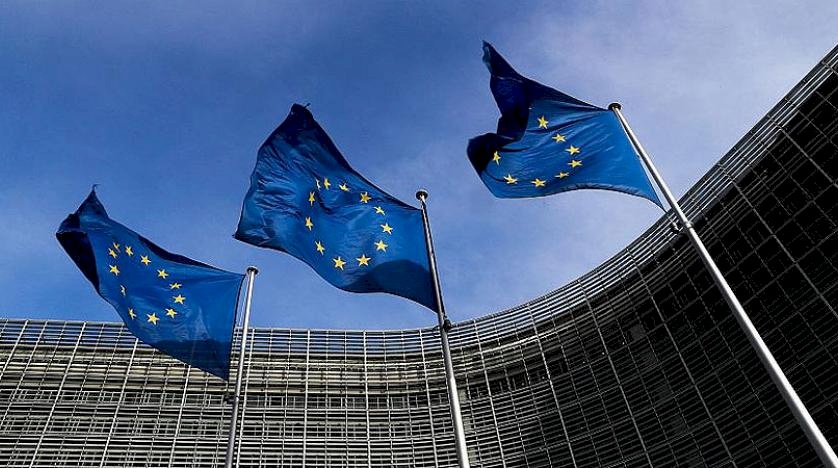
The European Union Enters a Crucial Week to Assert Its Strength Against Trump
SadaNews - The European Union faces a critical moment this week as it seeks to establish itself as an effective geopolitical power.
In the coming days, the European bloc has two pivotal deadlines ahead of it. The first is to finance Ukraine in its war against Russia without support from Washington, and the second is to prove its ability to diversify supply chains away from the United States, which has taken an increasingly hostile stance, and to expand its trade with South America.
Any failure in these two areas could deal a blow to the reputation of the European Union at a dangerous moment, granting U.S. President Donald Trump new material for his narrative claiming that the continent is "weak," according to diplomats and officials familiar with the bloc's thinking.
After a week in which NATO Secretary-General Mark Rutte warned that global wars have once again become a realistic possibility, many still fail to grasp the gravity of the moment, according to one official.
The Geopolitical Leadership of Europe at Stake
The issues of Ukraine and trade with South America represent a direct test of the European Union's ability to play a global leadership role.
With the Trump administration cutting off aid to Ukraine, the burden now falls on Europe to prevent Kyiv from accepting an imbalanced peace agreement or from being completely overrun by Russian forces. At the same time, the trade agreement has become a significant test of Europe’s ability to provide reliable alternatives to the United States and China.
The matter of financing Ukraine will reach its peak on Thursday, when EU leaders meet in Brussels to attempt to find a solution for a proposed massive loan for Kyiv. By Friday, the bloc needs to finalize work on the trade agreement, with a preliminary signing date set for Saturday. Any further delays in either matter could jeopardize the entire plan.
Is Trump Marginalizing Europe?
These developments come as Trump attacks the global order established after World War II that supported Europe for 80 years, effectively sidelining the EU.
In this context, China is ignoring European leaders and companies. Pressure is mounting on the bloc to prove that it is capable of being an active player in the emerging global order, and not just a bystander.
"If Europe wants to be a real geopolitical player, it must pair strong words with decisive actions," said Estonian Foreign Minister Margus Tsahkna. He added: "This is a moment of decision. Europe's credibility, security, and leadership are at stake."
Searching for Financing for Ukraine
The EU's preferred plan to support Ukraine involves using billions of frozen Russian assets on its territory.
The idea is to lend Ukraine €90 billion ($106 billion) from those funds over the next two years, enabling Kyiv to continue providing essential services and maintaining its army. Ukraine would only be required to repay this money if Russia pays for the damages it caused during the war.
However, these efforts face strong opposition from Belgium, where the majority of frozen assets reside, as the country fears being forced to repay the loan if Russia recovers those funds through judicial means. France does not oppose the use of frozen funds in Belgium but rejects the use of assets in its banks.
The United States is also quietly pressuring the EU not to touch these funds, arguing that they would be more effective as a bargaining chip in peace talks.
Confrontation Between Europe and Trump
This has resulted in a race against time within the EU to maintain what German advisor Friedrich Merz recently described as "the strongest bargaining chip currently in Europe's hands." One EU official stated that it is the bloc's responsibility to fulfill its promise to support Ukraine. Time is running out, and Ukrainian funds are expected to run out by April.
If the European Union does not reach an agreement this week, it will have to look for temporary solutions while reassessing its approach, according to people familiar with the discussions. This means more delays and more negotiations, playing into Trump's mocking narrative.
"Europe needs to find a solution for something unavoidable, which is the continued support for Ukraine," observed Portuguese Finance Minister Joaquim Miranda Sarmiento, noting that the requested amount represents only 0.5% of the EU's GDP. He added: "It’s a big number, but it’s still doable and absolutely necessary."
The MercoSUR Agreement
The trade agreement between the EU and the MercoSUR bloc, which includes Argentina, Bolivia, Brazil, Paraguay, and Uruguay, has taken on significant symbolic importance.
Alongside being the largest trade agreement ever signed by the EU, it will send a message to Trump, according to diplomats and officials who requested anonymity.
The U.S. president is currently working to reaffirm his country’s role in Latin America, recently claiming in his national security strategy that "the right to dominance in the Western Hemisphere" is his right. If Europe can sign the agreement just days after that and reduce trade barriers with South America, particularly at a time when Trump is threatening tariffs, it will remain relevant in the equation, according to officials.
Gabriel Mato, a member of the European Parliament and a Spanish center-right MP who led parliamentary work on the agreement, stated, "This is the right moment to demonstrate that we are capable, in front of our partners in MercoSUR and our agricultural sector, of opening the trade door without endangering our production."
Deepening Europe’s Ties with South America
The agreement will also bolster the EU's argument that it is capable of decoupling its economy from the United States and China by deepening its relationships with other democracies, a key focus of the bloc's plan to respond to Trump.
However, the atmosphere appears grim as the signing ceremony approaches on Saturday. France is pressuring for a postponement of the final agreement until at least January, fearing protests from its farmers. Some view this as an attempt to kill the agreement entirely.
A senior European diplomat opined that if the EU does not sign the agreement by the end of the year, it would indicate that Europe simply does not want to establish stronger relations with South America, which would negatively affect global confidence in the bloc.
The European Test
Trump's national security strategy blames EU policies for driving the continent towards "civilizational obliteration" and even threatens to fuel "resistance" within Europe, questioning whether European nations still deserve to be considered reliable allies in NATO.
These attacks mark another nail in the coffin of the Western alliance that has lasted for decades. Merz stated last week, "What we used to call the values-based West no longer exists in that form."
Instead, a new world emerges where great powers, such as America and China, impose the rules. The European Union is trying to prove that it is capable of charting its own path.
The upcoming decisions regarding Ukraine and the trade agreement will determine whether Europe can do that, according to one official, or if it will mark the beginning of a systematic decline.
 Follow the latest Sada News via Google News
The World Bank Warns: "The Worst-Case Scenario" for Global Growth is Approaching

Trump Prepares to Impose New Tariffs on Dozens of Economies

Gold Surpasses $4,100 as Selling Pressure Eases

Oil Rises for the Fourth Day as Supply Risks Escalate

An Additional $8 Billion.. A New Account from the Pentagon on the Cost of the War with Ira...

London Stock Exchange Enters the Era of 24/7 Trading

Shamaran Petroleum: Suspension of Oil Production in Duhok Fields in the Kurdistan Region o...
