

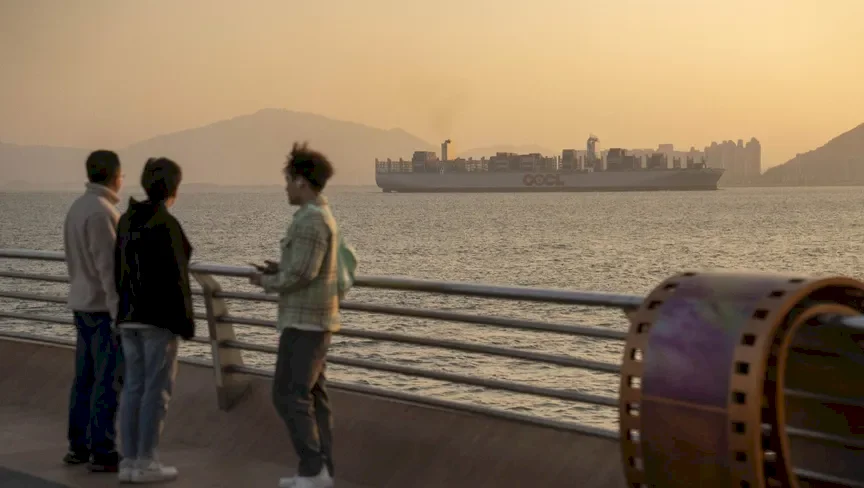
Asian Container Shipping Companies Experience Shift in Operations Amid Iran War
SadaNews - The profits of container shipping companies in China and Taiwan reflect how the sector is coping with global disruptions, as the war on Iran undermines hopes for reopening the Red Sea and pushes shipping prices up, providing a welcome relief after a year of declining profits.
Both "Orient Overseas International" from China and "Evergreen Marine" from Taiwan reported sharp declines in profits, as the prospect of reopening the shipping route through the Red Sea before the war exacerbated the oversupply that kept prices low throughout most of last year. Additionally, smaller Taiwanese shipping companies "Yang Ming Marine Transport" and "Wan Hai Lines" also experienced profit declines.
Potential Shift in Market Direction
It now seems that momentum is shifting despite ongoing uncertainties. While container shipping companies have much lower exposure to the Strait of Hormuz compared to oil tankers, the escalation of the war has effectively eliminated hopes for a complete reopening of the Red Sea this year, although expectations remain challenging.
Analysts at "Goldman Sachs," including Herbert Luo, wrote in a note: "The closure of the Strait of Hormuz could disrupt container shipping routes and lead to port congestion at alternative ports, which may create upward risks for shipping prices. "
Global shipping prices rose by 8.4% to $2,123 for a 40-foot container in the week ending March 12, marking the second consecutive week of increases after nearly two months of decline, according to the "Drewry" global container shipping index.
Dubai Stores Well-stocked Despite War and Food Shipment Delays
For their part, analysts at "Citi Group," led by Kasidit Chunnawat, wrote in a note that "Asian shipping companies may see a gradual improvement in spot prices by mid-year," assuming a reduction in the intensity of the conflict following the achievement of U.S. and Israeli military goals, and a return to normal energy costs.
"Orient Overseas" stated that "the pace of geopolitical developments is increasing, and with the potential for any single event to have immediate effects and widespread repercussions, it is becoming increasingly difficult to accurately predict market trends."
Risks of Disruption in Supply Chains
War disruptions are confusing global supply chains, forcing shipping companies to deal with challenges including transit stoppages and rising fuel costs.
"Yang Ming" stated that "complex re-shipping arrangements have increased operational challenges," referring to declining capacity on Middle Eastern routes. They added that this imposes "additional pressures on port operations and increases the risk of terminal congestion, along with rising insurance premiums and fuel costs."
"COSCO Shipping Holdings," the largest shipping company in China, and "Evergreen Marine" are among the Asian companies that suspended Middle Eastern bookings, joining global competitors such as "A.P. Moller-Maersk," "Hapag-Lloyd," and "CMA CGM." "COSCO Shipping" is scheduled to announce its annual results on March 19.
Nonetheless, these companies may have an advantage compared to their European competitors, according to "Bloomberg Intelligence" analyst Kenneth Luo, thanks to "cost leadership and strong expansion," while European competitors focus on schedule reliability and offering premium services.
Luo stated: "So far, it seems that the strategies of Chinese and Taiwanese shipping companies are serving them well, boosting their outlook for 2026 compared to their global peers."
Limited Impact but Potential to Worsen
Shipping companies with a larger presence in Asian trade, particularly on China-dominated lanes, can benefit from the resilience of Chinese exports in recent months, according to Luo.
Chinese exports rose at a faster-than-expected pace during the first two months of the year, prior to the U.S. and Israeli strikes on Iran, which also support shipping prices and boost margins.
Judah Levin, head of research at the shipping booking platform "Freightos Group," noted that despite the suspension of bookings in the Middle East, the impact has not yet reached the level of the initial Red Sea crisis.
Levin added that from a container shipping perspective, only about 3% of global volumes pass through the Strait of Hormuz.
However, this limited exposure could turn into headwinds if the conflict drags on, according to Lee A. Klaskov of "Bloomberg Intelligence," who stated: "If the strait remains closed for more than three months, the rise in energy prices will be inflationary and detrimental to demand."
 Follow the latest Sada News via Google News
Strait of Hormuz Approaches Maritime Paralysis After American and Iranian Strikes

Oil Prices Surge as US Airstrikes on Iran Renew

Gold Holds Steady Near $4080 Amid Middle East Escalation

The IMF Forecasts a Contraction in the Middle Eastern Economy This Year and a Faster Recov...

6000 Sailors Still Stranded in the Gulf

Floating Iranian Oil Faces Uncertain Fate After U.S. Exemption Cancellation

Brent Surpasses $76 After U.S. Strikes on Iran