

$80 Billion Expected Economic Impact of the 2026 World Cup
SadaNews - The expected economic impact of the 2026 World Cup in the United States, Canada, and Mexico is projected to reach $80.1 billion, according to a study released by FIFA and the World Trade Organization, highlighting the social and economic effects of the tournament scheduled to take place from June 11 to July 19, 2026.
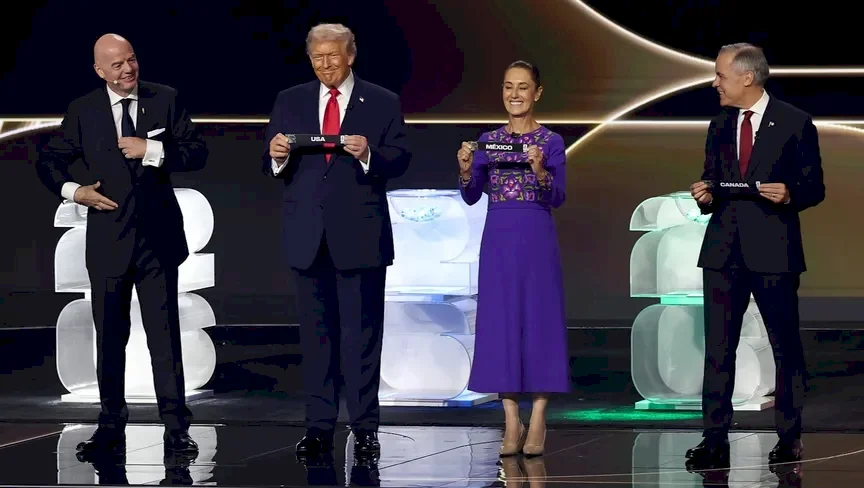
The Kennedy Center hosted the draw for the 2026 World Cup on Friday, attended by U.S. President Donald Trump - who received the inaugural "FIFA Peace" Award - Canada's Prime Minister Mark Carney, Mexico's President Claudia Sheinbaum, and representatives from the participating countries.
The Kennedy Center will receive approximately $7.4 million from FIFA for hosting the draw, as reported by the Associated Press citing Roma Daravi, Vice President of Public Relations at the center, which will donate $2.4 million along with sponsorship opportunities worth $5 million.
$80 Billion Economic Impact
According to the study, the economic output of this largest World Cup edition featuring 48 teams is estimated at about $80.1 billion, distributed as $30.5 billion for the United States and $49.6 billion for the rest of the world. Direct and indirect financial gains from associated event expenditures and tourism will contribute to this total.
The tournament could help increase GDP by approximately $40.9 billion, including $17.2 billion for the United States, generating $9.4 billion in direct and indirect government revenues, and providing $8.28 billion in social benefits.
It is expected that the tournament will create around 824,000 full-time jobs worldwide, with the total net wages for employees reaching $20.8 billion, slightly less than half of which will be in the United States. Estimates suggest that around 6.5 million people will attend the matches in the three host countries.
$14 Billion in Expenses
The total expenses for the 2026 World Cup are estimated at approximately $13.9 billion, which includes capital investments, host city costs, FIFA investments, and anticipated tourist expenditures for the first World Cup featuring 48 teams across three countries.
FIFA has allocated $3.9 billion in investments, over $1.5 billion of which is for operations, and $900 million for prize money, while the remaining funds will be distributed across broadcasting, team services, administrative costs, and marketing.
U.S. expenses are about $11.1 billion, including $2.9 billion from FIFA costs and $6.4 billion from expected tourism spending, which is estimated to total around $7.5 billion.
Record Arab Participation in the World Cup
The tournament will feature a record participation of Arab teams with 7 teams, including Qatar, which will compete in Group B alongside Canada, Switzerland, and a European team qualifying through the playoffs from among (Italy, Northern Ireland, Wales, Bosnia and Herzegovina).
The Moroccan team - fourth in the last edition in Qatar - will compete in Group C, with Brazil, Haiti, and Scotland.
The Tunisian team is in Group F alongside the Netherlands and Japan, waiting for a European team to qualify through the playoffs from among (Ukraine, Sweden, Poland, Albania).
As for the Egyptian team, they were drawn into Group G to compete with Belgium, Iran, and New Zealand.
The Saudi team will be in Group H, competing against Spain, Uruguay, and Cape Verde. Group J will see an Arab derby between Algeria and Jordan, with Argentina, the defending champion, and Austria.
Arab participation might increase, with Iraq's team entering the global playoff in March; if they qualify, they will be in Group I with France, Norway, and Senegal.
Source: Al Sharq
 Follow the latest Sada News via Google News
London Stock Exchange Enters the Era of 24/7 Trading

Shamaran Petroleum: Suspension of Oil Production in Duhok Fields in the Kurdistan Region o...

Dollar Steadies Near One-Week High Amid War Developments

Trump Imposes Tariffs on Canadian Imports... Ottawa Vows to Respond

Oil Prices Drop After Reports of Mediation Efforts Between the U.S. and Iran

Gold Price Rises Supported by Increased Buying Amid Lower Prices

Due to "Hazardous and Counterfeit Products".. Europe Fines "AliExpress" $627 Million
