

Palestinian Students in Israeli Universities under the Banner of Interrogation and Persecution
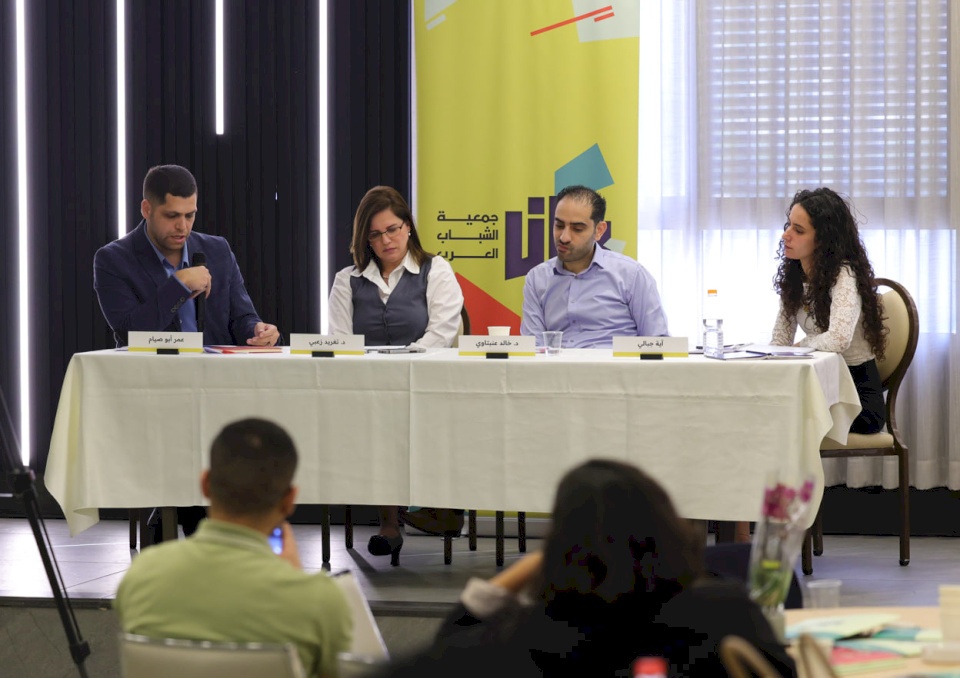
SadaNews: The Arab Youth Association - Beladna held a conference on Friday, November 28, 2025, in the Al-Awda Hall in Shfa’amr to announce the results of a new comprehensive study about the experience of Palestinian students in Israeli universities during the genocide war, with the participation of journalists, academics, students, and activists from various universities.
The student Maryam Abu Qweider opened the conference with a welcoming speech that began with a peace greeting and then shared her story with student activism, followed by a speech by the director of the association, Nada Nassar, who emphasized that the study comes at a sensitive moment where political and academic realms intertwine and that producing accurate knowledge regarding the reality of Palestinian students is a fundamental step in enhancing their rights and freedoms. Nassar stressed the importance of continuing to work for the empowerment of the student category by building resilience and protective structures for Palestinian students, describing it as a major and fundamental political task. She indicated that the Beladna Association is working with the Palestinian university student sector through various projects, describing them as "important and sensitive, especially in this pivotal phase that the Palestinian Arab society inside is experiencing."
Nassar also affirmed that university students are the jewel in the crown of Arab society, and their marginalization means crushing the leadership and critical spirit together, which is something that must be dealt with at the highest levels of seriousness.
With the presence of politicians, educators, and prominent figures in the student community, dozens of university students and activists from the Negev, the Triangle, and Galilee participated in the conference, including Sami Abu Shehada, the head of the Democratic National Assembly Party, who stressed the need to build and empower student organizations, pointing to its importance in forming an active political leadership for the Arab community.
Conference Sessions: Testimonials, Analysis, and Future Advocacy
The conference sessions were distributed over two main axes, managed by journalists Omar Abu Sayam and Wael Awad, who supervised facilitating the sessions that included specialists commenting on the research results, and university students who participated in its implementation, alongside prominent figures in the student movement, including Youssef Taha, who is responsible for the student and youth file in the Democratic National Assembly Party.
The first session addressed the most significant results of the research, managed by journalist Omar Abu Sayam, in which the main researcher Khaled Anabtaawi participated, who confirmed the preparation of students to participate in student organizations, pointing to the existence of "severe fear" about participating in political demonstrations. The research showed that 35% of the students reported they might participate in a political protest. Also participating in the dialogue was researcher in social science Taghreed Zubeidi, who emphasized the necessity of engaging Arab attendees in Israeli universities in the discussion around students' rights, indicating their limited ability to mobilize for Arab students' benefit.
Engineer Aida Jibali, part of the research preparation, talked about her personal experience as a student, indicating the sense of fear and insecurity that clearly emerged in student interviews, which mirrors the reality she lived during her university experience.
As for the second session, it was dedicated to the field experience of students, managed by journalist Wael Awad, who discussed the details of the first phase of the war, where Arab students were subjected to a background of publications on social media. The director of the projects at the Committee for Equality, Diversity, and Social Affairs in Beirut and Tadr, pointed out that through her work in the student dean's office, she encountered many trends related to incitement targeting Arab students. Meanwhile, lawyer Laben Tuma from the Justice legal center commented on this, stating that the university committees extracted the concept of incitement from the legal criminal context and used it against students in an unacceptable manner. Discussions also revolved around analyzing the official decisions taken by the universities during the war and the role of administrative organizations in reinforcing an atmosphere of fear within the university campus.
And Taha pointed to the pressing need for establishing a representative body for Arab students in universities, and working on developing a successful student organization, alongside establishing a national student work base.
Remarkable Findings of the Study
The researcher Dr. Khaled Anabtaawi presented a comprehensive review of the study results, which are considered among the broadest studies of their kind, as it relied on a large research sample including 437 students, in addition to in-depth interviews, and focal groups. The research employed both quantitative and qualitative tools simultaneously, enhancing its comprehensiveness and credibility.
Dr. Anabtaawi emphasized that the study results are alarming but reflect real crises that Palestinian students face, stressing that these results cannot be separated from the political context and the complex reality experienced by the Palestinian community in the homeland.
The study revealed that the university experience for Palestinian students has entered an unprecedented phase of tension; 68% of university students described it as an unsafe space for expressing their political identity, while 83% of them stated they feel academic pride in the institution, without accompanying that any sense of political belonging to it. About 45% of the students reported they have experienced direct feelings of fear during the past year.
The results indicate that the relationship of Arab students with the academic institution is complex; it combines educational aspirations and the desire to integrate into university life, and the constant feeling of persecution and political and social pressure.
Clear Recommendations and a Roadmap for Protection
In summarizing the research, Dr. Khaled Anabtaawi recommended taking immediate measures to protect Palestinian students within universities, the most prominent of which is restoring the university to its natural role as a safe space for expression, instead of transforming it into a regulatory apparatus, and establishing clear support organizations that include units for psychological and emotional support, and ongoing legal accompaniment, and a hot line during crises.
He called for enhancing the independent Arab student organization through electing representative committees, and expanding the work of the collaborative body for student blocs, alongside an active role for civil society in documentation, providing legal protection, and developing platforms to monitor violations.
The recommendations stressed the necessity of creating secure spaces for expressing Palestinian identity within university campuses, and constructing transparent university policies that distinguish clearly between freedom of expression and persecution, thus reinstating to students a sense of security and the ability to act within a space that poses an increasing danger to political engagement, which is something that cannot be accepted.
A Conference Rich in Testimonials and Exclusive Materials
The conference included presenting exclusive research materials and live testimonials reflecting the experiences of students during the past months. The study showed that the university experience for Palestinian students is not limited to the educational dimension, but intertwines with surveillance, fear, and managing emotions within a charged political space.
The research illustrated how fear has become a permanent component in students' daily lives; not fear of academic failure but of the political interpretation of every word. One student said in the interviews:
"I felt that the academic question was innocent... but my answer to it can involve me."
The study also identified the phenomenon of "strategic silence," where many students chose to remain silent to avoid persecution or discrimination, even though the university is supposed to be a free space for expression. One participant stated:
"I learned to walk between the words... I only say what is necessary, and keep the rest silent."
The sessions witnessed interventions from academics, students, and activists shedding light on the future of Arab students in universities, and the importance of continuous advocacy for protecting academic freedoms.
In conclusion of the conference, the Beladna Association confirmed that this research will serve as a knowledge base for developing supportive policies for students and enhancing human rights monitoring within academic institutions.
About the Beladna Association
The Arab Youth Association – Beladna is a civil society organization established in 2001, working on empowering Palestinian youth in the homeland and enhancing their social and legal presence through educational and community programs, and research addressing the issues of students and youth. The association seeks to conduct periodic studies that monitor the issues of the young generation and develop intervention programs based on the results of these studies. Previous studies can be found on the association's website.
The association will soon publish the full report of the study, in addition to audiovisual and digital materials, through its official website and its digital platforms.
 Follow the latest Sada News via Google News
Washington Investigates Possible Russian Role in Iranian Attacks on Its Sites

Mossad Chief Visited Washington to Discuss Iran and Its Nuclear Program

Report: Washington Informed Israel It Is Preparing to Intensify Attacks on Iran and Use St...

Organization of Islamic Cooperation Condemns Nauru's Decision to Open an Embassy in Occupi...

Video:: Nablus: Settlers Evict Tubasi Family from Their Home in Jaloud and Take Over It

Netanyahu: I Intend to Form a Broad National Unity Government

Syrian Foreign Minister Meets with Yasser Abbas in Damascus
