

Mas Institute Reviews Results of Three Policy Papers on Recovery and Reconstruction Priorities in the Gaza Strip
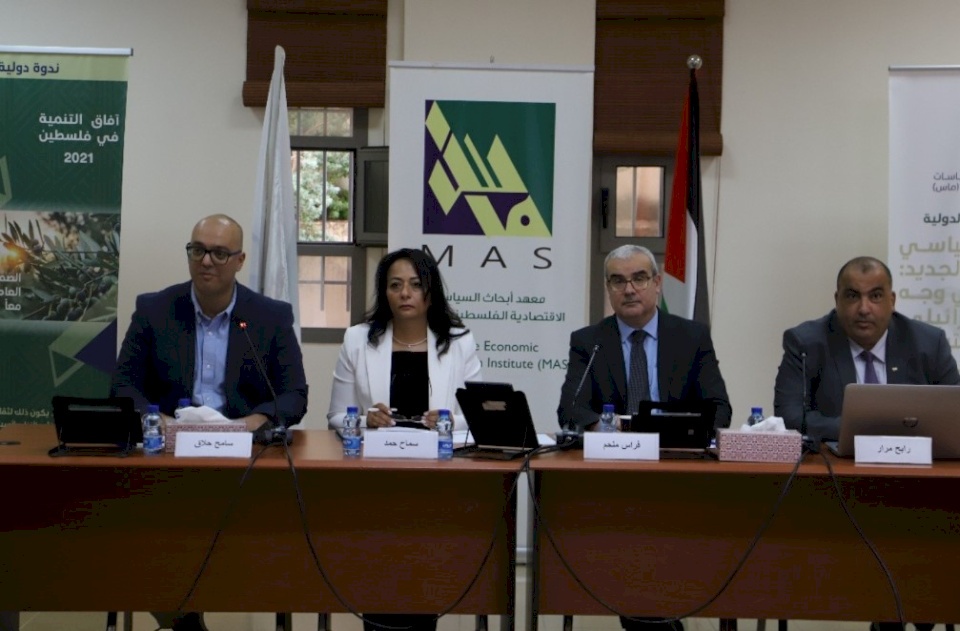
SadaNews - The Palestinian Economic Policy Research Institute (MAS) held a workshop to present and discuss the results of three policy papers, both in-person at the institute's headquarters and via Zoom. The meeting included Dr. Sumah Hamad, Minister of Social Development, Dr. Fares Malhem, General Director of the institute, Dr. Rabah Marar, Chairman of the National Authority for Vocational and Technical Education and Training and author of the papers, Engineer Wissam Nakhleh, General Director of Buildings at the Ministry of Education and Higher Education, and Dr. Samia Al-Batmah, an economics professor at Birzeit University, alongside a select group of specialists, experts, and interested parties. The meeting was moderated by Dr. Samah Hallak, who thanked the Arab Fund for Economic and Social Development for its support in executing these papers.
At the beginning of the meeting, the General Director of MAS welcomed the participants and highlighted the Palestinian government's interest in the Gaza Strip and reconstruction efforts, emphasizing its commitment to addressing the challenges and needs associated with this phase. He also noted the institute's interest in this file and its role in contributing to discussions and research efforts related to reconstruction and recovery.
While presenting the papers, researcher Marar indicated that the first paper addresses "Enhancing Access to Essential Social Services (Health and Education) for Palestinian Families in the Gaza Strip After the October 2023 War." He explained that the paper reviews the scale of challenges facing the health and education systems, and the implications of the collapse of essential services on the most vulnerable groups, particularly children, women, the elderly, and persons with disabilities. The paper calls for adopting a set of policies and urgent interventions to enhance access to essential social services. In the education sector, there is a clear need to develop emergency education programs, establish temporary schools, and provide psychological and social support for students and teachers. Regarding health, the paper emphasizes the importance of establishing field hospitals, enhancing primary healthcare services, and ensuring the availability of essential medicines and medical supplies. It also stresses the necessity of strengthening the role of the international community and humanitarian organizations in supporting reconstruction efforts, improving food security, and providing social protection networks for the most affected groups.
The second paper dealt with the topic of "Enhancing Access to Vital Infrastructure Services (Housing and Shelter, Electricity, Water) for Palestinian Families in Gaza After the October 2023 War." This paper sheds light on the significant challenges facing Palestinian families resulting from the destruction of housing units, the ongoing displacement crisis, and the near-total collapse of energy and water services, with extensive humanitarian, health, and economic repercussions. Marar explained that the paper presents a set of policies and interventions aimed at addressing the humanitarian crisis and enhancing access to essential infrastructure services. These interventions include developing emergency housing and reconstruction programs, expanding the use of renewable energy sources, particularly solar energy, to provide electricity, as well as implementing urgent programs to repair water and sewage networks and to improve water resource management. The paper also emphasizes the importance of collaboration between the Palestinian government, the international community, the private sector, and the local community to ensure an effective and sustainable humanitarian response, contributing to rebuilding infrastructure and enhancing the resilience of the Gaza community in the post-war phase.
The third paper addressed "Enhancing Food Security for Palestinian Families in the Gaza Strip: Challenges and Responses in the Post-October 2023 War Phase," relying on a comprehensive analytical approach to food security based on its four dimensions: food availability, physical and economic access to food, utilization for nutritional value, and the stability of these dimensions over time. The paper reveals that food insecurity in Gaza has evolved into a structural crisis linked to restrictions on the movement of food and supply chains, pushing families to adopt coercive coping strategies for survival. It also presents a roadmap for policies to enhance food security in the Gaza Strip, based on three integrated phases: urgent humanitarian response to prevent the exacerbation of famine, rehabilitating the agricultural sector and food value chains, and building a more resilient and sustainable food system. The paper asserts that achieving food security in the Gaza Strip requires, in addition to humanitarian and developmental interventions, the removal of restrictions on food movement and production inputs, and reintegrating the Gaza economy into its Palestinian and regional context to ensure fair and sustainable access to food and to enhance the community's ability to recover and remain resilient.
For her part, Minister of Social Development Dr. Sumah Hamad thanked the MAS institute for hosting and providing the opportunity to present this intervention, emphasizing that any efforts for reconstruction cannot begin without ending the ongoing humanitarian disaster in the Gaza Strip and addressing the urgent humanitarian needs of the population. She pointed to the importance of rebuilding institutional structures in the Gaza Strip and ensuring the restoration of essential services, explaining that the Palestinian government is implementing daily efforts within plans and programs aimed at responding to existing challenges. However, the continued bombardment and destruction, along with a systematic targeting of the remaining homes, increases the humanitarian and developmental needs.
The Minister indicated that food prices in the Gaza Strip have reached the highest levels in the Middle East, reflecting the magnitude of the living crisis and the economic pressures faced by the population. She affirmed that the Palestinian government has prepared detailed plans based on interconnected and comprehensive programs and projects, calling for all organizations and institutions working in the field to unify efforts and work within a single framework that combines the humanitarian and developmental tracks to ensure a more effective and sustainable response to the increasing needs. In the context of social protection, the minister stressed the importance of providing job opportunities as a tool to alleviate the pressures on social development programs.
Engineer Wissam Nakhleh pointed out that the education sector is one of the most affected sectors in the Gaza Strip, explaining that about 40% of educational buildings were operating on a double shift system before the war, reflecting the growing need for educational spaces at present. She added that many schoolyards and facilities have been converted into shelters for tents, which has affected their ability to provide educational services. Currently, there are about 750 educational points in the Gaza Strip to meet part of the increasing educational needs.
Dr. Samia Al-Batmah affirmed that what is happening in the Gaza Strip represents an exceptional case that cannot be easily compared to other experiences, noting that the proposed solutions often assume a gradual return to normalcy, while the reality on the ground is different due to the ongoing destruction. She highlighted the persistent food insecurity, questioning the available coping mechanisms under the current circumstances, and addressed the challenges of rehabilitating agricultural lands, pointing to the extent of destruction and the complexities associated with dismantling damage and addressing soil pollution, emphasizing that returning to agricultural production requires addressing these issues and learning from the experiences of other countries.
Regarding humanitarian assistance, she stressed the importance of highlighting the role of Israeli restrictions on the entry of aid, and raised questions about the possibility of using hydroponic farming techniques in the Gaza Strip, given the need to address challenges related to water availability, including sea water desalination.
 Follow the latest Sada News via Google News
Soaring Oil Prices Burn the Pockets of the Palestinian Citizen "The Poor"

Millions of Dollars in Losses.. "SadaNews" Reveals Shocking Figures for Traders from Pales...

The Problem of Shekel Overcrowding Worsens.. Fuel Station Owners Threatened with Closure o...

The Palestinian Economy at a Crossroads: 4 Files Awaiting Resolution

Mas Institute Reviews Results of Three Policy Papers on Recovery and Reconstruction Priori...

Warning Regarding Unlicensed Investment Companies and Promises of High Returns Issued by t...

Moody's Keeps Israel's Credit Rating Unchanged
