

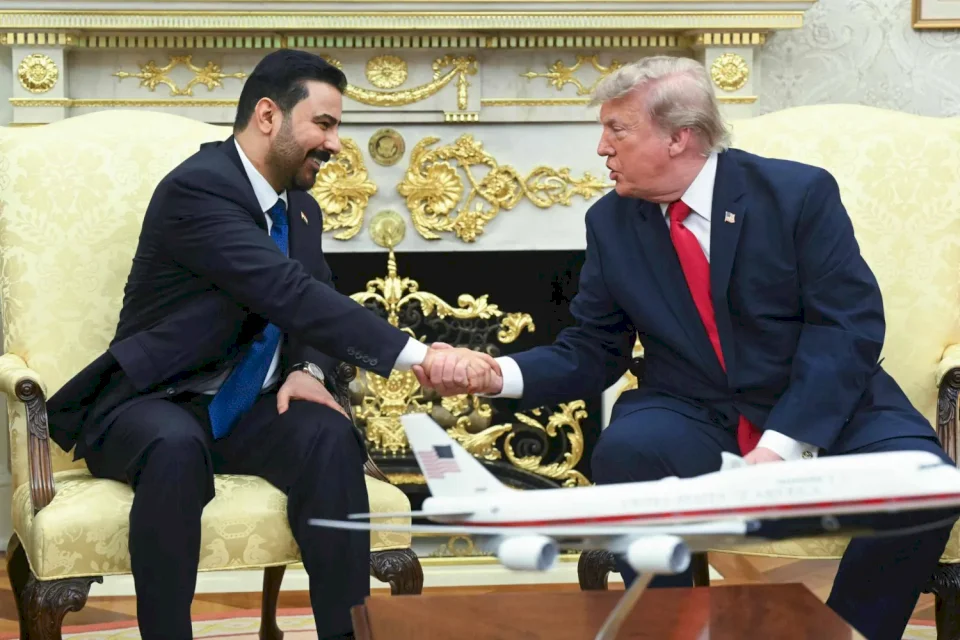
Trump: No Need for American Military Presence in Iraq
SadaNews - On Tuesday, U.S. President Donald Trump praised the performance of Iraqi Prime Minister Ali Al-Zaydi, describing him as a "great fighter and a great friend of the United States," emphasizing that Iraq possesses "huge oil wealth," and that the new government has achieved "significant change in a short period, particularly in its view towards the United States."
During Al-Zaydi's visit to the Oval Office, Trump stated that he would become "one of the most important leaders in the Middle East," and invited him to lunch, which was not on the visit's agenda.
Trump revealed a U.S. approach to establishing a long-term relationship with Baghdad based on investment and energy rather than military forces, stressing that the U.S. would be ready to support Iraq if it needed protection, but he added that he did not believe that would be necessary.
During the meeting, Trump confirmed the imminent announcement of major U.S. oil partnerships with Iraq, stating that American energy companies have begun to enter the Iraqi market "at unprecedented levels," and that the anticipated agreements would be the largest between the two countries, noting that they represent the core of the new relationship between Washington and Baghdad.
Trump said: "We do not think we need a military presence there anymore. American oil companies are entering the Iraqi market and establishing extensive partnerships, and this relationship does not require a military presence."
Message to Iran
Trump linked this shift to what he described as the decline of Iranian influence, stating that Iran had been playing the role of a "bully in the region," and that Iraq was one of the most affected by this influence. He said, "We are getting rid of this bully in the Middle East. Iran has been bullying Iraq and every other country, and there was fear prevailing in the Middle East, but there is no more fear now; their military capabilities have been completely destroyed."
Trump viewed this development as giving Iraq greater space to regain its sovereign decision and encouraged American companies to invest there.
For his part, Iraqi Prime Minister Ali Al-Zaydi emphasized that his visit is not limited to security files but represents an announcement of a new economic partnership between the two countries. He said that Iraq looks forward to the end of the coalition forces' mission on September 30 as the beginning of a new phase in its relationship with the United States.
He told reporters: "On the thirtieth of September, U.S. forces will leave Iraq, while American companies will remain there," stressing that economic and social relationships are more sustainable and important than military ones.
In response to reporters' questions about whether he was considering withdrawing from the OPEC organization, the Iraqi Prime Minister stated that Iraq needs a fair production share within the Organization of the Petroleum Exporting Countries (OPEC).
Weapon Control
The issue of armed factions occupied a significant space in the Iraqi Prime Minister's statements, who confirmed that his government is moving forward with its program to restrict weapons to the state. He stated that the government has already started to receive weapons from a number of factions, explaining that the groups that handed over their weapons have shifted to political and civil work.
He added that the presence of armed factions was "a temporary necessity, not a permanent profession," stressing that there is no longer any justification for their existence after September 30. He affirmed that Iraqi security forces will be able to secure the borders after the completion of the coalition forces' mission, and that the Iraqi decision "has returned to be in the hands of Iraqis alone," in a message aimed at reassuring Washington that Baghdad is capable of assuming security responsibility after the U.S. withdrawal.
Economic Partnership
The meeting reflected a clear shift in the priorities of the U.S.-Iraqi relationship, as the discussion is no longer focused on the number of U.S. troops or military operations against ISIS, but rather on investments, energy, and economic reform.
The Trump administration views Iraq as one of the most promising markets for American companies, particularly in the fields of oil, gas, electricity, and digital economy, while Baghdad sees attracting American investments as a fundamental pillar to revitalize the economy and reduce dependence on oil alone.
Analysts pointed out that the Trump administration is seeking to redefine its relationship with Iraq within a broader vision of reorganizing the U.S. presence in the Middle East, based on reducing direct military deployment in favor of enhancing economic and investment influence. In turn, the Iraqi Prime Minister is trying to leverage this moment to convince Washington that Baghdad has become a partner capable of enforcing state sovereignty, attracting investments, and maintaining the balance of its regional relationships, while reducing the influence of Iran-backed armed groups.
 Follow the latest Sada News via Google News
Report: Trump Asked Netanyahu to Withdraw Troops from Syria and Lebanon

Trump: No Need for American Military Presence in Iraq

The Organization of Islamic Cooperation Welcomes Achievements in the Palestinian Reform Pl...

India Participates in the Second Ministerial Meeting of the Donor Group for Palestine

What Do Syrians Expect from the New People's Assembly?

Water and Food Shortages Threaten Displaced People in Southern Lebanon

Between De-escalation and Bab el-Mandeb.. How Does Tehran View the Escalation in Yemen?
