

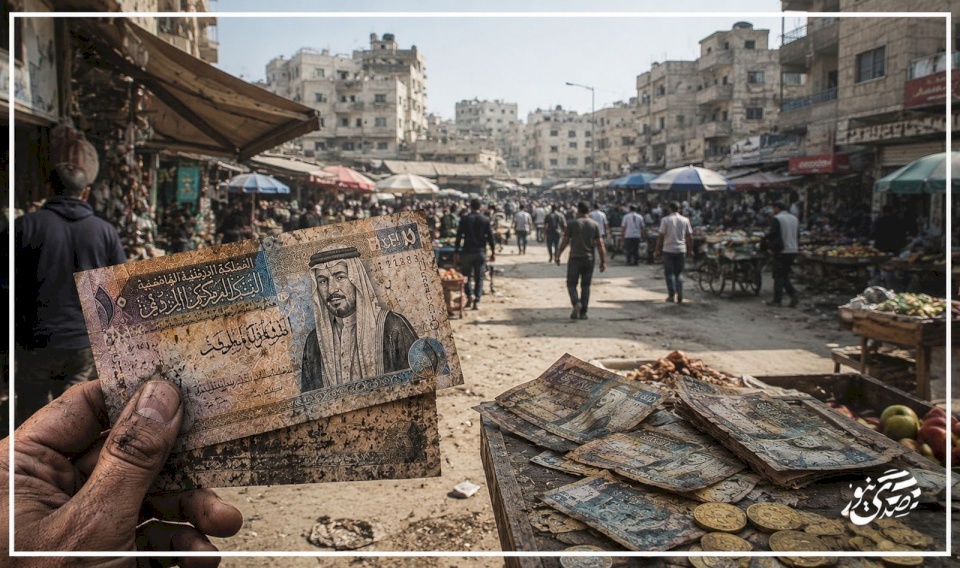
The Jordanian Dinar in Gaza: Surplus Due to the Reality of War
Exclusive to "SadaNews": "As a result of the circumstances in Gaza, citizens have turned to using the shekel as well as electronic payment for dowries, gold, and university fees," says activist Mohammed Al-Buheiri on his Facebook page, commenting on the decline in demand for the Jordanian dinar in Gaza.
Citizens confirm to "SadaNews" that there is a significant reluctance to use the Jordanian dinar after more than two and a half years of the genocide war, unlike the situation before the war when the dinar was used in some sectors, but circumstances have changed due to the imposed realities.
Citizen Shawqi Abu Shanab says, "Even the university refuses to accept the paper dinar for issuing certificates."
Economic policy expert Dr. Amin Abu Aisha tells "SadaNews": "Most of the paper currencies circulating in Gaza are damaged because the Israeli side has not allowed the entry of cash since the war began, especially in the form of shekels into Gaza," pointing out that most merchants and institutions refuse to deal in paper dinars and prefer to use apps through electronic payment tools.
He adds, "The dinar available in Gaza is mostly in a deteriorated state, due to the absence of currency exchange operations for three years, thus when it is traded in the market, its exchange rate is much lower than the screen price (due to the absence of cash payment transactions for university students, the lack of pilgrimages for Hajj and Umrah, and real estate purchases)."
He clarifies that the dinar is not sought after for its own sake but for settling and purchasing a number of goods and services, similar to any currency, as it currently exchanges between 3.50 to 3.70 if the paper currency is new," indicating that the lack of trust in the currency stems from a decrease in a number of mentioned dinar transactions and damage to some dinar units, resulting in (a demand deficiency and a surplus in supply, the result being a decrease in its exchange rate against the shekel in the Gaza exchange market).
He notes that for some transactions such as dowries, some people accept payments via electronic payment in dinars, because their bank price is the same as the screen price, emphasizing that electronic payment operations in Gaza generally overshadow cash payment operations.
He points out that even retailers prefer to carry out commercial transactions through electronic payment tools, noting that all individuals and merchants currently in Gaza have bank accounts or electronic wallets to make payments in buying or selling situations.
He adds, "The dinar in Gaza is not a primary currency and was used for specific purposes such as paying for real estate, land, dowries, or university fees, and paying for Hajj and Umrah fees as well as commercial rents," noting that transactions for purchasing properties and land and paying for Hajj fees are currently halted due to war conditions, while families prefer to pay dowries using electronic payment tools, as well as universities and landlords who prefer payments either in shekels or dollars since most categories have bank accounts in these two currencies," noting that the accumulation of dinars in Gaza without being used has led merchants to reduce its real price due to the deterioration of the paper currency, resulting in decreased demand.
"A number of reasons have led to the decline in the circulation rates of the Jordanian dinar and the decline in economic activity in Gaza due to the changes created by the war," noting that currently there is no demand for this currency which has led to a decline in its price in the markets compared to the official price.
For its part, a banking source who spoke with Sada News stated that the use of the Jordanian dinar in Gaza was essentially limited before the war, pointing out that Gaza is more connected to Egypt as opposed to the West Bank which is connected through various trade transactions, in addition to the movement of individuals with Jordan.
The source indicates that the state of war has changed much about the nature of cash transactions in Gaza, leaning towards electronic payment tools, especially as most currencies are damaged due to the occupation’s prevention of cash from entering since the war began.
According to data issued by the Palestinian Banking Association, the dinar constitutes about 16% of the total deposits in banks operating in Palestine by the end of last year, equivalent to $3.5 billion, compared to 42% of deposits in US dollars, and 39% in shekels.
While the dinar makes up 9% of the total credit facilities granted by the end of last year, equivalent to $1.07 billion, credit facilities in US dollars account for about 40% of the total facilities given, and shekels about 49% of total facilities.
According to a banking source, he confirms that the available cash liquidity in the markets and among individuals and companies in the West Bank is higher than its percentage of deposits and granted facilities, given that many categories prefer to store this currency away from banks due to its use for commercial exchange purposes in many sectors, especially amid increasing trade exchanges with the sisterly Jordan.
 Follow the latest Sada News via Google News
Soaring Oil Prices Burn the Pockets of the Palestinian Citizen "The Poor"

Millions of Dollars in Losses.. "SadaNews" Reveals Shocking Figures for Traders from Pales...

The Problem of Shekel Overcrowding Worsens.. Fuel Station Owners Threatened with Closure o...

The Palestinian Economy at a Crossroads: 4 Files Awaiting Resolution

National Economy: Referral of 6 Violators to Prosecution and Seizure of 76 Tons of Violati...

Israel's Foreign Currency Reserves Rise to $238.7 Billion

Exchange Rates of Currencies Against the Shekel on Wednesday (July 8)
