

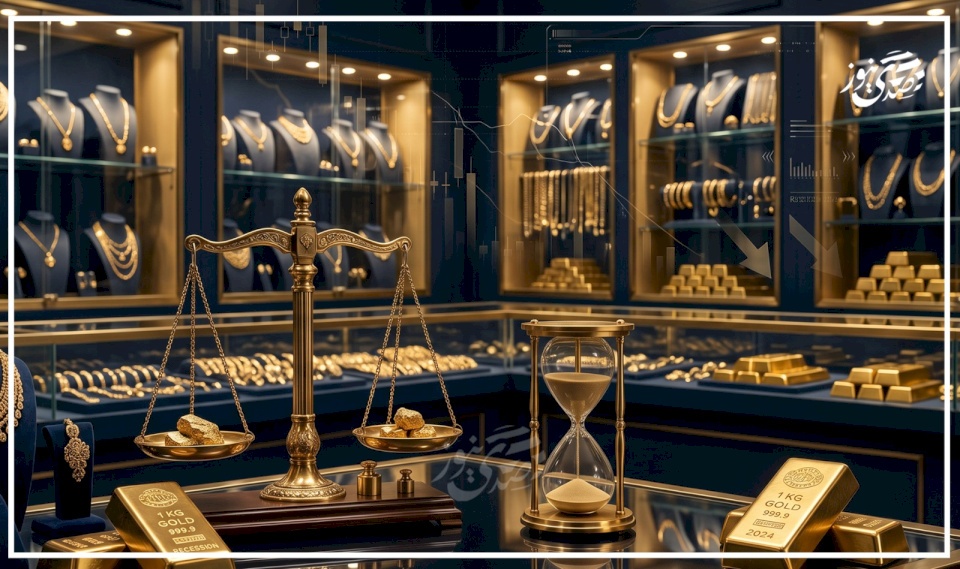
Exclusive: Four Main Reasons Behind the Significant Stagnation in the Gold Market in the West Bank
Exclusive to "Sada News": "We have days that pass without any sales," this is how Anan Huwari, a jewelry store owner, describes the condition of the gold market in the West Bank since the beginning of this year, pointing to a significant stagnation the market is experiencing.
He states that purchasing operations have witnessed a significant decline in recent times, noting that this is due to two reasons: first, the rise in global gold prices, and second, the deteriorating economic situation in Palestine.
Demand for Light Weight Pieces
Huwari points out that, for example, a bride whose dowry was around ten thousand Jordanian dinars about ten years ago used to buy around 250 grams of gold, but today the same amount only buys more than 100 grams.
He emphasizes that this has reflected on the purchasing method, as grooms are now buying lighter weight pieces to ensure they can get more items.
Huwari confirms that the percentage of decline in purchases during this recent period has exceeded 50% compared to normal conditions, while the demand to sell remains high due to the poor economic conditions for various social segments.
He notes that many traders have entered the gold market for speculation, which has caused a significant reduction in the profits of jewelry store owners.
Decline in the Quantity Hallmarked and Revenue Collected
Data from the Precious Metals Directorate reveals a noticeable decline in the quantities hallmarked and a drop in the collected revenue after the end of April of this year compared to the same period last year.
The quantities hallmarked in April reached a weight of 860,846.2 grams compared to quantities of 1,069,559.6 grams in April 2025, a decrease of 24%.
Meanwhile, the collected revenues only reached 839,294.4 shekels during April, reflecting a decline of 35.5% compared to the same period last year, which amounted to 1,137,474.9 shekels.
Amjad Ramadan, deputy director of the General Administration of the Precious Metals Directorate, confirms to "Sada News" that the data reveals a tangible decline in demand during this period, indicating that this is due to the decrease in the purchasing power of the Palestinian consumer, along with rising gold prices to unprecedented levels.
Why Are Local Prices Higher Than Global Prices?
Regarding the reason for the higher local gold prices compared to global prices, Ramadan says, "The high costs of bringing gold into the Palestinian territories cause the local product to be more expensive by an average of two dinars per gram."
Entry of Traders for Speculation
For his part, economic expert Dr. Thabit Abu Rous tells "Sada News" that the recorded results are normal, as last year gold became a commodity, and there was a rush to buy gold because its price was on an upward trend, indicating that speculation boosted this demand.
He adds, "New people entered the market who had not previously been involved in the gold market for speculation, while traders were inclined to invest in gold during a period considered ideal for purchasing as it was trending upwards."
He points out that many analyses had forecast that the price of an ounce of gold would reach (6) thousand dollars per ounce, thus allowing for profit, noting that this speculation period included both buying and selling operations.
Abu Rous confirms that last year represented a safe haven for gold, which traders relied upon to keep it as an alternative to currency, in addition to last year's news circulating that gold is a commodity that can be sold and purchased, not just to be kept or stored or used for adornment. He explains that purchasing operations last year increased due to the eagerness of traders from various sectors to invest in the precious metal.
The slowdown in purchasing operations during 2026 is attributed to analyses suggesting that gold is no longer a safe haven for investment, leading to a reluctance to buy, pointing out that there has been a rush to sell, as evidenced by gold stores refusing to buy the precious metal since it was trending downwards.
It is noted that data from the Precious Metals Directorate shows that the average market need in Palestine reaches (10) tons annually.
Are We Facing a New Upward Wave?
Regarding gold prices, banking and financial expert Mohammed Salama says to "Sada News": "Gold has responded naturally to market conditions and the reality of actions occurring in the global financial system," noting that the precious metal has been affected by the weakness of the dollar, as well as geopolitical tensions across the world, whether East or West.
He states, "At this stage, we have not noticed its impact from geopolitical developments in the region, and this is due to several reasons; one of which is that the dollar has regained its strength at this stage as a safe-haven currency, and there has been increased demand for it for trade exchanges, to buy oil, to finance budget deficits, or to manage economies in many countries, thus the need for liquidity has exceeded the demand for gold as a safe haven.
Another point, Salama believes that gold had been high and absorbed a range of geopolitical factors for a long time; the threat from Iran, the war in Ukraine, and other tensions have always existed and reflected on prices throughout last year, noting that central banks need liquidity more than they need gold, thus there were some banks that sold gold and capitalized on its rise to bolster liquidity in their countries' economies, pointing out that the appetite of many central banks stopped buying at a certain point because some believed that the rise in gold exhausted the expectations that were in the markets over the past two years, reaching a price level of (5) thousand dollars per ounce.
He adds, "Once the price of the ounce surpassed the (5) thousand dollar mark, central banks found that the first goal of the rise had been achieved," noting that if conditions calm and equilibrium is recalculated, there are expectations for gold prices to rise again as the end of the war on Iran may mean a decline in the dollar's status as a safe haven.
He points to trends from many countries to complete some exchanges in global trade using currencies other than the dollar, such as the Chinese yuan, etc., which may provide additional signals about the dollar's weakness, and this certainly feeds the strength of gold as a strategic commodity that is not sensitive to pricing, bought by investors or savers to preserve their money, as there are fears due to currency fluctuations that could drop significantly, especially concerning the US dollar.
He continues, "What the US has done in the Middle East and the Gulf carries much criticism after Europe fell behind American plans, as China stands against it. This may reduce American hegemony, leading to a weakening of the dollar and thus a rise in gold prices again."
 Follow the latest Sada News via Google News
Soaring Oil Prices Burn the Pockets of the Palestinian Citizen "The Poor"

Millions of Dollars in Losses.. "SadaNews" Reveals Shocking Figures for Traders from Pales...

The Problem of Shekel Overcrowding Worsens.. Fuel Station Owners Threatened with Closure o...

The Palestinian Economy at a Crossroads: 4 Files Awaiting Resolution

Israeli Discussions Explore Ways to Tackle Rising Crime Against Banks and Their Employees

Bringing in New Foreign Workers to Israel Instead of Palestinians

The Monetary Authority Organizes Training on Developing Financial Technology Systems and S...
