

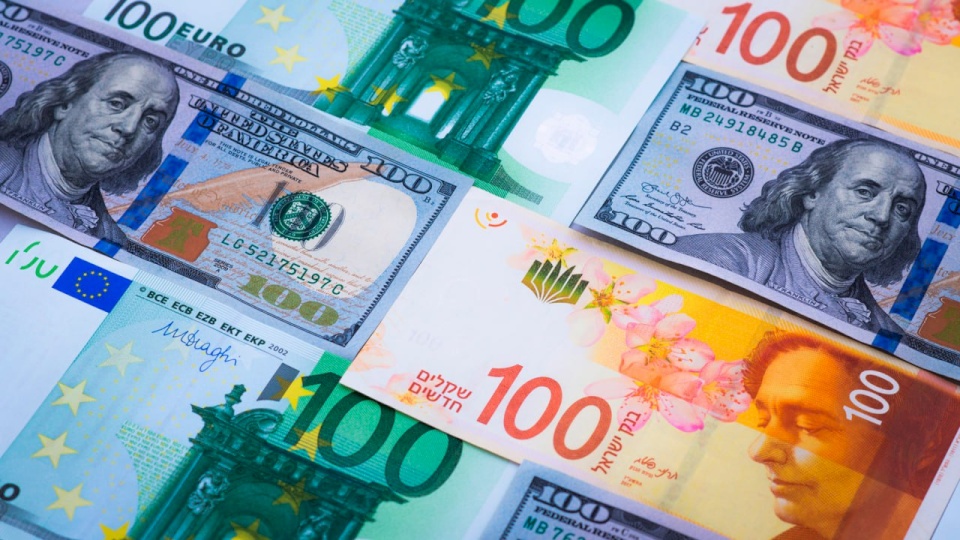
Why did the dollar fall below the 3 shekels mark for the first time in decades?
SadaNews Economy - The financial market in Israel has witnessed a dramatic transformation, the first of its kind in over thirty years, as the Israeli shekel broke below the 3 shekels mark against the U.S. dollar, recording a level of 2.993 during trading on Wednesday.
This historic breakthrough, not seen in the market since October 1995, came driven by a wave of overwhelming optimism among investors regarding the imminent end of military confrontations in the region, and approaching agreements for a ceasefire on the Iranian and Lebanese fronts.
Economic analysts believe that this sharp rise, which has exceeded 20 percent in the past year, is not merely a technical correction or a transient fluctuation, but a direct reflection of a "political breakthrough" that investors have begun to price in.
The possibility of the end of the conflict has led to a reduction in the geopolitical "risk premium" that has burdened the local currency throughout the war, transforming the shekel from a pressured currency into an attractive haven for capital.
Technology Investments and Defense Exports
Despite the positive appearance of this rise, this "digital success" of the shekel carries with it the seeds of a severe crisis for the export and industrial sectors, where manufacturers see the excessive strength of the currency as a "knockout blow" to their global competitiveness. The Israeli exporter, who receives revenues in dollars while paying operational costs and employee salaries in shekels, finds himself facing rapidly eroding profit margins, which has led some to warn that the continuation of this level may lead to factory closures and widespread layoffs, and even prompt major technology companies to consider relocating their operations abroad to escape rising dollar-denominated costs.
This financial imbalance has led industry leaders to warn of dire consequences, starting with the erosion of the competitiveness of local products in global markets, and could end with the closure of vital facilities and the layoffs of thousands of workers.
What's notable in this crisis is the indication from large multinational technology companies of moving their operations abroad to escape rising dollar-denominated costs, which could deprive the public budget of significant tax resources and put the economy to a real test of balancing "currency stability" with "industrial survival."
Bank of Israel
As for the official position of the Bank of Israel, it seems to lean towards "waiting and observing" without direct intervention in the currency market, as the reasoning is that the strength of the shekel helps curb inflation by making imports and fuel cheaper for the local consumer.
Since the central bank does not view this rise as a "bubble" but rather a reflection of the fundamental flexibility of the economy and an improvement in the geopolitical landscape, it prefers not to intervene with billions of dollars to offset the price, as long as the fluctuations do not threaten overall financial stability, despite repeated outcries from the export sector that sees itself as the first victim of this historic strength.
Former Israeli central bank official Asher Blas told "France Press Agency" that "the dollar is generally weak," noting that the shekel's gains against other currencies, such as the euro, were lower.
Blas added that the general positive outlook for the Israeli economy also played a role.
In February, the International Monetary Fund stated that "the Israeli economy has shown remarkable resilience" despite more than two years of bloody and destructive war with the "Hamas" movement in Gaza.
This month, the IMF projected Israeli GDP growth of 3.5 percent in 2026, exceeding the 3.1 percent recorded by the Central Bureau of Statistics for 2025.
Blas noted that military exports could be an important driver of growth, alongside other sectors such as space technology. However, the war launched by Israel and the United States on Iran in late February could negatively affect the Israeli economy if hostilities resume, which would require Israel to engage in extremely high defense spending, he said.
 Follow the latest Sada News via Google News
Soaring Oil Prices Burn the Pockets of the Palestinian Citizen "The Poor"

Millions of Dollars in Losses.. "SadaNews" Reveals Shocking Figures for Traders from Pales...

The Problem of Shekel Overcrowding Worsens.. Fuel Station Owners Threatened with Closure o...

The Palestinian Economy at a Crossroads: 4 Files Awaiting Resolution

Exchange Rates of Currencies Against the Shekel on Tuesday (July 21)

Inflation Expectations in Israel Stabilize at 1.5%

Ministry of Economy Announces the Opening of Import Application Submissions for Commodity...
