

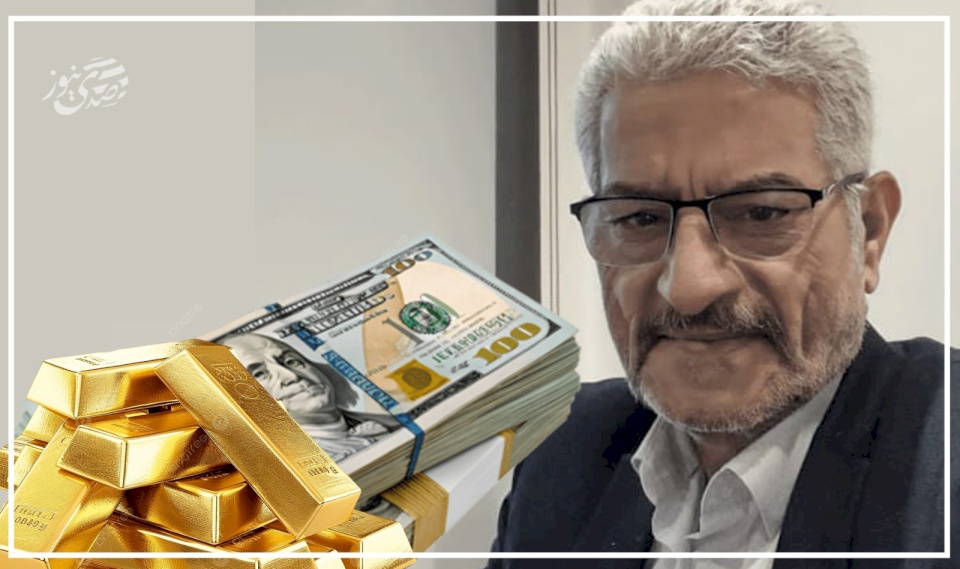
Banking Expert: The Dollar Will Fluctuate Against a Basket of Currencies by 5% Amidst Predictions of Ups and Downs
The dollar has lost 11.7% of its strength against the shekel this year.. Where is it heading in the future?
Gold has recorded a historic increase of 71.1% in one year, with several factors indicating further rises
Exclusive to "SadaEconomy": A financial expert predicted that the exchange rate of the dollar against a basket of currencies will remain fluctuating by 5% upward or downward during the coming year, ruling out any significant changes in exchange rates, saying that the likelihood of a collapse in the dollar exchange rate or a substantial decline remains unlikely.
The banking expert and financial advisor, Muhammad Salama, told "SadaEconomy" that despite gold rising by 71% since the beginning of this year, there are inclinations suggesting further increases in 2026, especially if the current geopolitical situations persist globally. He also clarified that the most rational experts expect continued fluctuations between rises and falls, though they suggest that the chances of buying gold at levels lower than its current price remain viable, stating that trading at a level of $5000 per ounce is close and surpassing it is possible, while returning to a price of $3500 per ounce remains probable.
Although the dollar has lost 11.7% of its strength against the shekel during 2025, Salama points out that there are still economic indicators and political factors that support the strength of the Israeli currency, while there are entirely opposing factors that could lead to the opposite, emphasizing that the general expectations of experts reflect the reality of continued price fluctuations within a wide range in the future, though the likelihood of further shekel strength at the expense of the dollar is more probable in the medium and long term.
A Bad Year for the Dollar
2025 was a bad year for the US dollar, as it fell by 9.65% against a basket of currencies. Meanwhile, it decreased by 11.7% against the Israeli shekel. Gold is almost closing the year at a historic high against the weakening dollar, having reached $4485 per ounce, marking an increase of 71.1% since the beginning of the year. While the dollar saw a decline, US stock indices recorded gains, with the S&P index rising by 17%, and the Nasdaq technology index increasing by nearly 21%.
Salama states that expert forecasts for the dollar's performance in 2026 indicate that some predict further declines by up to 5%, affirming the persistence of strong and momentum-driven reasons for this downward trend. There is still the possibility of another rate cut, and a new Federal Reserve chairman loyal to President Donald Trump may threaten the independence of the Fed and its monetary policy, alongside the ambiguity surrounding the financial policies of Trump and the ongoing geopolitical escalation that negatively affects.
He points out that some analysts expect the dollar to regain its status as the world’s primary reserve currency and gradually increase by 5%, noting that this expectation is based on the premise that markets have absorbed most of the factors and reasons leading to the dollar's weakness and depreciation.
Salama, in his talk with "SadaEconomy", emphasizes, "We must note that fluctuations in exchange rates between rises and falls are inherent to markets and accompany their existence. They depend on supply and demand. As long as the US dollar remains the primary reserve currency of the world's countries, the range of fluctuation in its exchange rates remains logical and reasonable, so it does not affect the balance of global economic performance." He notes that experts expect fluctuations between rises and falls of 5%, ruling out significant changes in exchange rates, as the likelihood of a collapse in the exchange rate of the dollar or substantial declines remains unlikely.
Dollar Against Shekel.. Where To?
The US dollar declined during the second half of this year to levels not seen since 2021, where it fell by 11.7% and traded briefly below 3.20 shekels per dollar.
Salama states, "This sharp decline came primarily as a result of reduced geopolitical risks for the occupying state after the US struck Iranian nuclear reactors, which financial markets viewed as a reason for lowering geopolitical risks surrounding the future of the occupation represented by Iranian threats. The cessation of aggression on Gaza also contributed to strengthening the Israeli shekel, and we must not overlook the impact of the general reduction in dollar interest rates."
Salama explains that most analysts predict further strength for the shekel in the coming period, supporting their expectations with the potential improvement in the Israeli economy's performance following the end of the aggression on the Gaza Strip, a current account surplus due to gas and arms exports, in addition to a large reserve of foreign currencies held by the Israeli central bank, which has a surplus of (231) billion US dollars, approximately 40% of the annual GDP.
He noted that some are optimistic about economic indicators, as unemployment has decreased to 3%, and inflation stabilized at 2.5%, below the target ceiling of 3% set by the central bank. The Israeli economy has also witnessed continuous growth exceeding expectations, which is why optimistic reports are appearing in the markets now and then predicting a decline to levels of 3 shekels per dollar during the next year.
Salama clarifies that some analysts stand in contrast amid expectations of political upheavals sweeping the occupying state in 2026, represented by the results of investigation committees, the trial of Israeli Prime Minister Benjamin Netanyahu, pressure on the judiciary, the extremism of the far right, and the looming threat of war on Iran and Lebanon, without closing the file on the aggression in Gaza, and the declining standing of the occupation politically, economically, and socially, pointing out that all these data will inevitably lead to a decline in the shekel during 2026, along with increased possibilities of interest rate cuts and a rising budget deficit, which may drive price testing back to 3.50 shekels. Overall, experts' expectations reflect the reality of continued price fluctuations within a wide range in the future.
Although the exchange rates of the dollar against the shekel are often linked to global stock price indicators, particularly the "Nasdaq" technology stocks and the S&P indices, which have risen significantly and supported the shekel's strength this year, despite this linkage declining after the aggression on Gaza, some analysts expect continued fluctuations in the dollar against the shekel in 2026, with expectations of stock indices declining and the dollar rising again to test levels near 3.50 shekels to the dollar. Salama adds in his conversation with "SadaEconomy", "In general, the shekel remains a strong currency supported by a large reserve of foreign currencies and supportive financial and economic indicators, as it is expected that the trend of the dollar exchange rate against the shekel will depend on the surrounding developments in the dollar's exchange rate in general. However, despite many analyses, the higher likelihood of further strength for the shekel at the expense of the dollar remains more probable in the medium and long term."
Gold Soars High
As for gold, its price has approached $4500 per ounce, marking a 71% increase this year. Salama states, "Gold has witnessed a significant transformation in investors' and central banks' perceptions as a safe haven, especially with the rising risks of currencies in an extremely ambiguous and complex geopolitical environment amid escalating tensions in the Pacific, between the United States and China, and the continuing Russia-Ukraine war and the possibility of its expansion instead of waning, alongside the wars waged by the Israeli occupation and the chaos they create in the Middle East."
He adds, "The world has never been in a state of turmoil and chaos as it is now, and this is generally a reason for the shift of investors and savers to gold for hedging, fearing a collapse in currency exchange rates and the erosion of purchasing power." He points out that the reduction of US dollar interest rates, paired with persistent inflation issues alongside the momentum of rising gold prices, has bolstered the gains of the precious metal.
He noted that the ambiguity surrounding the outcomes of Trump’s financial policies and their economic impacts, along with the reckless actions of the US administration towards Europe and India, have heightened fears of the fragility of the current global system, pushing everyone towards rational asset ownership amidst an excess cash mass beyond the needs of the global economy. He added that the demand of central banks for gold to bolster their reserves has been a decisive factor in the rise in gold prices, as has the ability to purchase it as a reserve in bank accounts for speculative purposes rather than as a raw material, which helped stimulate demand and increase its prices in the markets.
Although gold has increased by 71% since the beginning of this year, Salama believes that experts still favor further increases in 2026, especially if the current conditions persist, such as further rate cuts and increased tensions in the Caribbean, delays in halting the Russia-Ukraine war, and more recklessness in the Middle East. The abandonment of the United States of rational relations with India, as the largest human mass, could lead to chaos that pushes prices higher for the precious metal.
He points out that some call for reconsideration when dealing with gold, as prices have risen significantly, and the rate of credit acquisition through bank accounts or speculative companies could lead to price declines when profit-taking occurs in the markets, clarifying that the most rational experts expect continued fluctuations between rises and falls, though they believe that the chances of buying gold at lower levels than it currently holds remain in place. He adds to "SadaEconomy", "The truth is that trading at the level of $5000 per ounce is now close, and exceeding it is possible, while a decline to levels approaching $3500 and trading below that is also possible." He urged caution when making decisions regarding selling or buying, so that decisions are based on the data available at that time, stating that there is no logic or fixed rules governing such wide fluctuations that the markets are not accustomed to."
 Follow the latest Sada News via Google News
Soaring Oil Prices Burn the Pockets of the Palestinian Citizen "The Poor"

Millions of Dollars in Losses.. "SadaNews" Reveals Shocking Figures for Traders from Pales...

The Problem of Shekel Overcrowding Worsens.. Fuel Station Owners Threatened with Closure o...

The Palestinian Economy at a Crossroads: 4 Files Awaiting Resolution

Exchange Rates of Currencies Against the Shekel on Tuesday (July 21)

Inflation Expectations in Israel Stabilize at 1.5%

Ministry of Economy Announces the Opening of Import Application Submissions for Commodity...
