

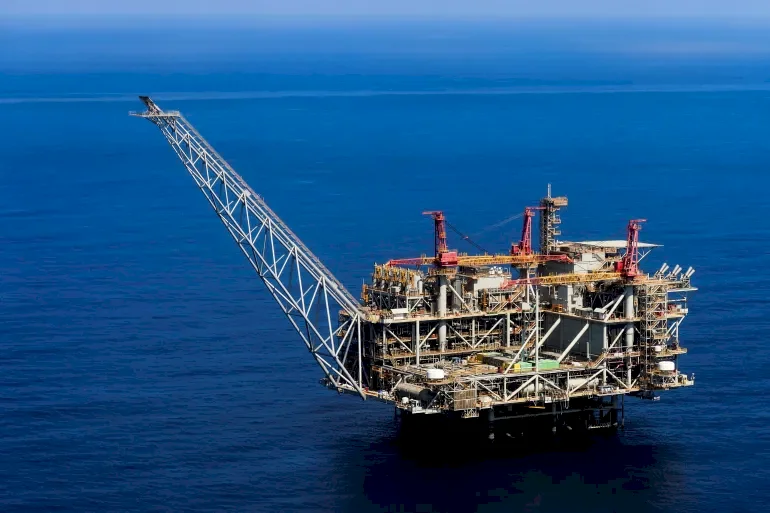
Trump's Pressure Behind the Approval of Israel's Gas Deal with Egypt
SadaNews - It is not the celebratory words issued from the highest political levels that will determine the fate of the gas export deal to Egypt, but rather one question: Will there be real competition in the Israeli gas market?
This is the essence of the issue posed by the Israeli economic newspaper Calcalist in its analysis of the agreement, considering that what is officially described as a "historic agreement" may turn into "crying for generations" if the current market structure remains uncorrected.
According to Calcalist, the fate of the entire Israeli energy system is at stake in a "highly centralized" market that virtually lacks competition, while the agreement guarantees nothing more than a "reasonable deal" at best, and could be "terribly bad" if a supply surplus is not enforced to compel producers to compete.
The Big Story.. Absence of Competition
Calcalist emphasizes that the core problem lies in the absence of real competition, as the American Chevron company owns 40% of the Leviathan field and a quarter of the Tamar field, in addition to its operational control, granting it actual control over about 90% of gas reserves.
The competition commissioner, Michal Cohen, described this situation as "problematic", stressing the need for new players to enter. However, the reality, according to Calcalist, is moving in the opposite direction, with the reduced role of the Karish field, which once served as a limited competitive element.
The newspaper sees that monopolization is clearly looming on the horizon, as options for the market dwindle.
Energy Security.. A Mere Obvious Promise
Calcalist clarifies that negotiations between the Israeli government and gas companies revolved around three axes: energy security, prices, and competition.
As for the energy security axis, it was - according to the newspaper - "a given", as it is illogical to export gas in the event of an internal crisis resulting from war or security emergencies.
Accordingly, the commitment to ensure that there is no gas shortage as long as sufficient production capacity is available is "not a negotiation accomplishment as much as it is obvious".
Prices Higher than Today.. and Automatically Rising
In terms of prices, which are the most sensitive issue, Calcalist notes the fixating of a price of $4.7 per million British thermal units, linked to a mechanism associated with household electricity tariffs that rise annually by about 1% to 2%.
The newspaper points out that the current price of gas is around $4.5, meaning the consumer will pay more "from day one". Worse, according to Calcalist, is that the linkage mechanism guarantees price increases year after year, which it described as "not ideal at the very least".
Conversely, supporters of the agreement promote the idea of "price stability", but Calcalist sees that this stability comes at the consumer's expense, in an already volatile global energy market.
Supply Surplus.. The Only Tool to Curb Prices
Calcalist explains that the only solution to create real competition lies not in restricting exports, but in imposing a "supply surplus" within the domestic market. When producers are forced to leave quantities of gas exceeding market needs, they are compelled to compete to sell it instead of leaving it underground, which leads to lower prices.
For this reason, the proposal by the Ministry of Finance to set an export ceiling of no more than 85% of the gap between domestic demand and production capacity has angered the companies, which viewed it as "huge losses", but Calcalist conveys from the ministry that this is the only way to enforce actual competition.
Although the proposal was not included in the settlement law, hopes remain pinned on the Dayan Committee, tasked with reevaluating gas export policies, to include this principle in its final recommendations.
A Deal Without Competition Until 2032
Calcalist harshly criticizes the fact that the current agreement expressly stipulates the absence of competition until 2032, meaning that the state will not possess a competitive intervention tool for seven years. The newspaper sees this as a "clear concession" that would have been better not granted.
It is true that the absence of competition may not be catastrophic in the short term, given that no large new contracts are expected to be signed until 2030, but the biggest loser - according to Calcalist - will be the five new power stations, which will have to negotiate prices with a single monopoly.
American Pressure.. The Decisive Factor
Calcalist concludes its analysis by indicating that the continuation of negotiations would have served the interest of the state, were it not for the "direct pressure coming from Washington". The newspaper states that this pressure has passed through political channels, headed by Prime Minister Benjamin Netanyahu and Energy Minister Eli Cohen.
According to Calcalist, President Donald Trump wanted the agreement, "and once he wanted it, the story ended." The newspaper enumerates Trump's motives, ranging from protecting the interests of American oil companies, primarily Chevron, to supporting Egypt, which is experiencing a severe energy crisis, as well as reducing dependence on Russian gas and enhancing U.S. influence in the regional energy market.
If the Dayan Committee does not enforce a supply surplus mechanism, the signed agreement may turn from a "historic achievement" into a long-term burden, with consumers paying the price according to Calcalist, while competition remains absent, prices are set to rise, and the political decision remains a prisoner of external pressures rather than fair market calculations.
 Follow the latest Sada News via Google News
Soaring Oil Prices Burn the Pockets of the Palestinian Citizen "The Poor"

Millions of Dollars in Losses.. "SadaNews" Reveals Shocking Figures for Traders from Pales...

The Problem of Shekel Overcrowding Worsens.. Fuel Station Owners Threatened with Closure o...

The Palestinian Economy at a Crossroads: 4 Files Awaiting Resolution

Palestine.. Trade Balance Deficit Increases by 15% During May Last Year

The Monetary Authority Keeps the Discount Rate at 25% of Public Sector Employees' Salaries...
Fuel Crisis in the West Bank: Supply Disruption or Liquidity Shortage?
