
Reducing the Cash Usage Ceiling: Is it a Shift Towards the Black Market or a Move to Stimulate the Economy?
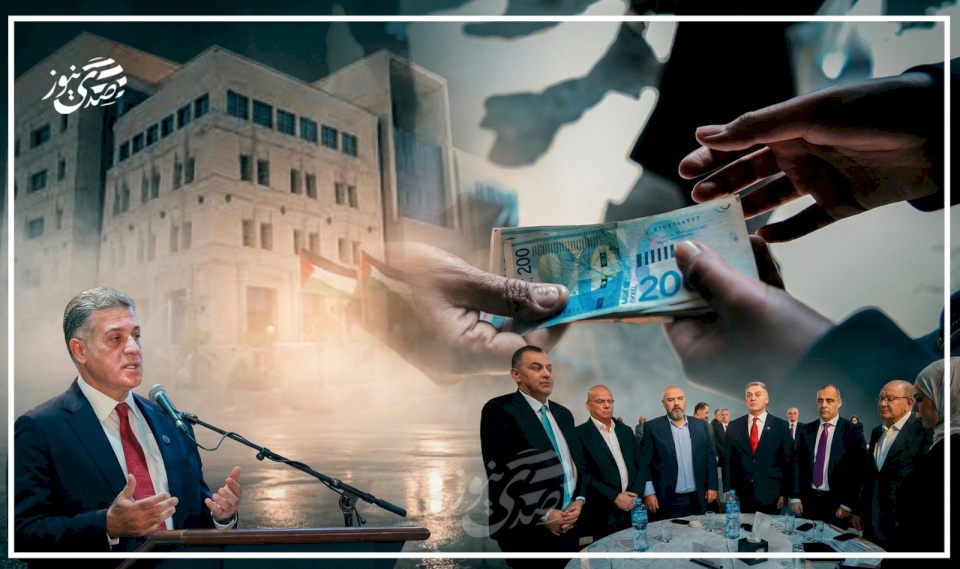
Exclusive to SadaNews - The announcement by the Palestinian Monetary Authority about a draft law to reduce the cash usage ceiling has sparked a wave of differing opinions. Some believe that this law will drive economic sectors towards the black market, which means further bleeding of the Palestinian economy that is already suffering due to various occupation measures on one hand, and the lack of control over crossings and borders on the other. Meanwhile, another opinion argues that this law will contribute to bringing sectors into the formal economy, thus pushing the economic wheel forward and achieving the desired growth.
Financial expert and consultant Muhammad Salameh told "SadaNews" that the excuse raised by some regarding the fear of insufficient liquidity flow from Palestinians in 48 to the Palestinian market as a result of the law has no scientific basis, as they are subject to the Israeli 'Loker' law, which has set a cash transaction ceiling of 6,000 shekels. Furthermore, some companies operating in the real estate sector in the West Bank, for example, conduct business transactions with Palestinians from 48 through bank checks, signing commitments to disclose the sources of funds and not violating any laws, whether in Palestine or Israel, to avoid any legal liability even at the expense of their profitability.
He states that opposition to implementing the law on any financial matter within Palestinian society primarily stems from a lack of trust in monetary and financial policy due to past experiences and the lack of certainty and clarity in our political reality. He pointed out that the flooding of the market with shekels over the years is a result of the failure of some financial policy ideas, such as the excessive borrowing in shekels to finance short-term loans to support salaries, which turned into long-term financial burdens due to withheld clearance and the lack of alternatives. This entrenched the shekel in the economy and increased the size of the money supply; however, the implementation of the law will lead to capital formation movement across vast sectors of the real economy instead of keeping money stagnant and marginalized. He noted that this will place it within the tax envelope, which will grow the public revenues of the Authority due to the transformation of money into capital assets. When cash usage is regulated, a shift will occur that will compel wide sectors to convert their cash into investments and transform them into productive assets, propelling the economic wheel forward.
Salameh expects that the implementation of the cash usage reduction law will raise the Palestinian GDP by at least 30% in the first three years, as the implementation of the law will lead to a reduction in cash in circulation by at least 50%, which will gradually increase bank deposits and improve their ability to extend credit, generate money, and support development. Additionally, there will be a shift of money towards individual interests even outside the banks in light of the obsolescence of cash, which will encourage sectors to convert cash into capital formation instead of hoarding cash.
He added to SadaNews: "This will have positive effects whether in reducing unemployment through creating job opportunities, limiting crime, and curbing inflation, or on the economic cycle by increasing the growth rate and contributing to raising output. Furthermore, there is an economic benefit from reducing the circulation of cash as it pertains to the cost of cash transactions."
Salameh points out that fears that the implementation of the law will push towards the black market are illogical, as the current environment is conducive, with the black market at its peak, currently accounting for about 50% (according to experts) of the current Palestinian economy in light of the lack of control over the components of the economy and lack of control over crossings and borders.
He notes that the expansion of the black market currently has clear indicators through the amount of cash existing outside the control of the Monetary Authority and banks, and the business operations that take place outside the tax envelope, pointing out that the law has become an urgent necessity in light of our current confrontation with the occupation, emphasizing that its application will lead, for example, to the gradual elimination of the problem of "shekel congestion" that shackles the Palestinian economy. Salameh affirms that the law's implementation will create the mechanisms that will lead to the desired positive outcomes.
Salameh calls for the formation of a committee of experts from both the public and private sectors to accelerate the research into the impact of the law's implementation instead of resorting to broad public dialogue, as there are technical aspects and interests that need expertise to examine and ensure that the law's implementation is in the best interest of the citizen and the nation.
Several representatives of the private sector expressed their concerns during a discussion session organized by the Monetary Authority regarding the draft law to reduce cash usage, fearing that this law might lead economic sectors to exit the formal market.
For his part, head of the Federation of Chambers of Commerce, Industry, and Agriculture, Abdu Idris, states the necessity of balancing financial inclusion operations with protection for the economic cycle, especially during this difficult phase that Palestine is experiencing, pointing out that more than 15 billion shekels are still in the hands of citizens and outside the banking sector, warning that this reality pressures Palestinian banks and pushes part of this cash to Israeli banks.
Other representatives from the private sector, including representatives of the Industries Union and the Coordinating Council of the Private Sector and the Union of Fuel Station Owners, emphasized the necessity to "not rush" into enacting the law or implementing it in phases, basing their arguments on several justifications, including concerns over sectors moving towards the black market, fears of limiting the flow of cash from Palestinians in 48 to Palestinian markets, which in turn contributes to stimulating the economic cycle, and the lack of appropriate digital infrastructure in many geographical areas of Palestine, which will create difficulties for implementing the law.
On his part, economic expert Dr. Said Sabri believes that the law is a double-edged sword. It is, on the one hand, a powerful tool to strengthen the formal economy. He says: "When we force financial transactions to go through banking channels, we increase transparency and give the state a greater ability to track money and combat tax evasion and money laundering," noting that this will also enhance public revenues and bolster trust in the financial system, which may attract new investments in the long run.
He adds: "It is a necessary step to integrate a large part of the economy that currently operates in the shadows. However, on the other hand, we cannot ignore the direct impact on the informal economy. This sector, which constitutes a significant part of our economies and relies almost entirely on cash, will face an existential challenge," pointing out that millions of small businesses, artisans, and daily workers, imposing rapid digital transformation on them without providing practical, low-cost alternatives or even incentivizing support, could lead to a sharp contraction in their activities.
He continues: "This means potential slowing of the economic cycle in the short term, as many daily transactions might freeze or stall."
He concludes that the law could lead to a "caesarean birth" of a more organized formal economy, but this delivery might be at the expense of significant suffering for the informal market.
He indicates that the success of this transitional process completely depends on the wisdom of its implementation, questioning: "Will it be gradual? Will there be technical and financial support for small businesses? Will secure and accessible digital infrastructure be provided for all?".
He states: "If these points are not addressed, we risk the economic and social cost of this transformation being much higher than the anticipated benefits."
For his part, Deputy Governor of the Monetary Authority Muhammad Mansara believes that the law will undoubtedly contribute to moving the economic wheel forward, as there are nearly $8 billion frozen and neutralized in their effect on the economy due to not being invested in banks, consisting of about 15 billion shekels (4.6 billion dollars) of cash stacked in banks in shekels due to Israel's refusal to receive it, in addition to about $2.7 billion as part of "Swap transactions," meaning foreign currency sales against shekels with a right of repurchase at a specific fee or price, as banks conduct exchanges using this money to buy shekels for trade financing operations with Israel, as there is also about $700 million in accumulated cash representing excess liquidity in dollars in the banks.
It is noted that the draft law to reduce the shekel usage announced by the Monetary Authority states that cash payments in transactions exceeding 20,000 shekels or their equivalent in other currencies will be prohibited, granting the Monetary Authority the authority to adjust this ceiling in coordination with the Ministry of Finance and relevant parties. The draft law also empowers the Monetary Authority to set upper limits on cash loans, donations, and cash contributions, and transactions in sensitive sectors such as real estate and luxury goods, to ensure transparency and minimize money laundering opportunities.
According to the proposed draft law submitted by the Monetary Authority, it sets a cash transaction ceiling of 20,000 shekels for each commercial transaction, based on the fact that 96% of cash deposits in shekels currently are less than 20,000 shekels.
 Follow the latest Sada News via Google News
Soaring Oil Prices Burn the Pockets of the Palestinian Citizen "The Poor"

Millions of Dollars in Losses.. "SadaNews" Reveals Shocking Figures for Traders from Pales...

The Problem of Shekel Overcrowding Worsens.. Fuel Station Owners Threatened with Closure o...

The Palestinian Economy at a Crossroads: 4 Files Awaiting Resolution
Fuel Crisis in the West Bank: Supply Disruption or Liquidity Shortage?

Government Contact Center Issues Clarifying Statement Regarding the Establishment of a Gov...

Exchange Rates of Currencies Against the Shekel Today, Wednesday (July 22)..
