

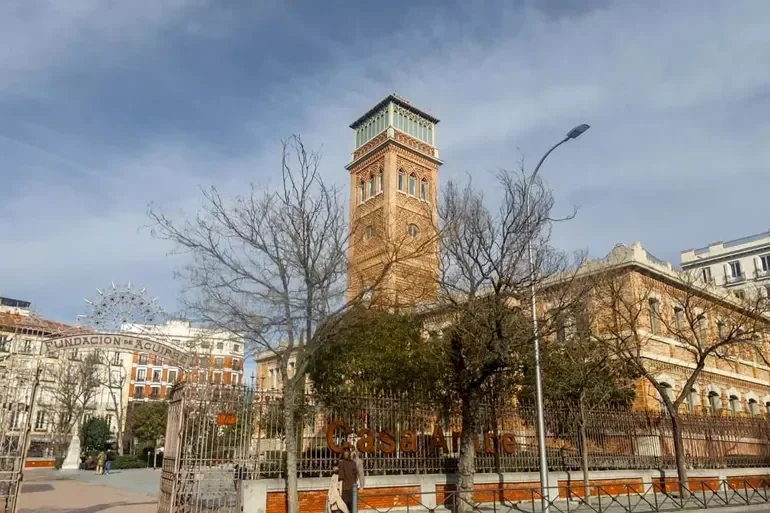
A Decision to Evacuate the Casa Árabe in Madrid.. Bahira Abdul Latif: They are taking the walls, but the message is loud and clear
SadaNews - Just one week before the Casa Árabe in Madrid marks its 20th founding anniversary, a surprising decision was issued to evacuate it from its historic headquarters. While the decision was not unexpected for those observing the political climate in the city, it was shocking for those who have lived with this institution from the inside, especially after nearly two decades where it served as a rich cultural bridge between Arabs and Spain, significantly influencing Spanish consciousness to form a true image of the Arab world.
Writer Bahira Abdul Latif asserts that "there is no justification for terminating such a successful and essential project, aimed at bridging the two shores of the Mediterranean and enhancing Spain's role as an open and democratic country."
This assertion is not a judgment from the outside, as Bahira has accompanied the founding journey of the Casa Árabe since its inception, serving as a translator, lecturer, and writer during its early stages. She believes that its true impact is not measured by the number of events, but by what it has created in the Spanish psyche, moving the audience from a stereotypical image that reduced Arabs to news of politics and crises, to a broader understanding that showcases Arabic literature, art, and thought as a living and contemporary civilization.
The Casa Árabe in Spain is a public institution operating under the supervision of the Ministry of Foreign Affairs. Since its establishment in 2006, it has played a strategic role in promoting relations between Spain and the Arab world, with activities distributed across two locations in Madrid and Córdoba, working in coordination with a wide network of similar institutions such as the American House, the Asian House, and the African House.
Bahira Abdul Latif is an Iraqi writer, translator, and academic who has been residing in Spain for decades, teaching Spanish literature and Arab Islamic culture at the university. She chairs the Global Arabic Language Forum and has been involved with the "Casa Árabe" since its foundational stages, with many of its publications produced under her pen or by her translation.
In this interview, Bahira discusses the Casa Árabe through the eyes of someone who has experienced it, seeing the threat to evacuate it as more dangerous than merely moving an institution from one building to another; it is a "attempt to erase an idea, and to demolish a bridge of dialogue that is not built solely by governments."
Andalusia and an Unforgettable Memory
Placing the Casa Árabe specifically in Madrid (or "Majrit" as the Arabs called it) is not a random choice; Madrid is a European capital founded by Muslim Arabs in the 9th century, and its buildings still carry elements of a shared memory and history spanning all these centuries in their "mudéjar" style.
For this reason, the president of the Global Arabic Language Forum goes to the essence of her conviction: the relationship between Arabs and Spain is not a product of the present, but has roots extending over 8 centuries of cultural interaction in Andalusia, when one of the richest experiences of cultural fusion in human history was formed, leaving its deep impact on language, architecture, sciences, and literature.
Thus, she evaluates the "Casa Árabe" as more than just a cultural institution, as it represents a symbolic acknowledgment that this shared history is not preserved in museums alone, but is renewed in live cultural programs that keep the bridge connected and intact between the two shores of the Mediterranean.
The Casa Árabe is not just stones
There is a question that seems simple but carries the weight of a civilization that has not had its buildings vanish with time; what happens when a Spaniard today looks at the Arab world not through news bulletins but through a novel, an exhibition, or an intellectual seminar?
The answer to this question is exactly what the founders of the "Casa Árabe" realized when they launched it in 2006 within a Spanish vision for soft cultural diplomacy, which made it a link in a network of institutions that enhance mutual knowledge between Spain and the world.
Bahira Abdul Latif has accompanied the journey of this institution from various positions and has witnessed, based on this long presence, what she described as "phases of prosperity and retreat" linked to the priorities of successive Spanish governments.
However, her final judgment transcends the evaluations of governmental administrations to the more important impact of this house, which cannot be measured by the number of its activities - which are very extensive, including conferences, seminars, art exhibitions, literary and musical evenings, Arabic language education programs, and cultural weeks - but by the image it has painted of Arab culture in the Spanish consciousness.
In a world where hate speeches are on the rise, Bahira refers to a concerning statistic; according to data from the Spanish Ministry of Interior, 2025 recorded the highest rate of hate crimes in the country, showing an increase of 23.6% compared to the previous year.
Her response to racism is that "it is not through counter-speech, but by producing deeper knowledge, opening spaces for human communication, and highlighting the contributions of Arabs and Muslims to Spain and Europe's history and present."
Palestine at the Heart of the Matter
One of the areas where Bahira Abdul Latif speaks with transparency is the cultural institution's stance on the Palestinian issue and the charged political atmosphere in Spain; in the institution that has spent two decades presenting Palestine as culture, identity, and human creativity through thought, literature, poetry, cinema, and visual arts, Bahira reads some of the backgrounds behind the assault on it.
In this context, it seems difficult to read the evacuation decision as a purely technical one, especially under Madrid Region's right-wing government's contrary stance to the central government's recognition of the State of Palestine.
However, Bahira is careful to maintain a precise distinction: the Casa Árabe was not established to be a platform for partisan political work, but a space that allows for multiple viewpoints and encourages sober dialogue, explaining that "while this project may represent an uncomfortable presence for some circles, that does not necessarily mean there is a flaw in its message, rather this reveals its importance."
Renovation or Silencing?
On June 29, the mayor of Madrid announced his intention to regain the headquarters of the "Casa Árabe," setting September 1 as the final deadline for evacuation, relying on "terms of the agreement on the historic building that allow its retrieval when the founding coalition composition changes, while the announced excuse was the need for renovation and maintenance work."
Bahira evaluates this excuse by saying: "A superficial justification that convinces no one." She adds a legal detail: the Madrid regional government's withdrawal from the coalition council has not yet been approved by the head of the formation, who is the Spanish Minister of Foreign Affairs, which raises doubts about the procedural soundness of the evacuation decision.
What truly concerns her is not the debate over a building or administration, but the deadline that does not exceed two months, with a complete absence of any announced alternative, in a large and impactful institution, representing a bridge and soft power for Spain with 22 Arab countries.
Who Protects Culture from Politics?
In the current Spanish scene, cultural institutions find themselves facing the danger of politicization and targeting. The university lecturer states that the case of the Casa Árabe illustrates how political will can disguise itself in bureaucratic clothing, causing damage to the dialogue projects built over years of accumulation.
According to her, "culture is fundamentally a long-term project, while politics is variable; what is built over decades can be subjected to instability if there is no long-term vision."
Hence, Bahira expands the circle of responsibility to include both parties: the Spanish side given that the Casa Árabe is a part of its cultural diplomacy and soft power, and the Arab side since Arab embassies are represented in the diplomatic council of the Casa Árabe, which makes silence in the face of what is happening an unjustifiable shortcoming.
The writer states: "I do not view the Casa Árabe as an institution serving only Arabs, but as part of Spanish cultural diplomacy and a bridge for understanding between Europe and the Arab world. Protecting such institutions is not a defense of a particular culture, but of the idea of Europe itself as a space for pluralism, dialogue, and openness."
This perspective reflects Bahira's analytical approach to cultural issues and mechanisms of dialogue between civilizations, stating, "My experience in the Casa Árabe has taught me that true dialogue is not crafted solely by governments, but is made by intellectuals, translators, researchers, artists, and everyone who believes that knowledge is stronger than stereotypes, and that culture endures beyond political disagreements."
Bahira Abdul Latif concludes her statements to Al Jazeera Net by saying: "Governments may change, and institutions may move from one building to another, but what should not change is the belief that culture represents one of the most important bridges between Arabs and Spain, and preserving it is preserving the possibility of mutual understanding between peoples."
As this interview was prepared for publication, protests were organized yesterday outside the Casa Árabe building in Madrid, where dozens of protesters participated, holding signs reading "The Casa Árabe is Untouchable," and expressing their strong rejection of the evacuation decision, in a scene reflecting the degree of cultural outrage at a decision described by the protesters as "a blow to Arab-Spanish relations."
The protests were not limited to the street; the Global Arabic Language Forum launched an online petition platform protesting the Madrid municipality's decision, participated in by a selection of Spanish academics, intellectuals, journalists, and politicians.
Source: Al Jazeera
 Follow the latest Sada News via Google News
It Can Catch a Whale.. 111,000 Spiders Build the Largest Web Known to the World

A Decision to Evacuate the Casa Árabe in Madrid.. Bahira Abdul Latif: They are taking the...

Arab Praise and Israeli Discontent.. Hossam Hassan's Statements on Gaza Ignite Platforms

From Omar Ibn Al-Khattab to the Syrian Revolution.. The Omari Mosque on UNESCO's Lists

"He didn't tell me" .. A mysterious statement from Scaloni regarding Messi's participation...

"Those who do not feel for them are not human".. Hossam Hassan: The West rises for animals...

A Turkish Child's Wave to a Police Helicopter Turns into an Official Tribute.. What’s the...
