

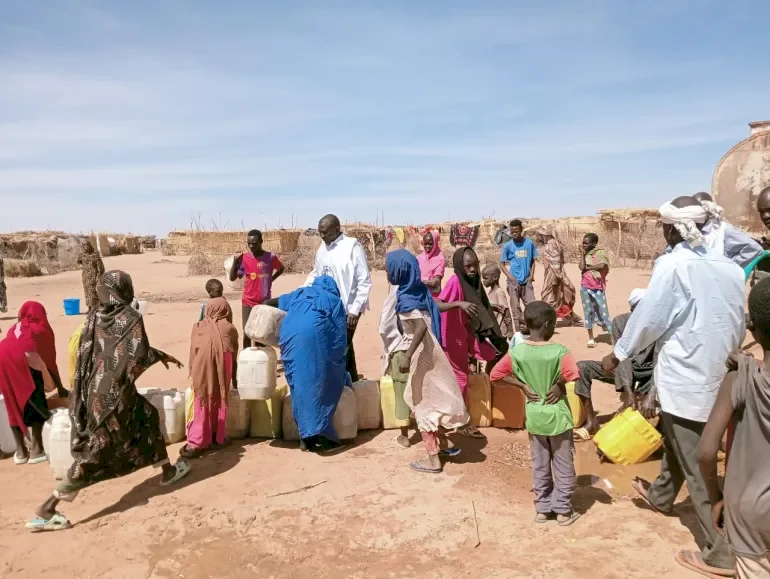
The Siege of Thirst and Death in Al-Obeid .. Will Condemnations Turn into Actions?
SadaNews - While global attention shifts to other crises, Sudan is approaching a new chapter in its humanitarian disaster. In Al-Obeid, the capital of North Kordofan, UN warnings intersect with criticisms of the positions of influential Western capitals regarding the conflict, evoking memories of the atrocities witnessed in the cities of El Fasher and Geneina in Darfur.
The Alarm Bell in Al-Obeid
International fears are escalating that Al-Obeid - considered one of the most important humanitarian and commercial centers in Sudan - could become a stage for widespread massacres as battles intensify and Rapid Support Forces approach the city, while the UN confirms that nearly half a million civilians are now at risk of mass atrocities.
This tragic reality has been analyzed by the British newspapers The Guardian and Financial Times, with the organization "Save the Children" warning of its repercussions on the most vulnerable segments of the city's population.
In an editorial, The Guardian considered what is happening in Sudan as a new collapse of the international community's promise not to allow a repetition of the Darfur tragedies.
The newspaper states that twenty years ago, the world raised the slogan "Never Again," but the facts today prove that the tragedy is repeating itself time and again, while international interest remains limited.
The newspaper warns that Al-Obeid faces the danger of becoming a theater for mass crimes, as the Rapid Support Forces approach, drone attacks continue, and the city is increasingly beleaguered.
However, it believes that the crisis is not only due to the obstinacy of the warring parties but also to the continued external support that prolongs the conflict, criticizing the hesitation of Western governments in exerting real pressure on regional entities accused of fueling the conflict.
The newspaper sees that the sensitivity of these regional entities regarding their international image makes political, economic, and media pressure more impactful than believed.
The editorial cited campaigns already underway in the United States calling for major corporations and institutions to reconsider their relations with regional parties implicated in the war in Sudan, pointing out that the inaction of governments is driving civil society organizations and celebrities to try to fill this vacuum.
The Political Engineering of Violence
In an analytical reading of the depth of the crisis, Amjad Farid Al-Tayeb, the political advisor to the Sudanese Transitional Sovereign Council, states in an article for the Financial Times that what is happening in Sudan is not just transient violence, but an intentional dismantling of society at the hands of a militia whose project is inherently violent.
Al-Tayeb clarifies that the Rapid Support Forces, which emerged from the Janjaweed militia, have reintroduced the tools of ethnic terror and demographic engineering it previously practiced in Darfur, this time supported by clear regional powers.
The writer harshly criticizes the attempts of the international community and Britain, in particular, to hide behind the language of diplomatic balance and equality of responsibility for the abuses between both parties.
Al-Tayeb cites in this context the 2024 Armed Conflict Location and Event Data Project (ACLED) reports, which demonstrate with figures that the Rapid Support Forces are responsible for 77% of the recorded damage and abuses against civilians, compared to about 10% from government forces.
He states that placing both parties in the same category "is not neutrality, but a distortion of reality," adding that Britain's insistence and its partners on treating the warring parties as equals in responsibility effectively grants the Rapid Support Forces a kind of institutional immunity.
Accusations Against Britain
From this understanding, the writer calls on the British government to take four steps he believes could make a tangible difference in the course of the war: The first is to classify the Rapid Support Forces as a terrorist organization under British terrorism law, allowing for the pursuit of its financing networks and criminalizing its activities within the United Kingdom.
The second step is to suspend arms export licenses to the relevant regional actors as long as the danger of military equipment reaching the Rapid Support Forces remains.
The third step is to open an independent investigation into accusations concerning the downplaying of internal warnings related to the risk of genocide to preserve relations with those regional parties, while the fourth step involves pursuing those responsible for abuses, as well as external entities providing political or military support for them.
He cited reports discussing the discovery of British-made equipment in the possession of the Rapid Support Forces, including guidance systems and engines for armored vehicles.
The writer's criticism extends beyond foreign policy to British domestic policies, arguing that the suspension of student visa grants to Sudanese in March harmed students and researchers who had fled the war, stating that Britain "publicly expresses sympathy for the suffering of Sudanese, yet punishes them with its policies in reality."
Children at Risk
These political calls come at a time when the outlines of a humanitarian crisis due to the war's repercussions in North Kordofan are unfolding. The organization "Save the Children" recently warned in a report that more than 11,000 people, including about 5,500 children, have fled Al-Obeid in the past two weeks due to escalating fighting.
At the same time, hundreds of thousands face the threat of a siege, lack of water and fuel, and basic services, coinciding with the spread of cholera and the stalling of humanitarian aid, according to the report.
These waves coincide with systematic drone attacks targeting infrastructure, including fuel stations and water tanks, resulting in economic paralysis and a crazy rise in prices, as the price of two bottles of water has reached 6,000 Sudanese pounds (about 10 dollars).
What exacerbates the tragedy - according to "Save the Children" - is the coincidence of displacement with the rainy season and the outbreak of cholera, which has recorded more than 300 cases in Kordofan, amid the deprivation of children from basic healthcare.
Francesco Lanino, the deputy director of the organization in Sudan, explained that the repeated displacement of children does not only mean the loss of their homes but also the destruction of safety nets, loss of education, and healthcare, not to mention the deep psychological effects that haunt an entire generation, of whom children comprise about 55% of the total 14 million displaced in Sudan, representing the largest displacement crisis in the world currently.
 Follow the latest Sada News via Google News
Poll: One-third of Americans believe Israel committed genocide in Gaza

The Siege of Thirst and Death in Al-Obeid .. Will Condemnations Turn into Actions?

Moroccan Security Announces Foiling of "Terrorist Plans" Linked to ISIS

Hundreds of Ukrainian Drones Target Moscow and Deaths in Russian Attack on Kyiv

Iraqi: No Final Negotiations with Ongoing American Threats

Netanyahu Urges Washington Not to Sell Turkey F-35 Aircraft or Engines for Local Fighter J...

Ahmadinejad's Appearance at Khamenei's Funeral Dispels Uncertainty Surrounding His Fate
