

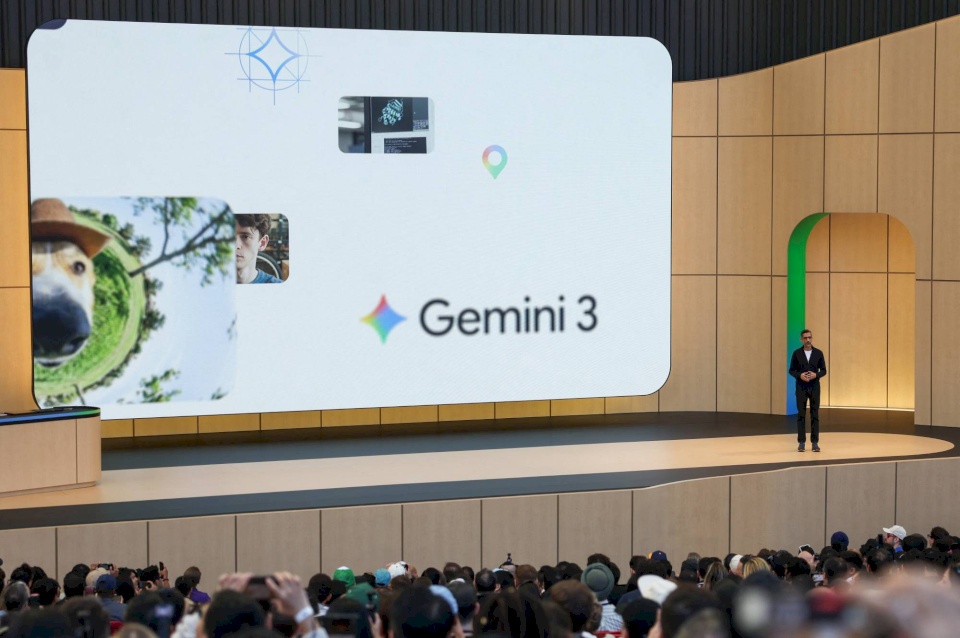
From 'Gemini' to Smart Glasses... Here Are the Highlights of Google's Developer Conference Announcements
SadaNews - The "Google I/O 2026" conference was not just an occasion to announce new AI models. The broader message was that "Google" wants to shift artificial intelligence from being a separate tool to a layer functioning within search, email, video, shopping, augmented reality glasses, and developer tools.
The question is no longer just: what can the model answer? But rather: how can AI become part of how we use the internet and our daily devices and services?
Search Enters the Agent Phase
The most significant point of the conference was the ongoing reconstruction of the search experience around artificial intelligence. "Google" announced that "AI Overviews" reached over 2.5 billion active monthly users, a figure indicating that AI-supported search is no longer a marginal experience. It also stated that "AI Mode" surpassed one billion active monthly users within a year, describing it as one of the largest shifts in the history of search.
This shift means that "Google" is no longer treating search merely as a list of links; instead, it is viewed as an interface capable of generating answers, assembling information, providing steps, and perhaps later executing tasks. Hence, the concept of the "agent era" emerged, which the company emphasized. Rather than users merely asking the search engine for information, "Google" wants AI to assist in planning, selecting, comparing, and executing within various products.
'Gemini' at the Heart of the System
"Google" introduced major updates to the "Gemini" family with announcements of new models such as "Gemini 3.5" and "Gemini Omni." The fundamental idea is that "Gemini" is no longer just a chatbot; rather, it serves as an operation center for tasks, media, and interaction among applications.
As showcased by the company, "Gemini 3.5 Flash" is presented as part of a new generation that combines speed and the ability to execute more complicated steps. "Google" talked about improvements in agent uses, programming, and long-term tasks. Meanwhile, "Gemini Omni" represents another direction as a multimodal model capable of handling various types of inputs, with a noticeable initial focus on video and media editing.
This aspect is important as it reveals the competitive direction in artificial intelligence. Major companies are no longer just racing for a model that writes better text; they are competing for a model that can understand text, images, sound, video, and personal context, and then navigate through products and services.
A Helper that Doesn't Wait for the User
Among the notable announcements was the introduction of "Gemini Spark," presented as a personal assistant capable of working in the background, following tasks across devices and applications. The idea is that AI remains connected beyond a question-and-answer moment; it can organize tasks, gather information, and link data from different services like email, maps, and calendars.
This trend positions "Google" in direct competition with other companies attempting to build AI agents that can work on behalf of the user. However, in "Google's" case, it takes on a distinct dimension due to the company's vast ecosystem of daily products, such as search, "Gmail," "YouTube," "Android," "Chrome," "Workspace," and maps. The more capable "Gemini" becomes at functioning within these services, the closer it gets to being a personal operating layer over the user’s digital life.
Email, Video, and Shopping
The presence of artificial intelligence was not limited to search; the announcements included new features in "Gmail," "YouTube," and shopping. Among the proposed ideas were more advanced voice interactions within email, new experiences for finding videos, or asking content-related questions within "YouTube," in addition to shopping tools that attempt to help users compare, track offers, and complete purchases more intelligently.
This indicates that "Google" wants to integrate artificial intelligence into practical usage moments like writing a message, searching for a video, choosing a product, comparing prices, or completing a small task that the user does not want to spend too much time on. Thus, artificial intelligence becomes less like an independent experience within a specific application and more like a supportive layer that appears as needed within each product.
The Return of Smart Glasses
The topic of smart glasses made a strong comeback at the conference, where "Google" presented its vision for glasses based on "Android XR" integrated with "Gemini," in partnership with companies like "Samsung," "Warby Parker," and "Gentle Monster." The message here is that after years of failed experiments with smart glasses, "Google" believes that artificial intelligence could be the element that makes these devices more useful.
The difference is that the new glasses are not presented merely as a camera or a small screen in front of the eye; rather, they serve as a means of acquiring contextual assistance in the real world. The model can see what the user sees, hear what is happening around them, provide immediate translations, assist in navigation, or answer questions related to the scene in front of them.
However, the success of this path will not rely on technology alone. The glasses must be socially acceptable, comfortable, and respect privacy, avoiding the mistakes of the first generation of wearable devices. Therefore, "Google" is working with specialized eyewear brands, not just tech companies, because form and daily acceptance will be critical.
Developer Tools
"Google" did not forget the developer audience, which is the essence of the "I/O" conference. The announcements included tools that allow building applications or interfaces or programming experiences using natural commands, in addition to improvements in models directed towards programming. This is important because the battle for artificial intelligence is not only settled in consumer products; it is also about developers' and companies' ability to build applications on top of the models.
"Google" wants to make application building faster and allow companies to use its models in multiple environments. Competition here is intense with "OpenAI," "Anthropic," and "Microsoft," especially in programming and business automation. Therefore, "Google" focused on speed, cost, and the models' ability to execute complex tasks, not just produce text answers.
AI as a New Interface
The common thread among the announcements is that "Google" is pushing towards making artificial intelligence a new user interface. In the past, the user would open an app, search, click, select, and then execute. The model proposed by "Google" aims to reduce these steps: ask, the system interprets, suggests, organizes, and perhaps executes.
This does not mean everything is ready or guaranteed. There are significant questions about accuracy of answers, data privacy, agent limitations, and how to prevent mistakes when AI begins to execute tasks instead of merely offering suggestions. Additionally, integrating AI into search could shift the relationship between publishers and sites with distribution platforms, as users might obtain composite answers without always going to the original source.
What Does This Mean for Users and Businesses?
For the average user, these transformations may gradually appear in the form of more interactive search, smarter email, a more present assistant, a more straightforward shopping experience, and possibly glasses capable of adding an information layer over the real world.
As for businesses, the most important message is that artificial intelligence is no longer a side project. If tools like "Gemini" become part of search, email, video, and devices, organizations will need to consider how they appear within these new experiences and how their data, content, and services are managed when AI becomes an intermediary between the user and the internet.
"Google" did not present a single isolated announcement; rather, it attempted to reorganize its products around one idea, which is that "Gemini" is not an additional application; it is an operational layer for the next phase of the personal and practical internet. This is what makes "Google I/O 2026" significant, not just because it unveiled a new model, but because it illustrated how "Google" wants to transition artificial intelligence from a chat window to the heart of everyday digital experience.
 Follow the latest Sada News via Google News
The Egyptian Federation Files Official Complaint Against Referee Letexier

Do You Know How to Comfort Someone Who is Crying? Here's What to Say and Do in Tough Momen...

"Backrooms": From Digital Legend to Cinematic Phenomenon

Prediabetes.. The Silent Bomb Carried by Millions Without Their Knowledge

From Sweden 1958 to the Epic of Egypt 2026.. Argentina's History with World Cup Comebacks

After the South Africa Precedent.. Nigeria Investigates the Encroachment of Technology Com...

Argentine Admission and Global Consensus on the Referee's Injustice to Egypt's National Te...
