

The government is under significant pressure... attempts to secure a payment of salaries soon may reach 50%
Exclusive SadaNews - Amidst union strikes and the worsening financial crisis of the Palestinian National Authority, and after more than a year of holding back clearance funds entirely, which constitute about 68% of the public treasury revenues of the authority, the government finds itself besieged on multiple fronts, amidst extraordinary efforts to secure a payment of salaries for public sector employees.
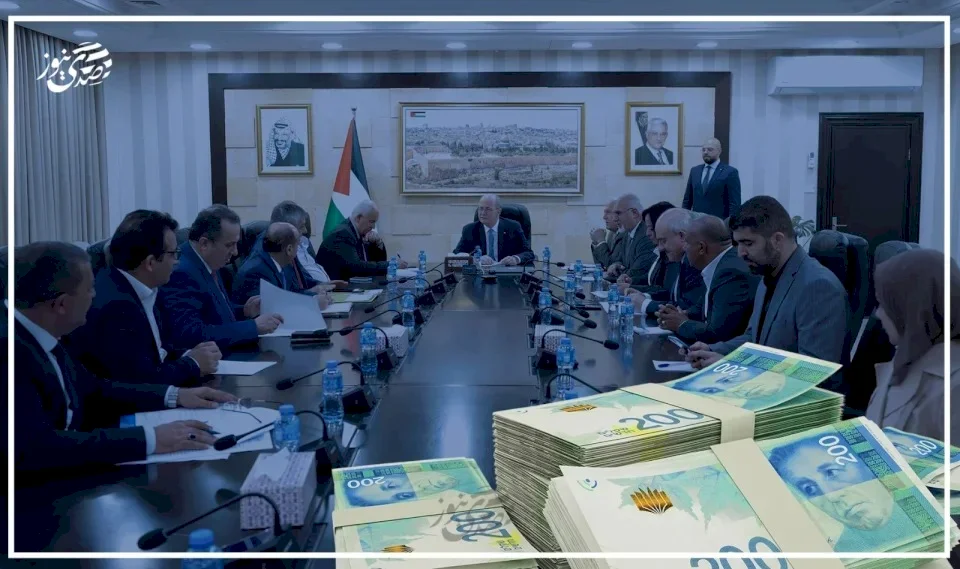
The Palestinian Cabinet announced during its weekly session today, Tuesday, that it listened to a presentation from Finance Minister Dr. Stifan Salama regarding ongoing efforts on various fronts and paths to secure sufficient financial resources to pay a portion of the salaries of public employees soon, in a clear message from the Cabinet to all employment sectors that it is making an effort to meet as many needs as possible, amidst a financial siege faced by the National Authority.
"SadaNews" has learned from informed sources that the complex financial conditions, which ignited extensive union protests, have pushed the government to "squeeze every penny" from an already empty treasury to provide the highest possible percentage of salary before the Eid al-Adha holiday, likely to be paid by the end of next week or the beginning of the following week (most likely between the 20th and 25th of this month).
An informed source noted that the government's direction is focused on paying a higher portion than last month which may reach 50%, with a minimum of 2,000 shekels, pointing out that indications of achieving this may be possible, but not guaranteed, as the success of the government in securing this payment will depend on several factors including completing steps to obtain facilities from one of the banks.
Sources suggested that the government relies on several pathways to provide a salary payment including local revenues ranging between 250-300 million shekels, as well as settlements with local companies and entities that may reach 150 million shekels, and also the pursuit of limited bank facilities amid the banking sector's rigidity and its refusal to grant the government more facilities without high guarantees, believing it has already given everything it can in this escalating crisis that sees no near-term solution, especially since the government has previously requested to postpone previous loan installments from this year, which may reflect on financial indicators of banks if they are asked to set reserves in return for these delayed installments.
In the event that the government is unable to secure the necessary amounts to pay the 50%, the scenario of repeating last month's payment remains possible, which is the disbursement of a fixed sum of 2,000 shekels for all job categories, but a source suggested that government efforts are concentrated on reaching a sum that enables it to pay the 50% recognizing the level of pressure that employees face during this difficult and critical phase.
The Cabinet confirmed in today’s session, Tuesday, the continued exceptional financial and political circumstances facing the State of Palestine due to the ongoing Israeli pressure on the Palestinian people, along with increasing challenges to the government’s ability to meet its financial obligations towards employees and vital sectors, and the government's ongoing efforts on all fronts to secure financial resources and external support, in addition to mobilizing more international pressure to release our funds withheld by the occupation.
In light of these extremely complex circumstances, the council called on various sectors to take into consideration the general situation and the difficult economic conditions of citizens, and to ensure the continued provision of essential and urgent services to the Palestinian people amid the difficult financial situation, especially as these circumstances are beyond the government’s capacity and capabilities, and therefore, any reluctance or disruption in providing essential services exacerbates the suffering of our people under the challenging conditions that everyone is experiencing.
The government relies on some limited assistance recently provided by the European Union or Japan to meet basic requirements to maintain vital services, especially in the health sector, and prevent its collapse, while sometimes having to increase borrowing to provide the necessary liquidity to ensure a salary payment.
It is noteworthy that the figures available from the Ministry of Finance and Planning indicate that the total public debt reached approximately 47.7 billion shekels by the end of last January, distributed between 10.7 billion shekels in local borrowing, 4.2 billion shekels in external borrowing, 7.9 billion shekels due to employees, 8.2 billion shekels due to the private sector, and 16.7 billion shekels in debts owed to the pension fund and other entities.
The monthly wage and salary bill for approximately 172,000 civilian and military employees, as well as nearly 290,000 beneficiaries, amounts to about one billion and fifty million shekels per month, which means that more than 80% of the National Authority's expenses go towards meeting its obligations in this regard.
 Follow the latest Sada News via Google News
High-level sources reveal to SadaNews: Washington seeks to hold a Gaza Reconstruction Conf...

Iraqji Reveals Details of the Attack on the Iranian Supreme Leader's Headquarters

صراع على إرث خامنئي وسط غياب مجتبى.. والمتشددون يتهمون قادة إيران بـ«الانقلاب»

The European Union Reiterates Its Call for Israel to Refrain from Expanding Settlements in...

"Mamdani Berlin".. The German Left Bets on a Politician of Turkish Descent to Lead the Cap...

Hebrew Channel: Kushner Pushing to Enhance Communication Between the United States and the...

SadaNews Report: Israeli Elections with a Settlement Flavor!
