

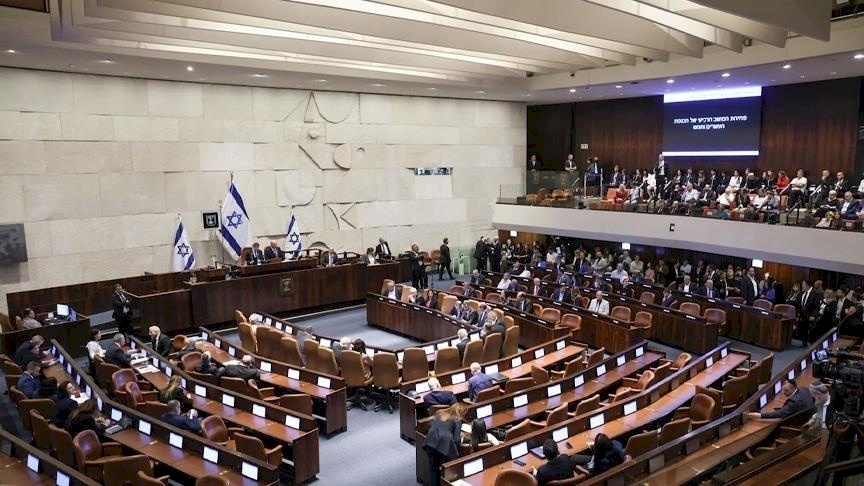
The Knesset Approves a Special Court to Trial "Elite" Prisoners... Death Penalty is on the Table
SadaNews - On Monday evening, the Knesset's plenum approved, in its second and third readings, a bill that establishes a special judicial body to prosecute Palestinian detainees accused by Israel of participating in the October 7, 2023 attack, including the possibility of issuing death sentences against them.
The law received support from 93 Knesset members, with no opposition, backed by the ruling coalition and a majority of Israeli opposition parties, after cooperation between the head of the parliamentary Constitution and Law Committee, MK Simcha Rothman (Religious Zionism), and MK Yulia Malinovsky (Yisrael Beitenu).
Israeli Minister of Justice Yariv Levin stated after the law's approval that "this is one of the most important moments in the current Knesset's life," considering that the law "ensures the trial of the terrorists and their partners and imposes penalties on them, including death sentences," in his words.
The law stipulates that no one suspected of involvement in the October 7, 2023 attack, or accused of it, or convicted for it, can be released in any prisoner deals; noting that the Knesset had approved the bill in the first reading last January.
The law establishes a special judicial body that will effectively operate as a military court, to look into the files of more than 250 detainees whom Israel classifies as "elite" members of the Hamas movement, held by Israel since October 7, 2023.
According to the law's text, indictments will be submitted to a military court in Jerusalem, including charges such as "genocide," "violating state sovereignty," "causing war," and "aiding the enemy in time of war," along with violations under the "Counter-Terrorism" law and murder charges.
The law grants the Chief of Staff of the Israeli army the authority to appoint military prosecutors, based on a recommendation from the military attorney general, while the court panel will consist of three judges, at least one of whom must have previously held the position of head of a military court.
The law also allows the court to bypass criminal procedure rules and evidentiary rules on the grounds that such actions are "necessary to reveal the truth and achieve justice," including handling investigation materials, the series of evidence, making decisions based on written pleadings, and making adjustments concerning witness testimony.
During the discussions preceding the law's approval, additional amendments were made, the most notable of which is the establishment of a special guard unit for the military court, similar to civil court guards, to be led by an officer appointed by the Israeli Minister of National Security, with the approval of the head of the military appeals body.
A clause was also added allowing for the establishment of special regulations for the execution of death sentences issued under this law, essentially separating it from the death penalty law which the Knesset approved at the end of March, which does not directly apply to the detainees of the "elite."
The bill has faced criticism within Israel since its inception, particularly for being presented as a special legislative initiative after the Minister of Justice failed to pass a government bill due to ongoing disputes with the government legal advisor, Gali Baharav Miara, who considers the law unconstitutional.
 Follow the latest Sada News via Google News
Axios: Proposal for a 10-day Ceasefire Between Washington and Tehran and Two Options for M...

In a Rapid Pace.. The Occupation Builds a Huge Earth Barrier Inside Gaza

Meeting Between Aoun and Trump Expected Alongside 'Experimental Areas'

Gaza Health Warns of Collapse of Oncology Services Due to Depletion of Treatments and Susp...

The Occupation Demolishes a House in the Town of Sa'ir near Hebron

Israel Reveals Details of Secret Iranian Nuclear Facility in Mount Fas

A Mother, Her Child, and Her Three Daughters Martyred in Israeli Shelling on Gaza City
