

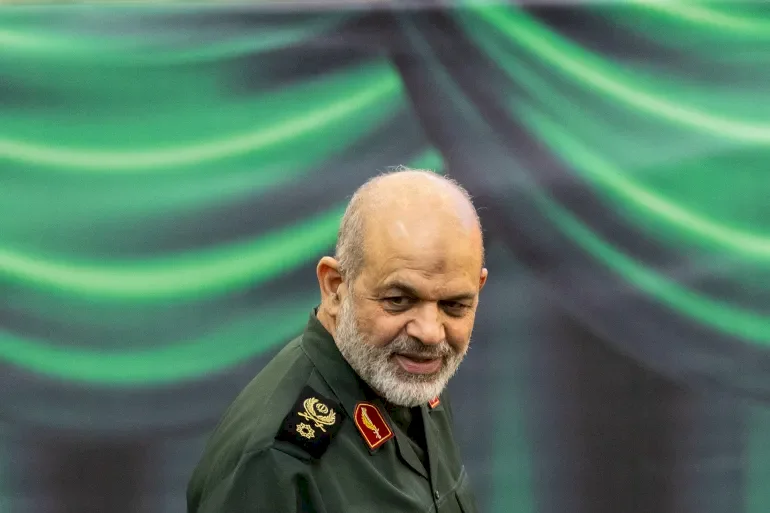
Turkish Newspaper: Ahmad Vahidi, the Shadow Strategist in Iran's Policies
SadaNews - Amid rising tensions between Tehran and Washington, journalistic analyses have highlighted Iranian Revolutionary Guard leader Ahmad Vahidi as the shadow strategist who determines the course of the Iranian scene from behind the scenes.
With the surprising American decision to extend the ceasefire, the debate over the dividing lines between diplomacy and the balances of power on the ground has resurfaced, amid increasing talk of a silent power that could change the rules of the game, as reported by Turkish newspaper Hurriyet.
In this context, Turkish researcher at the Iranian Studies Center (Eram) Oral Toga points to the Iranian Revolutionary Guard's monopoly over civilian institutions, which has gradually escalated since 2010 and peaked after 2021.
While Ahmad Vahidi's name emerges as the real decision-maker behind the scenes, Toga clarifies to Hurriyet that the current scene in Iran is not a reflection of a division in power, but rather a result of a monopolized decision-making center that has yet to formulate a unified proposal to present to the United States.
A Silent Power
Regarding the reasons for Vahidi's almost complete absence from the media scene, the Turkish researcher believes it should be assessed on three levels:
Operational Security: The assassination of the former leaders of the Revolutionary Guard shows that the public appearance of senior leaders has directly turned into a factor that threatens their lives.
Personal Career Path: As a leader of the Quds Force prior to Qassem Soleimani's era, Vahidi belongs to a school of intelligence discipline and adopts a personality that is closed off from the media.
Ideological Level: In the post-assassination environment, the Iranian high leadership has returned to operating on the principles of concealment and distributed leadership.
The Role of Regional Agents
When asked whether Vahidi's strategic background would make Iran's regional agent networks mere deterrents or transform them into a doctrine for disciplined escalation, Toga pointed out that Vahidi's background does not allow for confining these networks to a single doctrine, explaining the following:
During his leadership of the Quds Force between 1988 and 1997, Tehran's relationship with its regional allies was based on two functions: deterrence by increasing the cost of targeting Tehran, and disciplined escalation through managing conflict via proxies.
This doctrine has significantly declined in the current scene as a result of the "notable weakness" of Hezbollah in the post-2023 period and the "erosion" of the resistance axis model.
With the fall of the regime of ousted Syrian President Bashar al-Assad in Syria and the Houthi movement facing international pressures, Vahidi's influence on these structures increasingly relies on the memory of the founding generation, but the real variable that determines field effectiveness is the ability of these proxies to withstand.
 Follow the latest Sada News via Google News
Monitoring the Fall of Two Drones from Lebanon in Western Galilee

Ben Gvir Threatens: A Thousand Hezbollah Killed for Every Hair of an Israeli Soldier

Smotrich Calls for Demolition of Buildings in the Southern Suburb of Beirut

Raids and Arrests in the West Bank

Growing Israeli Concern as Washington and Tehran Agreement Approaches

New York Times: Iran Emerges from War More Hardline

Israeli Opposition Leader Criticizes Upcoming Agreement with Iran
