

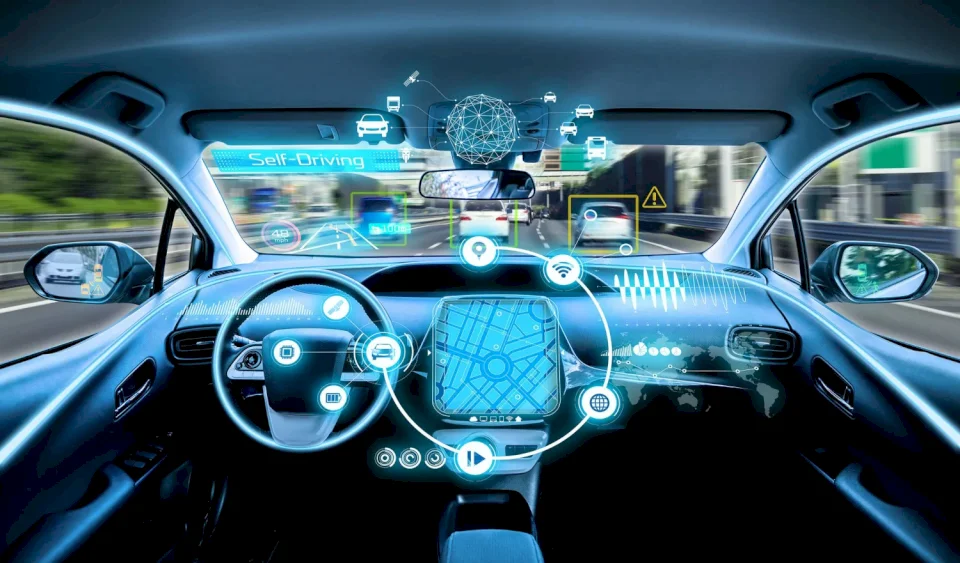
Smart Eyes Give Autonomous Cars a Human-like Vision
SadaNews - Autonomous cars and advanced robots face a fundamental challenge in dealing with environments where lighting changes rapidly or where levels of light and darkness overlap. Cameras, algorithms, and artificial intelligence can analyze scenes under many conditions, but they may stumble when strong light meets dark backgrounds, as happens, for example, when driving a car at night amidst powerful headlights and dark skies.
A new study, co-led by an engineer from Penn State University, suggests a different approach to tackle this problem. Instead of solely relying on improving cameras or training algorithms, the researchers turned to simulating the mechanism of the human eye itself by developing a small component capable of adjusting its light sensitivity according to the surrounding environment.
The Mixed Light Problem
Artificial vision systems typically work well when lighting conditions are stable, whether they are bright or dim. However, the problem arises when the scene is mixed, such as a very bright part and a dimly lit part, with small details that need to be distinguished amid this contrast.
This type of environment is not rare, as the autonomous car may need to distinguish a red light amid strong reflections or see pedestrians at the edge of a dark road with opposing vehicle lights. A factory robot might move between well-lit areas and others that are much darker. In these cases, it is not enough for the camera to be high-definition; the system must be able to adapt to light as the human eye does.
A Component that Mimics the Eye
The component developed by the researchers belongs to a class known as "photomemristors," which are optical versions of memristors. A memristor is a small electrical device capable of storing information about its previous state, even after the power source is removed. The photomemristor adds to this the ability to sense light and convert it into an electrical current.
In the human eye, rod and cone cells help manage different light levels. In darkness, rod cells allow the distinction of details, while their pigments are affected in bright light before gradually replenishing. This process inspired the researchers to design a component that changes its behavior depending on the light, rather than remaining fixed in one state.
The team used two main materials to build the device: the first is a conductive gel-like plastic known as "PEDOT" and titanium dioxide. Titanium dioxide captures light from the environment and converts it into an electrical current, which then influences the plastic material's ability to absorb or expel water from its structure. In darkness, the component quickly absorbs water. In light, it expels water and gradually dries out. This movement between absorption and expulsion allows the device to dynamically regulate its light sensitivity.
Faster Adaptation than the Human Eye
The researchers tested the new components by exposing them to different levels of ultraviolet radiation. The results showed they could effectively and accurately sense light intensity while maintaining stable readings even when external humidity varied.
Although each component is very small, about half a millimeter, multiple components can be connected together to form a larger array without needing to increase the size of each unit. To test the idea, the team created a 4 by 4 array of components and connected it to a neural network in a simple vision system simulating what cars or robots might use.
In the experiment, the researchers placed "LED" lights shaped like the letter "F" against a background with adjustable brightness. The system was required to distinguish the letter despite the difference in lighting between the shape and the background. After just seven training cycles, the system was able to recognize the patterns with an accuracy exceeding 95 percent in a mixed lighting environment.
Notably, the researchers state that the human eye may take 20 to 30 minutes to fully adapt to changes in lighting, while these components adapted in seconds, while still retaining their ability to capture details from the surrounding environment.
The Significance of the Research for Cars and Robots
This research does not mean that autonomous cars will soon have a complete "human eye." The technology is still in the research phase and requires further development and wider testing before entering commercial applications. However, its significance lies in the direction it points to: instead of making vision systems more reliant on software processing alone, the components themselves can be improved to become smarter and more adaptive at the sensing level.
In autonomous cars, such components may help in the future to enhance vision in challenging conditions such as nighttime, tunnels, reflections, or sudden transitions between shadow and light. In robots, they could enable more reliable operation in factories or changing environments where lighting is not always optimal or stable.
Toward More Integrated Artificial Senses
The research team plans to develop these components within a larger sensing system capable of integrating vision and touch. The idea is that future robots and machines may not rely on one type of data but on a mix of artificial senses that work together more efficiently and with lower energy consumption. While the direct application in cars and robots is the closest, the researchers also point to the potential for this technology in the long term to contribute to optical systems that assist the visually impaired. However, this possibility remains distant and requires lengthy development stages. What the research proposes is that artificial vision might not only become better through stronger artificial intelligence but through sensors that learn from one of nature's oldest and most precise technologies: the human eye.
 Follow the latest Sada News via Google News
World Cup: America Secures a Big Win, Canada Snatches an Exciting Draw

The England Stars' Shoes and Equipment Robbed in Major Heist in America

Smart Eyes Give Autonomous Cars a Human-like Vision

Watermelon is Not Just for Hydration... An Unexpected Benefit for Heart Health

Surprising Study: Changing Your Diet May Make You Younger in Just One Month

Why Does Poor Sleep Make You Feel Older?

Study: Dietary Supplement for Joint Pain Linked to Worsening Dementia
