

Step by Step: What Do We Know So Far About the "Hormuz" Siege?
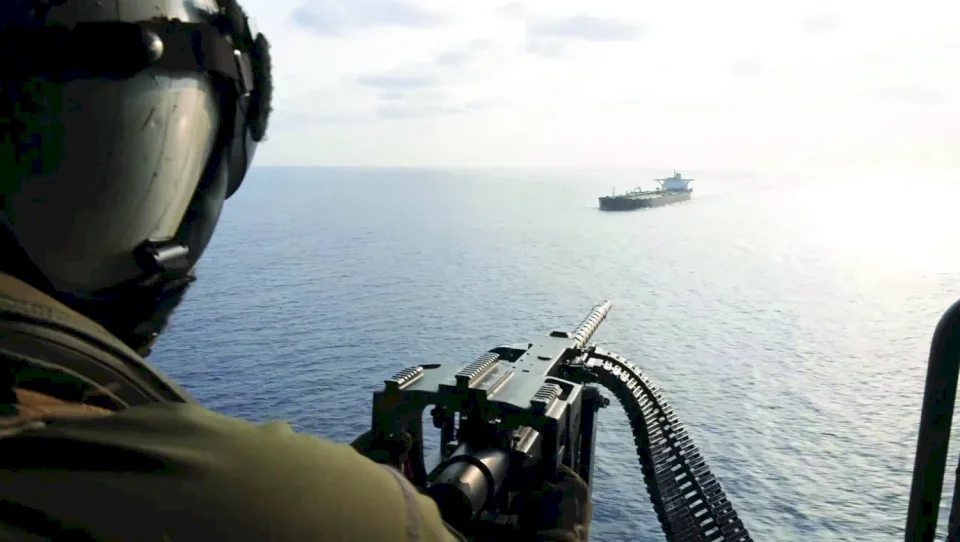
SadaNews - Since Monday, only three ships have crossed the Strait of Hormuz; maritime traffic has almost come to a standstill following attacks targeting commercial vessels by the United States and Iran in an attempt to control this vital waterway.
An American Navy destroyer opened fire on and seized an Iranian cargo ship on Sunday after it defied the American blockade imposed on Iranian ports.
In a separate incident, two vessels were hit while trying to cross the strait on Saturday, according to the UK Maritime Trade Operations Center. One was fired upon by armed boats belonging to the "Revolutionary Guards," while the other was struck by a "mysterious projectile." Those ships, along with others, then changed their course.
A fragile two-week truce between the US and Iran is set to expire on Wednesday.
What are the latest updates?
The US Central Command (CENTCOM) said on Monday that the Navy has redirected 27 ships attempting to enter or leave Iranian ports since the start of the US blockade outside the disputed Strait of Hormuz about a week ago.
On Sunday, an American destroyer attacked and seized the Iranian cargo ship "Tosca" in the Gulf of Oman, near the strait, after it ignored a six-hour warning from the US to turn back, according to "CENTCOM".
The destroyer, equipped with guided missiles, "Spreance" - one of more than a dozen warships enforcing the blockade - ordered the crew of the ship to evacuate the engine room before firing several rounds from its "Mk-45" gun at the propulsion system, while the ship was headed toward "Bandar Abbas" in Iran, according to a statement that included a video recording.
US officials will decide what to do with the disabled ship after the inspection is completed. Independent experts suggested that one option could be towing it to Oman, while another could involve allowing it to navigate to an Iranian port if it is able.
Iran has stated it will soon respond to what it termed as "armed piracy".
Also on Sunday, Iran attacked two ships that were trying to cross the strait, according to the British Maritime Operations Center, while India stated that the two vessels were flying its flag.
Additionally, Iran forced at least two other tankers - one flying the flag of Botswana and the other the flag of Angola - to turn back, according to a semi-official Iranian news agency.
How is the US enforcing the blockade?
"CENTCOM" reported that it is using over 10,000 soldiers, more than a dozen warships, and dozens of aircraft to prevent ships from sailing to and from Iranian ports.
There are no fixed geographic boundaries for the blockade, as the US military stated that it will be enforced from the Gulf of Oman and the Arabian Sea, both located east of the Strait of Hormuz.
Experts say the US military is capable of enforcing the blockade from distances far away and does not need to approach ships to force them to change course.
An American official stated that more than 12 military ships were stationed in international waters in the Gulf of Oman, while the military reported that an amphibious assault ship participating in the mission was sailing in the Arabian Sea at a farther distance.
Can ships evade the blockade?
Maritime intelligence experts note that more ships in the vicinity of the Strait of Hormuz have begun adopting "misleading" tactics to avoid detection.
Under international maritime law, most large commercial ships carry a transponder that automatically broadcasts the ship’s name, position, trajectory, and other identifying information, including a nine-digit number representing its "digital fingerprint".
These methods have previously been employed by ships in Russia's "shadow fleet" to evade sanctions related to the 2022 Ukraine war.
When using misdirection, the ship’s captain can enter a false origin or destination, or pretend to be navigating another ship, as well as temporarily turn off transponder devices, making it appear as if the ship has disappeared from one location and appeared in another.
Eric Bethel, a partner at the “Marine Liberaum” technology investment fund, stated that the strait represents a "contested information environment".
However, regardless of the tricks they employ, ships headed to and from Iran may only reach a certain limit. It is difficult to pass between open ocean and a narrow waterway like the Strait of Hormuz without being discovered.
The CEO of "Windward", Amy Daniel, said: "I estimate that the US Navy can operate in the Gulf of Oman... I don’t think there is a way to breach the blockade."
What are the strategies of the US and Iran?
The blockade represents a crucial test in the war: which party can bear greater economic costs?
Instead of using missiles and bombs, President Donald Trump aims to choke off Iranian oil exports, which represent nearly all of the government's revenue.
Some experts have questioned whether the blockade will succeed; as International Relations professor in Ankara, Ahmed Qassem Haan, stated: "Iran is already suffering, but it has shown a willingness to withstand additional blows.”
In contrast, Iran relies on its influence in global energy markets, where it can impact the US economy through rising fuel and commodity prices.
Why is the strait important?
The Strait of Hormuz is a strategic passageway linking the Arabian Gulf to the Gulf of Oman and the Indian Ocean, and it is the only maritime route for transporting oil, gas, and goods from the gulf, with the Iranian coasts extending along its length.
At its narrowest point - between Iran to the north and Oman’s Musandam Peninsula to the south - the width of the navigational channel is about two miles in each direction, according to the International Energy Agency.
The legal status of the strait is complex; it lies within the territorial waters of Iran and Oman, but is treated internationally as an open waterway. Iran signed this framework but has not ratified it.
Before the war, about 20% of the world’s oil and liquefied natural gas passed through the strait, mostly headed for Asia, particularly China, India, Japan, and South Korea.
It is also used by other ships, including car carriers and container ships. Vital goods passing through include helium from Qatar, fertilizers from Oman and Saudi Arabia, and plastics from petrochemical industries in the region.
How does Iran control the strait?
The Iranian military can threaten maritime navigation throughout the Strait of Hormuz, despite the destruction of a large part of its naval fleet due to American and Israeli strikes.
The US and Israel launched their war against Iran, arguing that if Iran ever obtained a nuclear weapon, it would have the ultimate deterrent against any future attacks. It has been shown that Iran already possesses a deterrent: geography.
Caitlin Talmadge, a professor at the Massachusetts Institute of Technology who studies Gulf security, said, "Iranians have thought carefully about how to use geography to their advantage." Their arsenal includes missiles, drones, fast boats, and mines.
The narrowness of the strait forces ships to approach the mountainous Iranian shores, giving Tehran an advantage in employing asymmetric warfare tactics based on small, dispersed weapons that are difficult to eliminate completely.
However, placing mines in the strait could also prevent Iran’s own oil - and the much-needed revenue it provides - from exiting the gulf.
Nonetheless, laying mines could also hinder Iran’s own oil exports.
How do oil prices react?
The near-total closure of the strait has caused the "biggest supply disruption in the history of the global oil market," according to the International Energy Agency.
The rise in energy prices has impacted the global economy, increasing inflationary pressures and threatening several countries.
Despite Trump’s rhetoric about US "energy dominance," oil is a globally priced commodity, meaning that rising prices translate directly into fuel prices within the US, regardless of its domestic production levels.
 Follow the latest Sada News via Google News
The Presidency: The Break-in at Al-Aqsa is a Gross Violation of the Historical and Legal S...

The Electoral Committee Announces the Legal Timelines for the 2026 Legislative Elections

Panic Grips Israel Following Washington-Riyadh Nuclear Deal

Officially.. Saudi Arabia and America Announce Reaching Nuclear Cooperation Agreement

More than 900 settlers storm Al-Aqsa Mosque so far

Why Can't Zahran Mamdani Arrest Netanyahu in New York?

The 5,000 Plan: What Are the 'Temple' Groups Planning for Al-Aqsa?
