

Trump: Iran Cannot Blackmail America
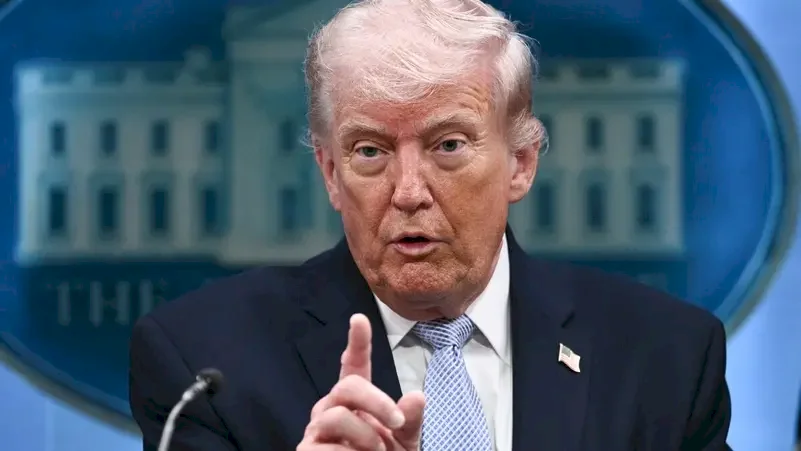
SadaNews - U.S. President Donald Trump said on Saturday that "Iran cannot blackmail" the United States, emphasizing that "very good" talks are ongoing.
Trump indicated that there is "some very good news regarding Iran," hinting at optimism regarding peace talks to end the war on Iran, but he noted that the ceasefire in the conflict may not be extended unless an agreement is reached by Wednesday.
Iran temporarily reopened the Strait of Hormuz a few hours ago, following a separate ceasefire agreement brokered by the U.S. between Israel and Lebanon. However, subsequent statements from both the U.S. and Iranian sides left a haze regarding how quickly maritime traffic could return to normal through this strategic oil passage.
Trump, in statements aboard Air Force One on Friday, refused to delve into details about this good news.
Ambiguity Surrounding Direct Talks
Trump told reporters while returning to Washington from Phoenix, Arizona, "Things seem to be going well in the Middle East with Iran... We will negotiate at the beginning of the week. I expect things to go well. Several of these matters have been negotiated and agreed upon."
He added, "The most important thing is that Iran will not possess a nuclear weapon. Iran cannot be allowed to have a nuclear weapon; that comes before anything else."
But in a sharp contradiction, he said he may end the ceasefire with Iran unless a long-term agreement to end the war is reached before it expires on Wednesday, adding that the U.S. blockade on Iranian ports will continue.
The war with Iran, which began on February 28 with a U.S.-Israeli attack, has resulted in thousands of deaths and a rise in oil prices due to the effective closure of the Strait of Hormuz, through which about one-fifth of global oil trade passed until recently.
Trump told Reuters that there may be further direct talks between Iran and the United States at the beginning of this week. Some diplomats have said that this is unlikely due to logistical difficulties related to meeting in Islamabad, where talks are expected to take place.
No signs of preparations for talks in the Pakistani capital had emerged even as early as Saturday morning, where high-level U.S.-Iranian negotiations since the Islamic Revolution in 1979 ended without an agreement last weekend.
The chief Pakistani mediator, Army Chief Asim Munir, has been in talks in Tehran since Wednesday.
A Pakistani source familiar with the mediation efforts stated that a meeting between Iran and the United States could result in a preliminary memorandum of understanding, followed by a comprehensive peace agreement within 60 days.
Among the complicating factors, Iran's parliament speaker and chief negotiator Mohammad Baqir Qalibaf posted on social media that the Strait of Hormuz "will not remain open" if the U.S. blockade continues.
Iranian Foreign Minister Abbas Araghchi had announced on social media that the strait is open to all commercial vessels during the remaining period of a 10-day truce agreed upon on Thursday between Israel and Lebanon, which was attacked by Israel after the Iran-backed Hezbollah group joined the fighting.
Data from ship movements showed a group of about 20 vessels, including container ships, bulk carriers, and oil tankers, crossing the Gulf towards the Strait of Hormuz on Friday evening, but most ended up returning without a clear reason.
The group included three container vessels belonging to the French shipping group CMA CGM, which declined to comment.
Tehran affirmed the necessity for all ships passing through the Strait of Hormuz to coordinate with the Iranian Revolutionary Guard, a practice not in place before the war. The Ministry of Defense stated in a broadcast by state television that military vessels and ships associated with "hostile forces," meaning the U.S. and Israel, are still banned from passage.
Shipping companies said they would seek clarifications, including regarding mine risks, before their vessels can pass through the strait into the Gulf.
The U.S. Navy warned sailors that the mine risk in parts of the waterway has not been fully determined, advising them to avoid the area.
Ambiguity Regarding the Iranian Nuclear Program
It remains unclear how both sides will address the Iranian nuclear program, a major point of contention in the talks so far, as Iran defends its right to what it says is a civil nuclear energy program.
Trump told Reuters that the U.S. will take the enriched uranium out of Iran, but Iranian Foreign Ministry spokesman Ismail Baqaei confirmed to state television that these materials will not be transferred anywhere.
On the other hand, a senior Iranian official told Reuters that Tehran hopes to reach a preliminary agreement in the coming days.
Oil prices fell by about 10 percent, while stocks worldwide saw a surge on Friday following news of a potential resumption of maritime traffic through the strait.
The UK stated after a video conference held on Friday that more than 12 countries have expressed readiness to join an international mission to protect navigation in the strait when conditions allow.
A senior Iranian official told Reuters that there is an agreement to unfreeze Iranian assets worth billions of dollars as part of a deal to reopen the Strait of Hormuz, though no timeline was provided.
Later on Friday, Trump, who has repeatedly referred to the peace agreement as a "deal" or "transaction," said at a rally with his supporters in Arizona that "no money will be paid in any form whatsoever."
The U.S. had previously proposed in negotiations to suspend all Iranian nuclear activities for 20 years, but sources familiar with the proposals said Tehran suggested a suspension of between three and five years.
Two Iranian sources indicated that there are signs of a compromise that could allow for the removal of part of the stockpile.
Trump told Reuters that the U.S. may not move quickly. He added in a phone interview, "We will start working with Iran at a calm pace... and we will start digging with massive machines... and we will bring it to the United States."
He used the term "nuclear dust" to refer to the effects left by the U.S. and Israel's bombing of Iranian nuclear facilities in June of last year.
Despite Trump's optimism, Iranian sources told Reuters that there are "still ongoing disputes" before reaching a preliminary agreement, while senior clerics adopted a hardline tone in Friday sermons.
Cleric Ahmad Khatami said, "Our people do not negotiate while being humiliated."
 Follow the latest Sada News via Google News
Washington Investigates Possible Russian Role in Iranian Attacks on Its Sites

Mossad Chief Visited Washington to Discuss Iran and Its Nuclear Program

Report: Washington Informed Israel It Is Preparing to Intensify Attacks on Iran and Use St...

Organization of Islamic Cooperation Condemns Nauru's Decision to Open an Embassy in Occupi...

Video:: Nablus: Settlers Evict Tubasi Family from Their Home in Jaloud and Take Over It

Netanyahu: I Intend to Form a Broad National Unity Government

Syrian Foreign Minister Meets with Yasser Abbas in Damascus
