

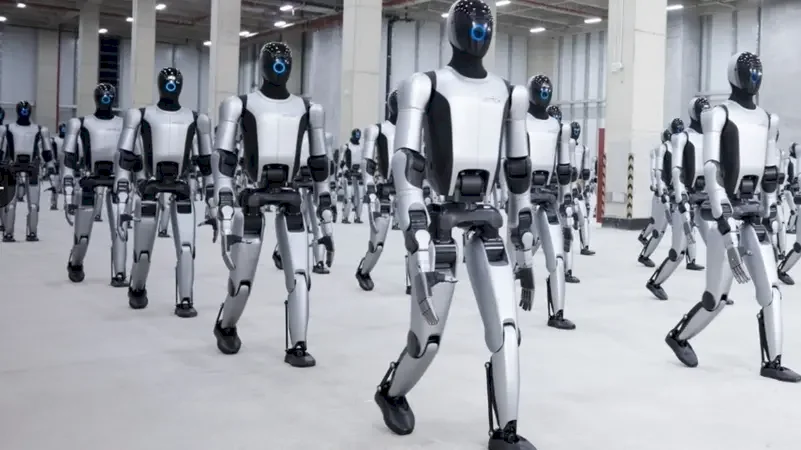
Swiss Study: Robots May Learn the Same Skill Without Complete Reprogramming
SadaNews - Researchers from the CREATE lab at the Swiss Federal Institute of Technology in Lausanne (EPFL) have developed a new framework aimed at addressing one of the most perplexing issues in industrial robotics related to how to teach one skill to robots with different structures without having to reprogram from scratch each time.
The study, published in the journal Science Robotics, introduces what the researchers call "motor intelligence," an approach that transforms the task presented by a human into a general movement strategy, then automatically adapts it to the mechanical design of each robot individually.
The problem is that robots, even when used for similar tasks, do not move in the same way. Variations in joint arrangements, movement limits, and balance requirements make the skill learned by one robot non-transferable to another robot directly. Consequently, updating a fleet of robots in factories often does not just mean replacing the hardware; it also involves redefining tasks, adjusting safety limits, and re-verifying the movement behavior of each new platform. The new study seeks to separate the "idea of skill" from the characteristics of individual robots, allowing it to be transferred between different platforms at a lower cost and in a shorter time.
Safe Skill Transfer
To build this framework, researchers started with human-demonstrated manipulation tasks, such as positioning, pushing, and throwing. The team used motion capture techniques to record these tasks, then mathematically transformed them into general movement strategies that are not tied to any specific robot. After that, they established an organized classification of the physical constraints specific to each robotic design, such as the range of joint movements and positions to avoid to maintain stability. Thus, the robot no longer copies human movement or that of another robot as is, but "interprets" the skill within its own mechanical boundaries.
In the core experiment, a human presented a complex task on an assembly line by pushing a wooden block from a conveyor belt to a work platform, placing it on a table, and then throwing it into a basket. According to the report, three completely different commercial robots were able to safely and reliably execute the same sequence using the motor intelligence framework. Most importantly, the system continued to operate even when the distribution of steps among robots changed, indicating that the framework does not just memorize a single path but transfers the logic of the task itself to different bodies.
Faster and Simpler Automation
The researchers state that the main value here relates not only to completing the task but also to ensuring that each robot executes it within its safety limits. The lab head, Od Pellars, described this as addressing an old challenge in robotics related to transferring learned skills between robots with different mechanical structures while maintaining safe and predictable behavior. One participating researcher clarified that each robot "interprets the same skill in its own way but always within safe and feasible limits." This point is crucial because many robotic learning systems perform well in the lab but become less reliable when moved to other platforms or to actual operational environments.
The significance of this approach is particularly apparent in manufacturing, where switching or upgrading robots can lead to long and costly disruptions. If skills can be transferred between different robots through a general representation of the task instead of detailed reprogramming, deploying new robots could become faster and more sustainable. The report also notes that this could reduce the level of technical expertise required to operate systems in real-world environments, which may be important for companies looking to expand automation without entirely relying on specialized programming teams for each platform.
The researchers' ambitions extend beyond production lines. They envision that the framework could extend to collaboration between humans and robots or to interaction based on natural language, where users can direct robots with simple commands without delving into complex technical programming. The approach also seems suitable for emerging robotic platforms where hardware is evolving rapidly, and current models may be replaced with more advanced ones in a short period. In these environments, the challenge is not only to teach a robot one task but also to maintain that skill transferable with each new generation of machines.
 Follow the latest Sada News via Google News
After Deschamps' Departure... Zinedine Zidane Tops the Candidates to Lead France

Mbappe Surpasses Messi and Becomes the All-Time Top Scorer in the World Cup

England Defeats France and Achieves Largest World Cup Achievement Since 1966

Messi Refused to Play for Spain and Missed 3 World Cups

Publishers Sue Google for Allegedly Using Books to Train Artificial Intelligence

Google Expands Capabilities of Google Search Console to Support Social Media Accounts

The Mediterranean Table... An Ancient Diet Revealing Its New Secrets for Health and Longev...
