

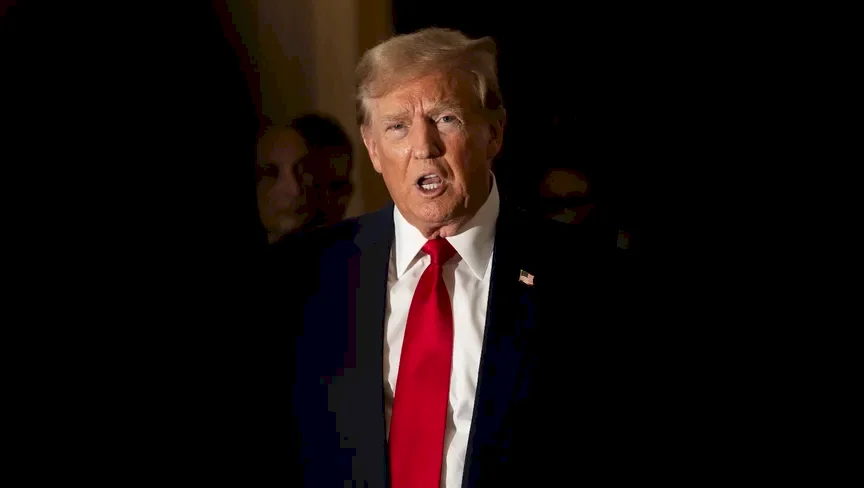
Trump announces an expected meeting between the "leaders" of Israel and Lebanon
SadaNews - U.S. President Donald Trump said late Wednesday (U.S. time) that the Israeli and Lebanese leaders will speak on Thursday, a day after their first direct negotiations.
Trump wrote on his Truth Social platform, "We are trying to find a period of calm between Israel and Lebanon. It has been a long time since the last conversation between the two leaders (Israeli and Lebanese), nearly 34 years. That will happen tomorrow," but he did not provide any additional details and did not specify who he meant by the leaders.
The Israeli attacks on Lebanon since March 2 have resulted in the deaths of more than 2,100 people and the displacement of more than a million from their homes, according to authorities.
"Not happening anytime soon"
A Lebanese official source told Agence France-Presse that he has no information about any expected contact with the Israeli side.
The newspaper Israel Hayom reported, citing informed sources, on Thursday that despite Trump's statements, a ceasefire in Lebanon "will not happen anytime soon."
The Israeli Broadcasting Authority (official) also stated that the military leadership confirmed that it had not received any instructions from the political leadership to prepare for a ceasefire in Lebanon.
In contrast, the British newspaper Financial Times reported on Thursday, citing Lebanese officials, that they expect a ceasefire between Israel and Lebanon "soon."
A senior official in the U.S. administration said that Trump would welcome the end of the war between Israel and Hezbollah, but noted that a similar agreement does not constitute part of the ongoing peace negotiations with Iran, according to Agence France-Presse.
The official, who did not wish to be identified, stated, "The president will welcome the end of hostilities in Lebanon as part of a peace agreement between Israel and Lebanon."
He added, "The United States wants to see lasting peace, but it has not demanded an immediate ceasefire," pointing out that "the negotiations between the U.S. and Iran are not related to the ongoing peace talks between Israel and Lebanon."
The official clarified that Washington's focus is on building trust between the Lebanese and Israeli governments "so that we can find a space for a peace agreement, and for any future understandings to be lasting. Both sides need to build political momentum."
Direct talks took place on Tuesday between Lebanon and Israel in Washington, lasting for two and a half hours, and the two sides agreed at the conclusion to start peace negotiations, the location and timing of which will be determined later.
Israeli Ambassador to Washington Yair Lapid, Lebanese Ambassador to Washington Nada Hamadeh Mouawad, and U.S. Ambassador to Beirut Michel Issa participated in the talks.
The recent diplomatic developments coincided with the ongoing Israeli military escalation on the ground, while Lebanon is experiencing sharp internal divisions regarding these talks.
On March 9, the Lebanese president called for starting direct negotiations with Israel under international sponsorship, as part of an initiative aimed at establishing a complete truce halting all Israeli attacks on his country.
On April 8, the U.S. and Iran announced a two-week truce, mediated by Pakistan, paving the way for a final agreement to stop the war initiated by Washington and Tel Aviv on Tehran on February 28, which extended to Lebanon, resulting in thousands of casualties.
Despite Islamabad and Tehran confirming that the truce includes Lebanon, Washington and Tel Aviv denied that, and the Israeli occupation army launched strikes on Lebanon last Wednesday, described as the most intense since the war began, resulting in at least 357 deaths and 1,223 injuries on the first day of the truce, according to the Lebanese Ministry of Health.
 Follow the latest Sada News via Google News
Washington Investigates Possible Russian Role in Iranian Attacks on Its Sites

Mossad Chief Visited Washington to Discuss Iran and Its Nuclear Program

Report: Washington Informed Israel It Is Preparing to Intensify Attacks on Iran and Use St...

Organization of Islamic Cooperation Condemns Nauru's Decision to Open an Embassy in Occupi...

Video:: Nablus: Settlers Evict Tubasi Family from Their Home in Jaloud and Take Over It

Netanyahu: I Intend to Form a Broad National Unity Government

Syrian Foreign Minister Meets with Yasser Abbas in Damascus
