

Lacking Food Security.. Daraa Camp Without "Basic Living Essentials"
SadaNews - The suffering of Palestinian refugees in the Daraa camp in southern Syria is increasing day by day, as living conditions deteriorate and essential services decline, amid a lack of income sources and ongoing economic pressures that have exhausted the residents.
Residents say that their daily lives have become harsher, with difficulties in securing basic needs for food and medicine, along with a noticeable drop in health and educational services.
This camp is located in the center of Daraa city in southern Syria and was established in 1950 to accommodate Palestinian refugees who were displaced from their homes following the Nakba of Palestine in 1948. Today, its population is approximately 11,500 refugees, according to local estimates, making it one of the oldest Palestinian communities in the region.
Poverty in Living Essentials
Palestinian refugee Abdullah Al-Hassan, a resident of the camp, states that conditions have reached "unprecedented levels," noting that the cessation of financial and food aid for more than a year and a half has exacerbated poverty and food insecurity among most families.
He adds that reduced health services have increased the suffering of residents; medication shortages and rising costs of surgeries have become unaffordable for many, forcing patients to seek treatment in the private sector and face its high costs.
He noted that the absence of sanitation services has accumulated waste within the camp, warning of disease outbreaks, in addition to the deterioration of infrastructure that has been significantly damaged during years of war.
He called on the United Nations Relief and Works Agency for Palestine Refugees in the Near East (UNRWA) to urgently reactivate support programs and improve essential services, along with providing job opportunities to help residents cope with difficult economic conditions.
The story of Mohammad Beitari, one of the residents of the Daraa camp, reflects a part of the patients' suffering amid declining health support. He told Al Jazeera Net that his wife suffered from severe hemorrhaging about a year ago, which required emergency surgery costing approximately 5 million Syrian pounds (about $400). He approached UNRWA for financial assistance and was informed that there was approval to cover part of the costs.
Consequently, Beitari had to borrow the amount and have the surgery done at a private hospital in Daraa city, but to this day, after a full year, he has not received any amount, he confirmed, "despite repeated follow-ups and ongoing promises."
He continued, "I wish I had been informed that funding was unavailable, rather than being given hope on which I based my decision to borrow," pointing out that he has only managed to repay half of the amount so far and was forced to sell some of his household belongings to cover part of the debt.
Beitari works intermittently in car maintenance after leaving his shop due to high rent, noting that his current income "barely covers his family's basic needs."
Demands and Pressure
The suffering of women in the camp has doubled in recent years, especially as many have lost their husbands or providers.
Noorhan Al-Hamd, speaking to Al Jazeera Net, indicated that many families currently live without a source of income, amidst the cessation of the aid previously provided by UNRWA, which was about $30 for each family member every three months, before being halted for over a year and a half.
Noorhan called for launching special programs to support women through small home-based projects, such as sewing or food and dessert preparation, which would help them secure an income to alleviate the burden of current conditions.
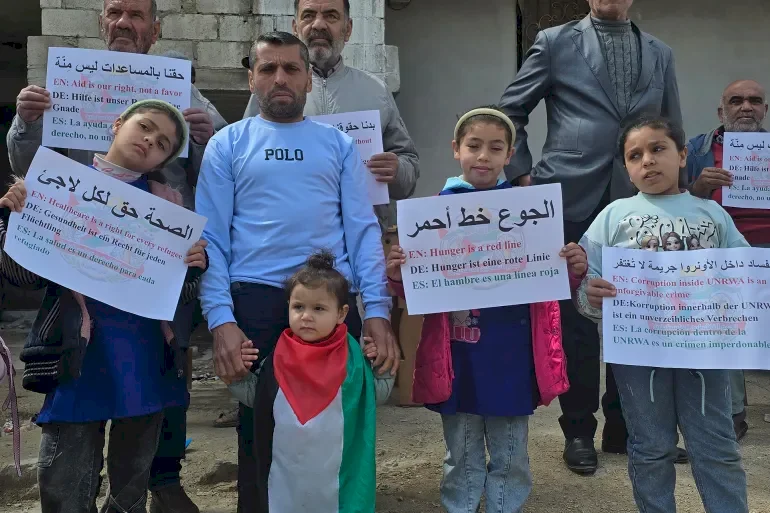
Amid these circumstances, residents of the camp have resorted to protesting as a means of pressure after repeated attempts to convey their demands through official channels. Activist Eyas Fallaha stated that the protests came after several previous visits to demand improvements in services within the camp.
Camp residents demanded the resumption of financial and food aid that has been suspended for about a year and a half. They emphasized the need to support the education, health, and sanitation sectors, but these demands "have not received any actual response," according to activist Fallaha.
Worrying Situation
In his statement to Al Jazeera Net, UNRWA's director of operations in Syria, Amani Michael Ebe, said that the humanitarian situation for Palestinian refugees in Daraa "raises grave concerns," indicating that the main reason for the decline in assistance is a "severe funding shortfall," as the agency has been unable to secure more than 10% of the funding required for its humanitarian programs in Syria.
He added that the decline in support from donor countries, especially the cessation of funding from the United States, which contributed over 40% of UNRWA's total operational budget, has led to "difficult decisions," including reductions or suspensions of some cash and food assistance.
Regarding health services, Ebe acknowledged gaps in surgical coverage, confirming that UNRWA prioritizes the most urgent cases and works with its partners to secure alternatives within available means.
He pointed out that UNRWA continues to provide education and primary health care services, despite challenges, along with implementing projects to repair housing and improve infrastructure in cooperation with international organizations.
Regarding the protests organized by the residents, Ebe said they understand the refugees' demands and consider them a reflection of the pressures they face, affirming continued communication with the local community "within available resources."
In light of the deteriorating humanitarian reality suffered by Palestinian refugees in Daraa camp, they still hope that these movements will prompt the agency to take urgent steps to restore the minimum essentials of life and alleviate the suffering of thousands within the camp.
Source: Arab 48
 Follow the latest Sada News via Google News
Jordanian Army Intercepts 4 Iranian Missiles and 4 Drones

Death of a Moroccan Man During His Arrest in Italy Sparks Calls for Investigation

Due to Trump's Sanctions.. Canada Cancels Joint Ceremony with the US for Bridge Opening

Trump: We will make great progress with Beirut.. Aoun: It is time for Lebanon to be stable

The Lebanese Army Deploys in the South and Comes Under Gunfire; Israel Clarifies

Bezhkian: Directives from the Leader to End the State of No War, No Peace

Meeting Between Aoun and Trump Expected Alongside 'Experimental Areas'
