

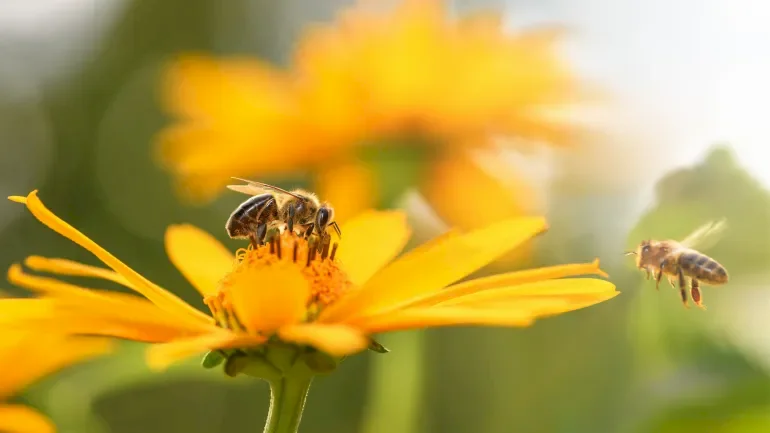
Common Pesticide Disrupts Bee Behavior and Threatens Global Food Security
SadaNews - In modern agricultural fields, pesticides are sprayed to eliminate unwanted plants, allowing crops to grow consistently. However, behind this apparent balance, recent research reveals a more complex story, featuring a small creature that plays a pivotal role in our food security: the honeybee.
A recent study published in the "Journal of Experimental Biology" highlighted the unexpected impact of one of the most famous pesticides in the world, glyphosate. While it does not kill bees directly, it disrupts their vital functions on a deeper level: the brain and behavior.
Glyphosate has long been considered relatively safe for insects because it targets a vital pathway found in plants that animals do not possess. However, this assumption is gradually starting to crack.
Bee Activity
In the new experiments, researchers exposed honeybees to sub-lethal doses of this pesticide and then monitored their daily behaviors. The result was a 13% decrease in foraging activity within just a few days.
Although this percentage may seem limited, at the level of a full colony, it means a decline in food flow and a disruption in the balance of the delicate social system that governs bee life.
The impact does not stop at observable behavior. By examining the brains of the bees, scientists discovered changes in the chemistry of the nervous system, particularly in compounds known to play a key role in regulating movement, motivation, and reward response.
Among these compounds, changes in "tyramine" levels and other compounds like "octopamine" emerged, indicating that glyphosate may reshape the neural signals related to foraging and decision-making.
A Fundamental Question
These findings raise a fundamental question in evaluating the toxicity of chemicals: Is it enough for a substance not to kill an organism for us to consider it safe? In the case of bees, the answer seems to be no.
Social organisms like honeybees rely on precise coordination among their members, and even a slight disruption in the behavior of a few workers can amplify to affect the efficiency of the entire colony, from collecting nectar to pollinating plants, all the way to producing the food that humans themselves depend on.
This issue gains double importance if we place it in the context of the global decline in pollinator populations, which are responsible for many of the plants we humans consume, directly threatening our food security. Bees are indeed facing multiple pressures, from habitat loss to diseases and parasites, and now subtle effects from commonly used chemicals are added.
Source: Websites
 Follow the latest Sada News via Google News
The Size of the Cumulative Portfolio of Car Loans in Palestine Until May 2026

Loans in Palestine Exceed 11 Billion Dollars by May 2026

419.2 Million Shekels in 5 Months.. How Was Income Tax Distributed in Palestine?

6.3 Billion Shekels Net Revenue of the Palestinian Government in 5 Months

Due to Insufficient Balance: More than 181,000 Returned Checks in Palestine

In 5 Months.. Returned Checks in Palestine Exceed Half a Billion Dollars, and March Record...

How the Incoming Guests Sector in West Bank Hotels Changed Over 9 Years?
