

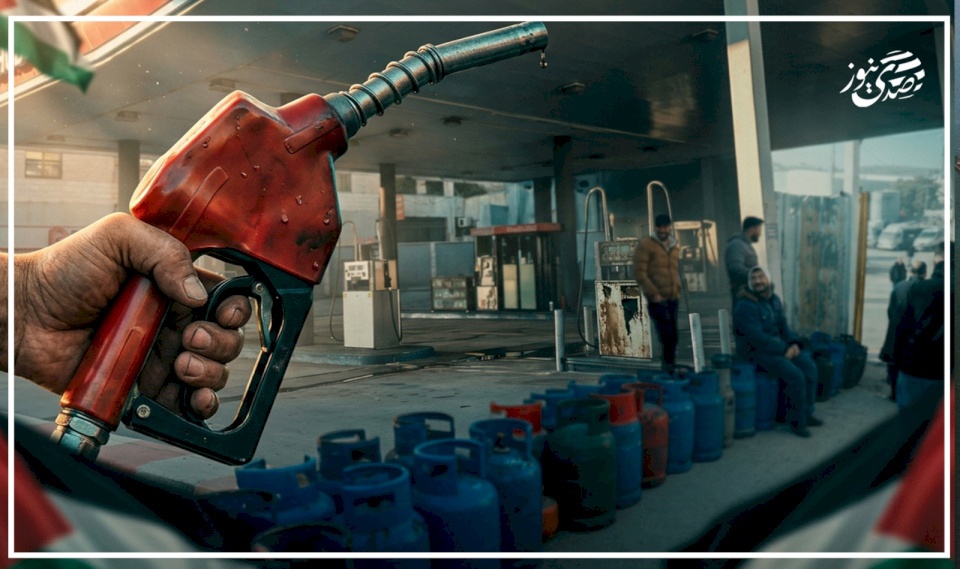
Fuel and Gas.. Shortage in Quantities or a "Union" Crisis?
SadaNews Special: The Palestinian government confirms that it is working to secure the necessary quantities of fuel and gas, denying that there is a disruption in the entry of quantities from the Israeli side. In contrast, the Union of Fuel Station Owners asserts that there is a shortage in quantities, pointing to the fact that the crisis is due to mechanisms for paying for goods to the Israeli side amidst the financial crisis facing the Palestinian Authority.
Amid this, the Palestinian citizen finds himself facing a new crisis added to his daily problems. Several citizens in the West Bank confirm that they are unable to meet their fuel needs for the second consecutive day, despite the official denial of the existence of a crisis. In fact, citizens themselves are being accused of causing the current situation due to their rush to stockpile the supplied quantities in anticipation of the repercussions of the ongoing war between the United States and Israel on one side, and Iran on the other side. Meanwhile, voices of skepticism are rising about fuel stations resorting to storing their available quantities in anticipation of price hikes at the beginning of next month to achieve higher profit margins.
Journalist Ayham Abu Ghosh, an expert in economic affairs, states, "All this talk about supplying quantities of fuels raises many questions. Since yesterday, I have been touring all the stations in my cities of Ramallah and Al-Bireh, and today as well at different times, and unfortunately, they were closed." Journalist Thaer Al-Sharif adds, "Gas stations are also closed, and the same applies to the vast majority of the provinces."
He further adds, "At the same time, there have been observations of citizens carrying out large stocking operations without justification." However, in the end, there is a crisis that must be dealt with and solutions must be found, regardless of the reasons, whether related to a shortage in supply or an increase in demand, with the necessity to tighten control operations. It is unreasonable for the stations to be closed for two consecutive days without knowing the real reasons behind it."
Economic researcher Ikhlas Tamleh said, "There were quantities available at one of the stations, but there was congestion at the queue." Another citizen mentions, "I waited 45 minutes in line until I could fill up at a station in Beituniya," while another noted that he only found limited quantities of 98 octane gasoline, which is the more expensive type, whereas the most commonly used 95 octane has run out in most stations.
For his part, Majdi Al-Hassan, Deputy Minister of Finance and Head of the Petroleum Authority, states, "There is no fuel crisis and no gas crisis; rather, there is a crisis of unions," calling for dispelling rumors and hinting that the statements of members of the Fuel Station Owners Union came for personal reasons, saying: "We will talk later in detail, after these crises pass, and I do not wish to speak too much right now, but we want to work and address the crises."
He pointed out that the authority worked to introduce 15,000 tons of gas in March until today, while the highest supply during March did not exceed 10,000 tons. He said: "Today, 600 tons of gas and 3.5 million liters of fuel will be pumped, and there are tremendous efforts being made by the authority and its crews, day and night, to secure the needs of the citizens, and this is our duty."
Al-Hassan hinted that at the beginning of next month, there will not be scenes of congestion around the stations, without explaining what that means. Journalist Fares Al-Malaki commented, questioning: "There are those who say that station owners are not selling the quantities supplied to them in full because they want to benefit from the anticipated price increase at the beginning of April to achieve higher profits." Al-Hassan replied to this saying: "Honestly, I do not know, but the crews have been examining that since yesterday with the security agencies." He added: "Believe me, if prices go down, you wouldn’t hear from those who speak on behalf of the station owners."
Regarding his price expectations, Al-Hassan said: "Prices will be announced tomorrow, Tuesday," amid expectations of a notable rise due to global price increases and expectations of Israel raising prices by 12-13%.
The Union of Fuel Station Owners announced through several of its officials that there is a shortage in the supplied quantities, noting that the current supplies reach 3.5 million liters of fuel daily, whereas previously it was about 4.5 million liters, which created the crisis.
Samir Hadeed, head of the Fuel Station Owners Union, told SadaNews regarding whether there is a shortage in the quantities at fuel stations in the West Bank: "Yes, there is a shortage, and the two most affected governorates are Hebron and Bethlehem."
Hadeed ruled out that the reason for this shortage is the effects of the ongoing war on Iran or what Israel is experiencing from Iranian bombardment, saying: "The disruption in supply is due to the financial siege that Israel imposes on the Palestinian Authority and its detention of tax revenues," referring to the fact that fuel station owners pay cash to the Public Petroleum Authority, but the Israeli side speaks of not supplying the full prices of the goods.
The Israeli Institute for Environmental Energy had predicted that fuel prices in Israel would rise by 12.5% at the beginning of next April if the Israeli Ministry of Finance does not approve a reduction in production tax, leading to the price of 95 octane gasoline reaching 7.90 shekels per liter.
It is worth noting that estimates suggest that the number of fuel stations in the West Bank is approximately 240 stations, while the local consumption volume reaches about 90-100 million liters of fuel per month, with two-thirds being diesel and one-third being gasoline. The average consumption of cooking gas in the West Bank is about 14,000 tons monthly in winter, reducing to 5-7 thousand tons in summer.
 Follow the latest Sada News via Google News
Soaring Oil Prices Burn the Pockets of the Palestinian Citizen "The Poor"

Millions of Dollars in Losses.. "SadaNews" Reveals Shocking Figures for Traders from Pales...

The Problem of Shekel Overcrowding Worsens.. Fuel Station Owners Threatened with Closure o...

The Palestinian Economy at a Crossroads: 4 Files Awaiting Resolution

Palestine Stock Exchange Officially Launches Total Return Index to Enhance Investment Deci...

Fuel and Gas.. Shortage in Quantities or a "Union" Crisis?

Currency Exchange Rates Against the Shekel on Monday (March 30)
