

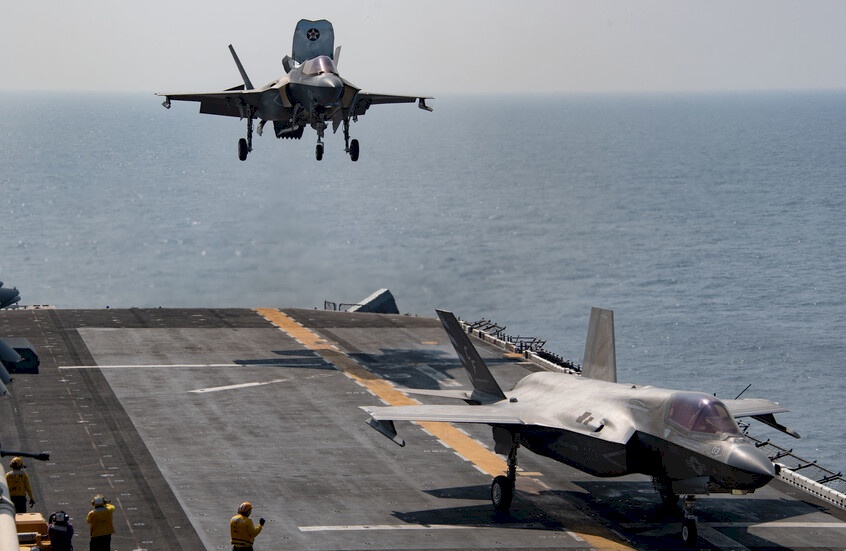
More than 50 fighter jets arrive in the region within 24 hours in preparation for striking Iran
SadaNews - Data from flight tracking and a U.S. official revealed that over 50 fighter jets, including "F-35", "F-22", and "F-16" models, have moved to the Middle East in the past 24 hours.
This move reflects a military escalation coinciding with diplomatic efforts regarding the Iranian nuclear file. It follows days after the administration of President Donald Trump sent a second aircraft carrier to the region, indicating increasing military preparations in anticipation of any potential developments with Iran.
U.S. Vice President JD Vance stated that Iran has yet to show a willingness to acknowledge some of the "red lines" set by President Donald Trump, chief among them preventing Tehran from acquiring nuclear weapons.
In an interview with Fox News, Vance confirmed that Washington's primary goal is to prevent Iran from becoming a nuclear state, warning that its possession of nuclear weapons would drive other countries in the region and beyond to seek them as well.
He indicated that all options remain on the table, including military options, alongside the diplomatic path.
These comments come following a new round of indirect talks between the United States and Iran in Geneva.
Iranian Foreign Minister Abbas Araghchi announced that Tehran and Washington reached "guidelines" for a potential nuclear agreement, following a three-hour negotiation session in Geneva with Trump’s envoys Jared Kushner and Steve Witkoff.
Araghchi described the talks as "serious, constructive, and positive," confirming a "good progress compared to the previous meeting," and added that both parties reached a "general understanding of a set of guiding principles" that will be built upon to start drafting a potential agreement text, noting that the path has begun but does not mean a swift arrival at a final agreement.
For his part, Omani Foreign Minister Badr al-Busaidi, who played a mediating role, stated that the second round ended "with good progress towards defining common goals and relevant technical issues," affirming that the atmosphere of the meetings was "constructive," and that there are "clear steps" before the next round.
While Tehran speaks of negotiating progress, Washington continues to mobilize additional troops in the Middle East, reflecting a dual strategy of military pressure alongside a diplomatic path.
According to Araghchi, the two sides agreed to work on written drafts and exchange texts in preparation for determining the date for the third round of negotiations, at a time when a U.S. official indicated that the talks "went as expected."
These developments present a complex regional scene, where U.S. military escalation intersects with signs of political openness, amid anticipation of what the upcoming negotiation rounds will yield.
Source: Axios
 Follow the latest Sada News via Google News
Jordanian Army Intercepts 4 Iranian Missiles and 4 Drones

Death of a Moroccan Man During His Arrest in Italy Sparks Calls for Investigation

Due to Trump's Sanctions.. Canada Cancels Joint Ceremony with the US for Bridge Opening

Trump: We will make great progress with Beirut.. Aoun: It is time for Lebanon to be stable

The Lebanese Army Deploys in the South and Comes Under Gunfire; Israel Clarifies

Bezhkian: Directives from the Leader to End the State of No War, No Peace

Meeting Between Aoun and Trump Expected Alongside 'Experimental Areas'
